
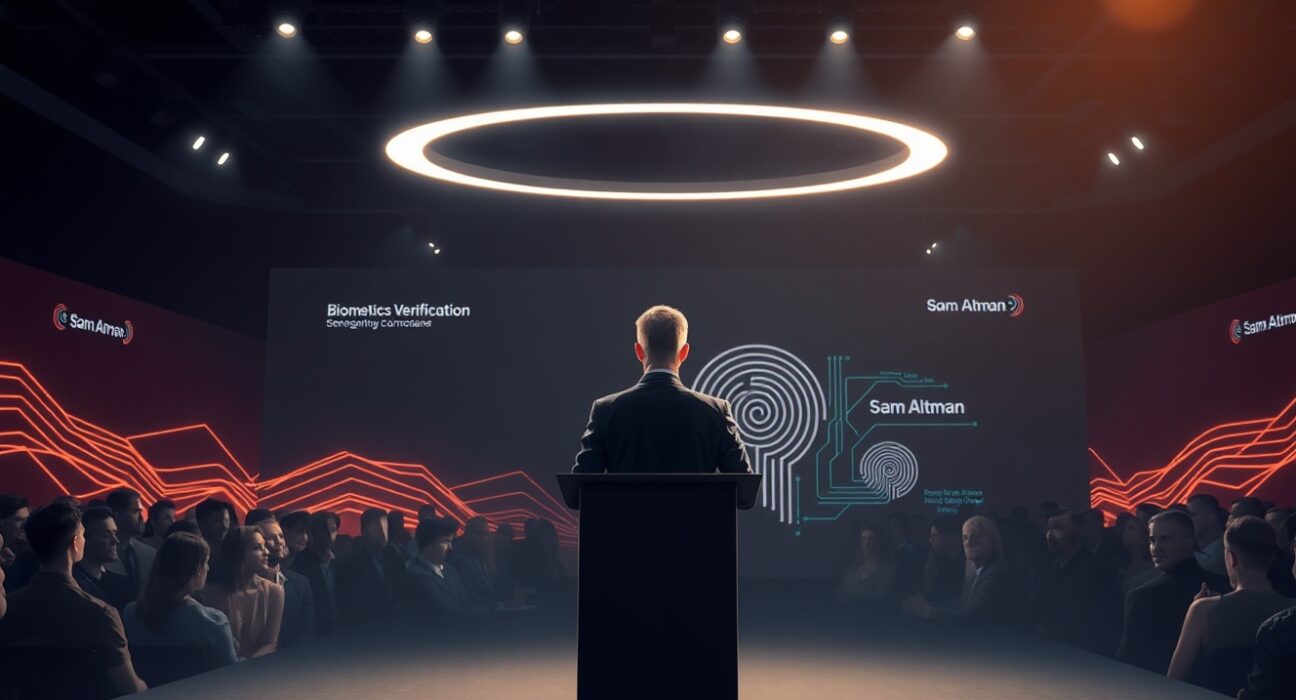
In a significant development for the digital identity and cryptocurrency sectors, Sam Altman, the prominent CEO of OpenAI, will attend Worldcoin’s ‘Lift Off’ launch event for its World ID system in Los Angeles on April 17, 2025. This high-profile appearance immediately elevates the event’s importance, connecting cutting-edge artificial intelligence leadership with ambitious biometric identity protocols. Consequently, the tech industry is watching closely as these two frontier technologies converge.
Sam Altman’s Role at the World ID Launch Event
The scheduled ‘Lift Off’ event in Los Angeles represents a pivotal moment for Worldcoin. Sam Altman’s participation, while not as a direct executive of Worldcoin, provides substantial validation. His presence links the project’s vision to broader discussions about AI’s future and human verification. Furthermore, Altman has been a co-founder and key advisor to Tools for Humanity, the company behind Worldcoin, since its inception. This connection underscores a consistent interest in solving complex, large-scale challenges.
Worldcoin’s core technology relies on a physical device called the Orb. This device scans an individual’s iris to create a unique, privacy-preserving digital identifier. The resulting World ID aims to prove ‘humanness’ online, a concept gaining urgency in an era of advanced AI-generated content. Therefore, Altman’s involvement bridges two critical narratives: secure digital identity and responsible AI development. Industry analysts note that his attendance signals the project’s transition from a speculative venture to a serious infrastructure proposal.
The Evolution and Context of Worldcoin’s Mission
Worldcoin, founded by Alex Blania, Sam Altman, and Max Novendstern, launched its protocol in July 2023. The project has consistently framed its mission around two pillars: a global digital identity network and a widely distributed digital currency. The World ID component is now taking center stage. This launch event follows a period of operational scaling and regulatory navigation. For instance, the company has deployed Orbs in dozens of countries, registering millions of users.
However, the path has not been without scrutiny. Privacy advocates and data protection authorities, particularly in Europe, have raised questions about biometric data collection. Worldcoin’s technical papers emphasize a ‘zero-knowledge’ proof system. This system allows verification without storing or sharing the raw biometric data. The April 17 event is expected to detail these privacy-preserving mechanisms further. It will also likely showcase real-world applications for World ID, moving beyond theoretical models.
Expert Analysis on the Digital Identity Landscape
Technology policy experts view this launch as part of a larger trend. “The need for a reliable, decentralized proof-of-personhood is becoming acute,” states Dr. Elena Torres, a digital identity researcher at Stanford. “With generative AI blurring lines online, systems that can differentiate humans from bots are foundational for the next internet.” She notes that while other projects exist, Worldcoin’s combination of hardware, cryptocurrency incentives, and high-profile backing makes it unique.
The table below contrasts Worldcoin’s approach with other digital identity models:
| Model | Basis | Centralization | Primary Use Case |
|---|---|---|---|
| World ID | Biometric (Iris Scan) | Decentralized Protocol | Universal Proof-of-Personhood |
| Government e-ID | Legal Documentation | Centralized Authority | Citizen Services & Legal Compliance |
| Social Login (e.g., Google) | Existing Account | Corporate Controlled | Website & App Authentication |
| SSI (Self-Sovereign Identity) | Digital Wallets & Verifiable Credentials | User-Centric | Selective Disclosure of Attributes |
This comparative view highlights Worldcoin’s ambitious scope. Its goal is not just authentication but creating a global, sybil-resistant network.
Potential Impacts and Future Implications
The successful launch of World ID could have far-reaching consequences. Firstly, it could provide a tool for fairer distribution of digital resources, from social media governance to airdrops. Secondly, it introduces a new paradigm for online trust. Developers could integrate World ID to prevent bot exploitation in applications. These range from financial services and voting systems to creative content platforms.
Sam Altman’s presence also sparks discussion about AI alignment. If AI systems become more pervasive, a reliable method to identify humans becomes crucial for security and interaction. Therefore, World ID is not merely a cryptocurrency accessory. It is potentially a key piece of infrastructure for the AI-integrated web, often called Web3. The Los Angeles event will likely address these synergistic possibilities directly. Moreover, it may reveal partnerships with other platforms seeking robust identity solutions.
The project also faces immediate challenges. These include:
- Global Adoption: Scaling the physical Orb deployment to achieve critical mass.
- Regulatory Harmony: Navigating diverse global data protection laws like GDPR.
- Technical Security: Ensuring the hardware and software stack remains resilient against attacks.
- Public Trust: Overcoming skepticism regarding biometric data collection.
Addressing these points will be essential for long-term viability. The launch event serves as a major communication effort to tackle these concerns head-on.
Conclusion
The attendance of Sam Altman at Worldcoin’s World ID launch on April 17 in Los Angeles marks a defining moment. It connects the trajectories of artificial intelligence and decentralized digital identity. This event is more than a product announcement; it is a statement about the future architecture of the internet. As the digital and physical worlds continue to merge, solutions for proving unique humanness will become increasingly vital. The success of Worldcoin’s World ID could therefore set a standard, influencing how billions of people verify their identity online. The tech world will be watching Los Angeles closely for the details that emerge from this pivotal launch.
FAQs
Q1: What is Worldcoin’s World ID?
World ID is a privacy-preserving digital identity protocol. It uses a unique iris scan from a device called the Orb to generate a proof of unique personhood, without storing the biometric image itself.
Q2: Why is Sam Altman attending the World ID launch?
Sam Altman is a co-founder and advisor to Tools for Humanity, the company building Worldcoin. His attendance signals the project’s significance and links its goals to broader discussions about AI and future digital infrastructure.
Q3: What are the main privacy concerns around Worldcoin?
Critics question the collection of sensitive biometric data. Worldcoin asserts its system uses zero-knowledge proofs to verify identity without exposing personal data, aiming to address these concerns directly.
Q4: How does World ID differ from logging in with Google or Facebook?
Traditional social logins are controlled by corporations and link to your existing activity. World ID aims to be a decentralized, global standard that proves you are a unique human, independent of any specific company or national border.
Q5: What could World ID be used for in the future?
Potential applications include preventing bot activity in online governance, enabling fair distribution of universal basic income (UBI) in digital form, securing digital asset airdrops, and providing a foundation for trusted interactions in AI-driven environments.
Disclaimer: The information provided is not trading advice, Bitcoinworld.co.in holds no liability for any investments made based on the information provided on this page. We strongly recommend independent research and/or consultation with a qualified professional before making any investment decisions.