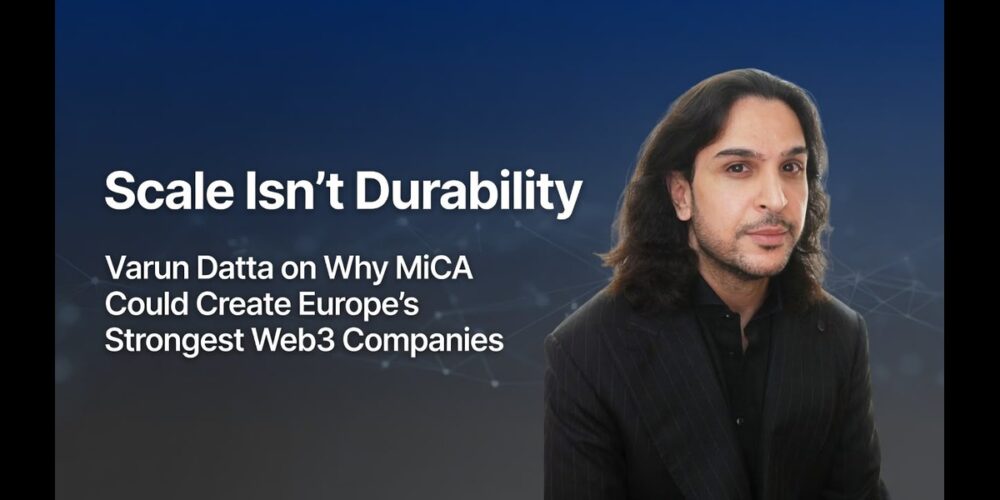
Scale Isn’t Durability: Varun Datta on Why MiCA Could Create Europe’s Strongest Web3 Companies
In this article
The countdown to the European Union’s Markets in Crypto-Assets (MiCA) regulation has understandably dominated discussion across the Web3 industry. For many firms, the transition marks the most significant regulatory change the sector has experienced to date. As the first comprehensive regulatory framework for crypto-assets across all 27 EU member states, MiCA is redefining how blockchain businesses raise capital, serve customers and expand across Europe.
Much of the conversation has centred on who might lose, but the more important question is who can build more durable businesses under the new framework.
According to Varun Datta, venture capitalist and CEO of Truth Ventures, recently quoted in Decrypt on the issue, that focus misses the more important story: MiCA may favour companies that gain value from trusted, institutional-grade regulation.
“I think many people are looking at MiCA through far too narrow a lens,” Varun Datta explains. “They’re asking which businesses become more expensive to operate. I’m asking which businesses become more valuable because they can now demonstrate robust governance, risk management and transparency within a regulatory framework that institutions understand and trust.”
Recent developments illustrate that shift. Binance’s withdrawal from several European markets as it rationalises its regulatory footprint, together with the growing expectation of consolidation among crypto exchanges, custodians and service providers seeking MiCA authorisation, has fuelled suggestions that Europe risks becoming a more difficult place to build blockchain businesses. Yet for Varun Datta and Truth Ventures, this consolidation points to a market selecting for durable companies, not simply fast-growing ones.
“Every emerging technology experiences this transition. Early growth often rewards speed, but eventually the market and customers begin rewarding resilience. Scale is simply not the same as durability, and this needs to be front and centre in founders’ and investors’ minds,” says Datta.
Why Regulatory Clarity Matters for Web3 Investment
For venture capital investors, that distinction has become increasingly important because it now shapes where capital is most likely to compound over time.
During Web3’s earlier growth phases, investors often prioritised user acquisition, token growth and ecosystem expansion. While those metrics remain important, Truth Ventures and Varun Datta believe the investment criteria have evolved considerably.
Datta explains: “Regulatory clarity has become a filter that directs capital towards founders building for long-term adoption. Increasingly, we’re looking beyond technical innovation alone. Governance, compliance architecture, operational maturity and security are becoming integral parts of the investment thesis rather than considerations that can simply be addressed later.”
Datta also believes one of MiCA’s greatest advantages is regulatory consistency. Rather than navigating different licensing regimes across individual European jurisdictions, qualifying firms can increasingly operate under a common framework, reducing uncertainty and making Europe a more attractive destination for founders, investors and institutional partners.
Why Institutions Are Embracing Blockchain Infrastructure
For institutional investors, these characteristics have always mattered. Banks, pension funds and asset managers rarely deploy significant capital into technologies they cannot properly assess from legal, operational and governance perspectives. While blockchain innovation has moved rapidly over the past decade, institutional adoption has often progressed more cautiously because the supporting regulatory frameworks have remained uncertain.
Varun Datta believes MiCA is beginning to change that dynamic by making the market easier for institutions to evaluate, which should ultimately be welcomed.
“For years, institutions were asking whether digital assets could ever fit comfortably within existing financial systems. Increasingly, they’re asking how blockchain infrastructure can improve those systems. That’s a fundamentally different conversation.”
Evidence of that shift has continued to emerge over the past eighteen months. Circle became one of the first major stablecoin issuers to align USDC and EURC with MiCA’s requirements. Crypto.com secured a MiCA licence to expand regulated services across the European Union, while exchanges including Bitstamp and Kraken have continued investing heavily in regulatory readiness as Europe becomes one of the world’s most clearly defined digital asset markets.
According to Varun Datta, these developments demonstrate that institutional interest is moving further down the technology stack, toward the parts of Web3 that can create lasting value.
“The attention is increasingly shifting away from speculation and towards infrastructure capable of operating within regulated financial ecosystems,” he explains. “Institutions are evaluating tokenisation, settlement, custody, digital identity and blockchain interoperability because these technologies can potentially improve efficiency while satisfying increasingly robust regulatory expectations.”
Truth Ventures’ Approach to Building Long-Term Web3 Value
That evolution closely mirrors Truth Ventures’ own investment philosophy.
Rather than concentrating on speculative market cycles, the firm’s portfolio focuses on companies building foundational infrastructure for the decentralised economy.
Truth Ventures has invested in the decentralised AI network Bittensor, the blockchain scaling platform Starknet, the privacy infrastructure provider Ternoa, the decentralised finance protocol 1inch, and the decentralised physical infrastructure network peaq.
While these companies operate across different sectors, Varun Datta believes they share one important characteristic.
“They’re solving problems that continue to exist regardless of market conditions,” Datta says. “Whether markets are bullish or bearish, institutions will always require secure infrastructure, scalable networks, trusted privacy layers and efficient settlement systems.”
One particularly interesting development is the growing regulatory discussion surrounding decentralised finance itself. Malta’s recent consultation exploring whether decentralisation should be viewed as a spectrum rather than a binary concept reflects a broader shift taking place across Europe.
For Varun Datta, this is an encouraging sign that regulators are beginning to engage with the technical realities of blockchain rather than applying traditional financial frameworks without adaptation.
“Very few protocols are entirely decentralised or entirely centralised,” Varun Datta explains. “Most exist somewhere between those two extremes. Recognising that reality allows regulators and developers to have far more constructive conversations about governance, responsibility and innovation.”
He believes these discussions will matter increasingly as blockchain applications extend beyond cryptocurrency into artificial intelligence, tokenised assets, decentralised physical infrastructure, supply chains and digital identity.
MiCA Could Make Europe a Global Leader in Blockchain Innovation
“The end of MiCA’s transition period isn’t the conclusion of Europe’s regulatory journey,” Varun Datta says. “It’s the beginning of a much more sophisticated conversation about how decentralised infrastructure integrates into the wider economy.”
While some businesses may struggle with the additional regulatory burden, Datta believes those capable of combining innovation with institutional-grade governance could ultimately emerge stronger because they are better positioned for durable growth.
“Every major technology industry reaches a point where trust becomes a competitive advantage,” he concludes.
“The internet matured. Cloud computing matured. Artificial intelligence is beginning to mature. I believe Web3 is reaching that same stage.”
“Europe now has an opportunity to become the world’s leading regulated market for blockchain innovation. If MiCA continues striking the right balance between encouraging innovation and maintaining appropriate standards, it won’t simply reshape Europe’s crypto market.”
“It could become the catalyst that attracts the next generation of blockchain founders, institutional investors and infrastructure businesses to the region.”
About Varun Datta
Varun Datta is a venture capitalist and the CEO of Truth Ventures, a $10 million venture capital fund currently investing in early-stage blockchain, Web3 and emerging technology startups. Having deployed over $3 million to date, the fund typically makes initial investments of $25,000–$50,000 into companies developing decentralised infrastructure, digital finance, AI-powered Web3 applications and other next-generation technologies. Beyond capital, Truth Ventures provides strategic guidance, industry connections and operational support, helping ambitious founders scale globally while advancing innovation and the mainstream adoption of decentralised technologies.