

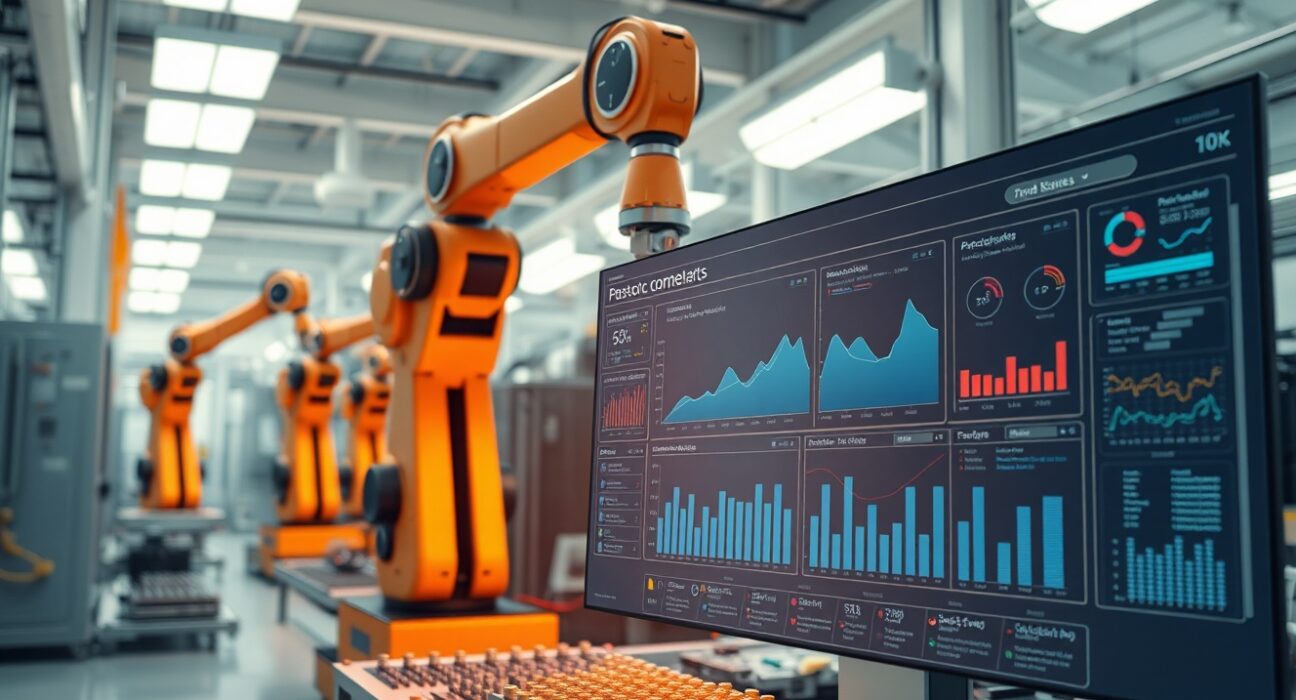
In El Segundo, California, a seismic shift is underway in industrial manufacturing, driven by two former SpaceX engineers who are applying rocket science to factory floors. Karthik Gollapudi and Austin Spiegel, founders of Sift Stack, are leveraging their experience with spacecraft telemetry to solve one of manufacturing’s most pressing challenges: managing the torrent of data from modern, sensor-laden machines. This transformation comes as industry giants like Jeff Bezos announce massive investments in factory automation, highlighting the critical role of software in the physical world.
Sift Stack’s Foundation in Aerospace Excellence
Gollapudi and Spiegel launched Sift Stack in 2022 after developing software tools at SpaceX. Their systems managed enormous streams of telemetry data during rocket testing, manufacturing, and launch. Consequently, they identified a significant gap in the market. Most companies building complex machines rely on generic database tools or custom Python scripts. However, these solutions often struggle with scale and integration. Sift Stack’s platform provides a specialized, best-in-class alternative.
The company’s initial customer base included major aerospace and defense contractors like United Launch Alliance. Additionally, robotics startups and power grid management firms adopted their technology. These early clients validated the platform’s robustness. They needed to handle data from thousands, sometimes millions, of sensors concurrently. For instance, some vehicles Sift Stack monitors contain over 1.5 million sensors streaming data in multiple formats and time scales.
The Data Infrastructure Challenge
Jeff Dexter, Vice President of Software at satellite company Astranis, illustrates the scale of the problem. His company might run ten million automated software tests in a single day. “Inevitably, it gets to a point where it’s costing us millions of dollars per month just to store data,” Dexter explained. He emphasizes that with Sift Stack’s technology, the focus shifts from storage costs to data utility. This shift is crucial for companies where data volume can become a financial burden rather than an asset.
The AI Pivot: From Custom Workflows to Data Enablement
The rapid advancement of artificial intelligence tools forced a strategic evolution at Sift Stack. Previously, the company’s value proposition centered on creating customized data workflows. These workflows helped engineers analyze test results and monitor manufacturing processes. However, the proliferation of AI and deep learning models changed the competitive landscape. Custom workflows became standard expectations rather than differentiators.
Gollapudi recognized this shift early. “Our long-term vision of how we saw this playing out over five years is actually being played out this year,” he stated. The company’s core strength—managing immense, complex data infrastructure—suddenly became its most valuable asset. The new goal is organizing and storing data specifically for AI applications. “A lot of the value is in exposing that to be machine readable,” Gollapudi noted. If AI agents are to analyze test data or flag manufacturing issues, they require clean, accessible, and well-structured data feeds.
Key Industry Trends Driving Sift Stack’s Growth:
- Software-Intensive Machines: Modern vehicles and industrial equipment generate more data than ever.
- AI Integration: Factories increasingly use AI for predictive maintenance and quality control.
- Cost Pressure: Companies seek to transform data storage costs into operational insights.
- Legacy System Limitations: Off-the-shelf tools cannot handle specialized industrial data streams.
Financing the Future: A $42 Million Series B Round
In 2025, Sift Stack secured a $42 million Series B funding round. StepStone led the investment with participation from GV (Google’s venture arm), Riot Ventures, Fika Ventures, and CIV. The round valued the company at $274 million post-money. This substantial investment underscores investor confidence in the convergence of physical manufacturing and advanced software. Moreover, it provides capital for research and development and market expansion.
The funding environment reflects broader trends. Jeff Bezos’s reported $100 billion fund for factory automation and AI signals massive capital flowing into the sector. This movement, often called “atoms, not bits,” highlights a renewed focus on tangible products and infrastructure. Sift Stack operates at the intersection of this trend, providing the digital nervous system for the atoms-based economy.
Comparative Analysis: Traditional vs. Sift Stack Approach
| Aspect | Traditional Methods | Sift Stack Platform |
|---|---|---|
| Data Handling | Off-the-shelf databases, custom scripts | Purpose-built for high-volume telemetry |
| Scalability | Often requires manual intervention | Automated, designed for millions of sensors |
| AI Readiness | Data requires significant preprocessing | Data is structured for immediate AI consumption |
| Cost Structure | Storage costs can escalate unpredictably | Optimized infrastructure reduces total cost |
The Broader Impact on Manufacturing and Industry
Sift Stack’s technology enables more than just efficiency. It facilitates a fundamental change in how factories operate. With reliable data infrastructure, manufacturers can implement true AI-driven automation. This means machines can predict failures before they happen. Furthermore, production lines can adjust in real-time based on sensor feedback. Quality control can become continuous and comprehensive rather than periodic and sample-based.
The company’s journey mirrors a larger industrial evolution. The first wave of factory automation focused on robotics and mechanical systems. The current wave centers on data, connectivity, and intelligence. Software is no longer just a support tool. It is becoming the central nervous system of physical production. This shift demands new types of companies and expertise. It also creates opportunities for professionals who understand both hardware engineering and software development.
Conclusion
Sift Stack represents a compelling case study in technological cross-pollination. Expertise honed in the extreme environment of rocket launches is now catalyzing innovation on factory floors. The company’s pivot from custom workflows to AI-ready data infrastructure aligns perfectly with industrial trends. As manufacturing becomes increasingly software-defined, the ability to manage, structure, and expose vast data streams will separate leaders from laggards. With strong funding and a clear vision, Sift Stack is positioned to be a key enabler in the smart factory revolution, proving that the tools which launch rockets can indeed transform how we build everything else.
FAQs
Q1: What is Sift Stack’s primary function?
Sift Stack provides specialized software infrastructure to manage and organize the massive amounts of sensor data generated during the testing, manufacturing, and operation of complex machines like rockets, satellites, and advanced vehicles.
Q2: How did the founders’ experience at SpaceX influence the company?
Working at SpaceX exposed them to the challenge of handling immense real-time telemetry data from rockets. This experience directly informed their creation of a robust, scalable platform designed for similar high-stakes, data-intensive industrial environments.
Q3: Why is data infrastructure so important for AI in manufacturing?
AI and machine learning models require clean, well-structured, and accessible data to function effectively. Sift Stack’s platform transforms raw sensor data into a machine-readable format, enabling AI applications for predictive maintenance, quality analysis, and process optimization.
Q4: What was the significance of Sift Stack’s 2025 funding round?
The $42 million Series B, led by StepStone, validated the company’s strategic pivot and market potential. It provides capital to scale their technology as demand grows for AI-ready data solutions in the manufacturing and industrial sectors.
Q5: How does Sift Stack help companies manage data storage costs?
By optimizing how industrial telemetry data is ingested, indexed, and stored, the platform helps companies avoid the escalating costs associated with simply dumping vast amounts of raw data into generic cloud storage, turning a cost center into a strategic asset.
Disclaimer: The information provided is not trading advice, Bitcoinworld.co.in holds no liability for any investments made based on the information provided on this page. We strongly recommend independent research and/or consultation with a qualified professional before making any investment decisions.