


Selling pressure is starting to build around Solana (SOL). After enjoying strong gains earlier in the cycle, SOL is now seeing increased profit-taking and more cautious positioning, leaving investors questioning its short-term direction. Meanwhile, a new decentralized finance project, Mutuum Finance (MUTM), moves forward with its protocol roadmap, rolling out new features.
Solana Rangebound
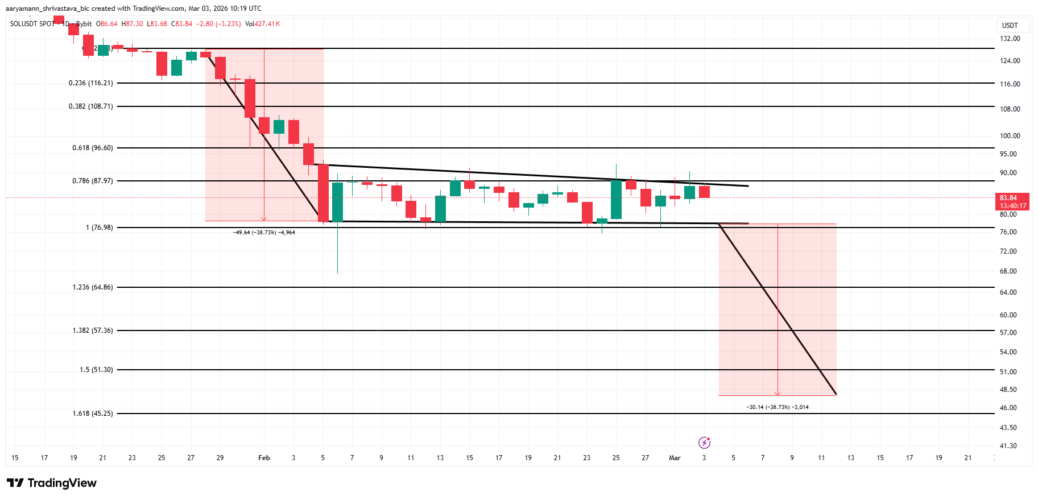
Solana has been moving sideways between $87 and $77 for several weeks and is currently trading around $83. While this range suggests stability on the surface, several indicators point to growing pressure beneath it.
One concern is the gap between short-term and long-term holders. Since February, short-term holders have seen their unrealized profits rise steadily. These investors tend to sell faster when in profit, which increases the risk of added supply hitting the market. Meanwhile, long-term holders are not sitting on similarly large gains, meaning there is less strong-handed support to absorb potential selling. If long-term holders begin to exit as well, the downside could accelerate.
Solana appears to be forming a bearish flag. If the price breaks below $77, the pattern points to a potential decline of up to 38%, with $51 as a possible target. A move below $64 would likely confirm stronger downside momentum, opening the door to $57, $51, and possibly $45. As this plays out, Mutuum Finance (MUTM) has entered phase 3 of its roadmap.
Mutuum Finance Protocol
Mutuum Finance is a decentralized, non-custodial liquidity protocol built on Ethereum that enables users to lend, borrow, or act as liquidators in a trustless environment. Its native token, MUTM, is currently valued at $0.04 with a holder base exceeding 19,000. The project has secured over $20.75 million in protocol funding.
Roadmap Progress
Mutuum Finance has recently entered the third phase of its roadmap, dubbed ‘Finalizing Mutuum.’ The roadmap kicked off with Phase 1: Introducing Mutuum. This phase rolled out the project’s sales phase, allowing the public to invest in MUTM. The MUTM smart contract was audited by CertiK, receiving a 90/100 token scan score. The project also secured a listing on CoinMarketCap during this phase, giving the token broader visibility.
During Phase 2: Building Mutuum, core smart contract development began. The platform smart contracts also underwent an independent audit by Halborn Security, and all recommendations from that review were implemented.
Phase 3 marks the move from development to live testing. It began with the release of the Mutuum Finance V1 Protocol on testnet. The V1 protocol enables users to deposit assets as collateral, borrow against them, and monitor their stability factor in a risk-free environment. Core features during the testnet include mtTokens, which track a lender’s position and their accrued interest, as well as debt tokens, which track a borrower’s loan and the accumulated interest. The testnet supports 4 test tokens, i.e., USDT, LINK, ETH, and WBTC.
In a recent X post, Mutuum Finance announced the launch of Safe-Mode Borrow Presets. This new feature allows select a preset that aligns their position with a target Stability Factor instead of manually calculating how much to borrow. Safe-mode borrow presets are tailored to three risk profiles: Safe (Stability Factor ≥ 2.0), Balanced (SF ≈ 1.7), and Aggressive (SF ≈ 1.4). If a user deposits $40,000 worth of ETH as collateral, selecting the Safe preset might allow them to borrow roughly $20,000 while maintaining a strong buffer against price volatility. Choosing Balanced could increase borrowing capacity to about $24,000, while Aggressive may raise it closer to $28,000.
Solana faces sell pressure near $77 support, and failure to hold support could send it to $51. Meanwhile, Mutuum Finance (MUTM) is advancing its roadmap with new releases. As SOL struggles, MUTM builds real DeFi utility, including audited lending and borrowing smart contracts.
Disclaimer: The information provided is not trading advice, Bitcoinworld.co.in holds no liability for any investments made based on the information provided on this page. We strongly recommend independent research and/or consultation with a qualified professional before making any investment decisions.
