

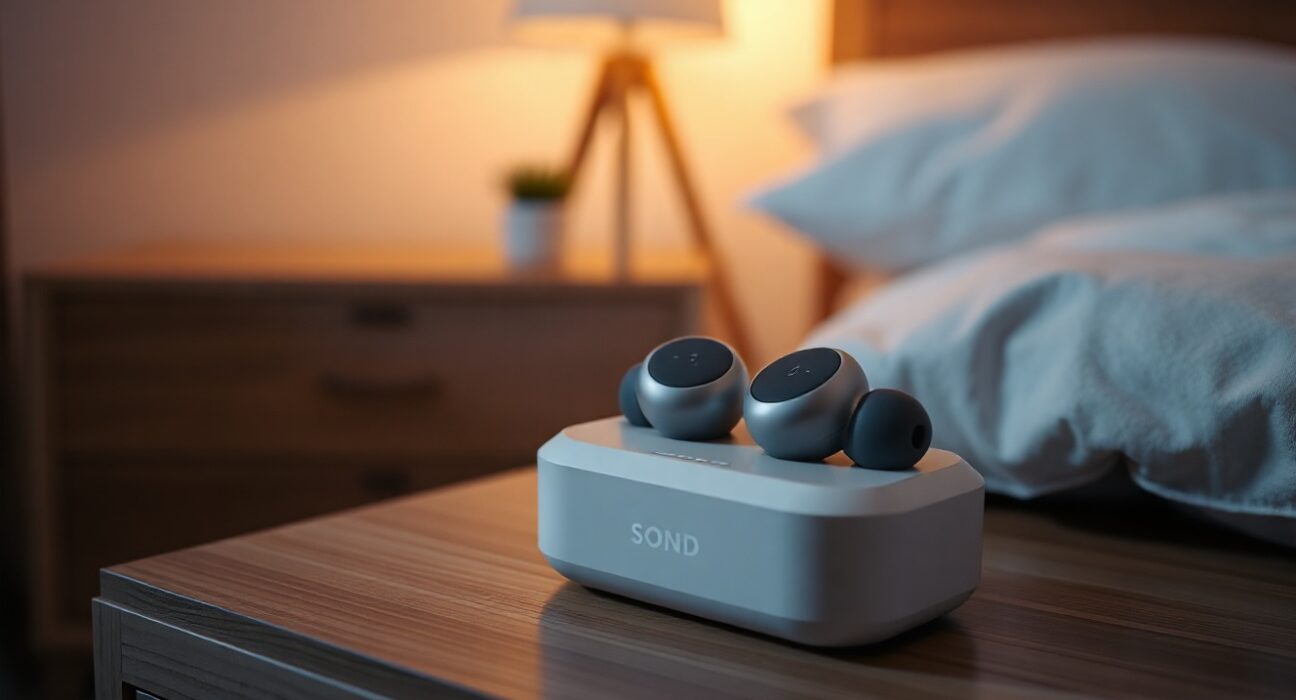
A Boston-based startup called SOND emerged from stealth on Wednesday with $7 million in funding and a debut product that aims to redefine how wearable technology approaches sleep. Unlike conventional sleep earbuds that simply mask noise or play calming sounds, SOND’s Dreambuds are designed to actively intervene in real-time to improve sleep quality.
Founded by MIT graduates Yadid Ayzenberg and Amir Lazarovich, the company brings together expertise from Bose and Google. Ayzenberg previously served as Bose’s Head of Global Sleep, where he launched the Bose Sleepbuds 2 before the company decided to exit the sleep business. That strategic shift, he said, created an opportunity to build a dedicated startup focused on advanced sleep technology.
How Dreambuds work: closed-loop sensing and AI coaching
Dreambuds are a closed-loop, in-ear system that captures 12 physiological signals from the wearer, including respiration, heart rate variability, cardiorespiratory coupling, sleep staging, body position, snoring, and seismocardiography (the mechanical vibrations of the chest wall produced by the heartbeat).
This sensor data streams in real-time to a cloud-based AI sleep coach, which selects or generates audio programs tailored to the user. Over time, the system learns which interventions work best for each individual. Users can also interact with the AI coach by speaking, asking for sleep insights or specific programs from SOND’s library of over 500 audio options. The AI can even generate custom sleep stories on demand.
Design philosophy: removing the phone from the equation
One of the key design decisions behind Dreambuds is the elimination of smartphone dependency during use. The charging case includes Wi-Fi, Bluetooth, an OLED display, physical buttons, and a speaker — enabling the system to operate end-to-end without requiring a phone. The case’s speaker can also serve as an alarm for users who fall asleep before inserting the earbuds.
Ayzenberg explained the reasoning with a pointed analogy: ‘Giving an insomniac a phone is like running an AA meeting in a liquor store.’ The goal, he said, is to remove the temptation and distraction of a phone from the sleep environment.
Founding story and funding details
The co-founders met at MIT about 14 years ago under circumstances that also involved sleep — Lazarovich had just moved into a family dorm without a mattress, and Ayzenberg offered him one. That chance encounter led to a lasting friendship and, eventually, to SOND.
Ayzenberg’s previous startup, The Sync Project, which mapped music to physiological factors like heart rate and heart rate variability, was acquired by Bose and led to his work on the Sleepbuds 2. He noted that Bose customers frequently requested sensors to track and improve sleep, but at the time, the technology wasn’t compact enough to fit into a small form factor without compromising battery life. By the time Bose exited sleep wearables, that had changed.
The $7 million funding round includes investments from E14 Fund (an MIT-affiliated fund), Crosslink Capital, Ubiquity Ventures, Alumni Ventures, Meach Cove Capital, and Boston Scientific co-founder John Abele.
Market context and differentiation
Ayzenberg is careful to distinguish Dreambuds from what might have been Bose’s next-generation sleep product. He acknowledged that competitor Ozlo’s earbuds are more likely what Bose’s Dreambuds III would have been. ‘We did something entirely different. Maybe the form factor is an earbud, but that’s where it ends,’ he said.
The Dreambuds feature outward-facing sensors arranged in an artistic pattern rather than hidden, giving them a distinctive look. They include wide-frequency drivers for high-fidelity audio, microphones, and motion detection sensors. The AI coach will never initiate conversation — users must double-tap to engage it — to avoid startling or unsettling wearers.
Timeline and availability
SOND has completed comfort studies and beta testing. The company aims to begin mass production by the second quarter of 2026, following a crowdfunding campaign to raise additional funds. Reservations are currently open on the company’s website. Users will also be able to review their sleep data and hypnograms through a companion app.
Why this matters
The sleep tech market has long been dominated by passive solutions — noise masking, white noise machines, and basic sleep trackers. SOND’s approach represents a shift toward active, adaptive intervention powered by real-time physiological monitoring and AI. If successful, it could set a new standard for what consumers expect from sleep wearables, moving the category from passive comfort to personalized, data-driven sleep improvement.
Conclusion
SOND’s emergence from stealth with Dreambuds signals a maturing of the sleep technology space, where hardware, sensor miniaturization, and AI converge to offer more than just noise cancellation. With a founding team that combines deep experience at Bose and Google, and a clear design philosophy centered on removing the phone from the sleep experience, SOND is positioning itself as a serious contender in the premium sleep wearables market. The coming months, including its crowdfunding campaign and path to mass production, will determine whether its ambitious approach resonates with consumers.
FAQs
Q1: What makes SOND Dreambuds different from other sleep earbuds?
Unlike passive noise-masking earbuds, Dreambuds actively monitor 12 physiological signals in real-time and use an AI coach to adjust audio interventions — such as breathing exercises, soundscapes, or binaural beats — to improve sleep quality based on the user’s current state.
Q2: Do Dreambuds require a smartphone to operate?
No. The system runs end-to-end without a phone. The charging case includes Wi-Fi, Bluetooth, an OLED display, physical buttons, and a speaker, allowing users to control everything directly. A companion app is available for reviewing sleep data and hypnograms, but the core experience is phone-free.
Q3: When will Dreambuds be available and how much will they cost?
SOND plans to begin mass production by Q2 2026 after a crowdfunding campaign. Reservations are open now on the company’s website. Pricing has not yet been announced.
Disclaimer: The information provided is not trading advice, Bitcoinworld.co.in holds no liability for any investments made based on the information provided on this page. We strongly recommend independent research and/or consultation with a qualified professional before making any investment decisions.
