

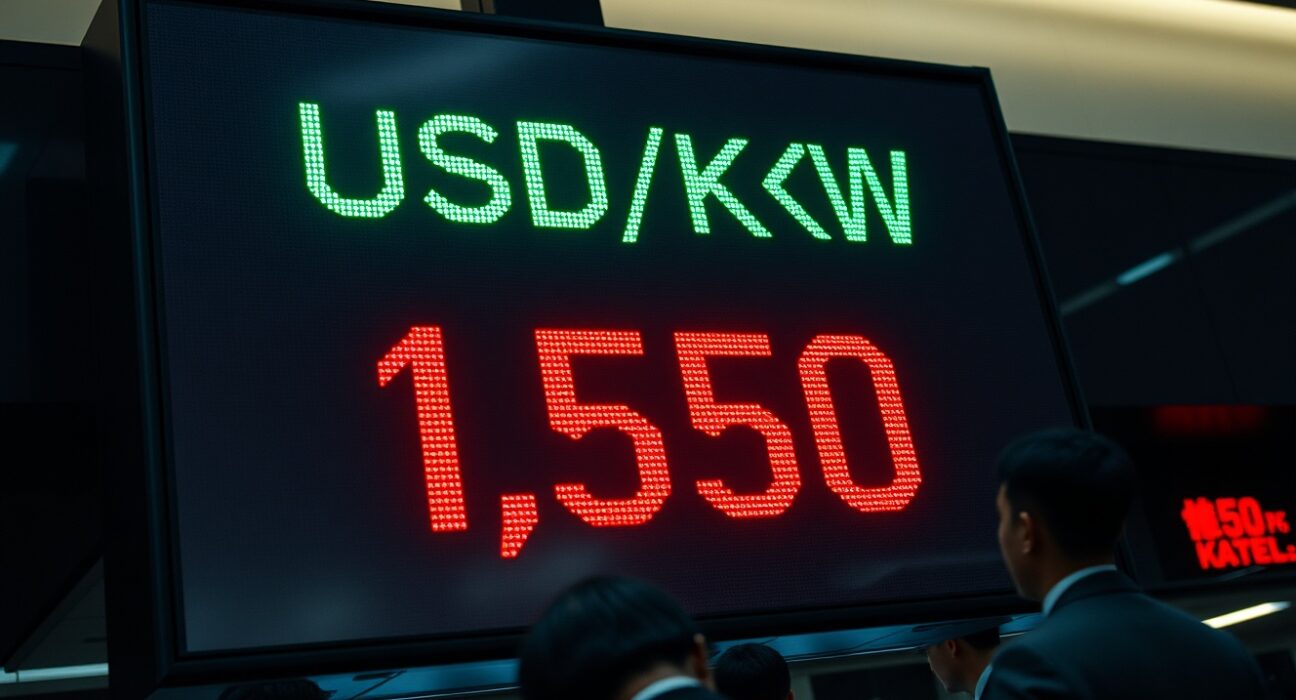
The South Korean won staged a sharp recovery from the psychologically significant level of 1,550 per US dollar on Thursday, triggering widespread speculation that authorities intervened to stabilize the currency. The move, which saw the won strengthen by more than 1% in a matter of hours, marks the latest chapter in a prolonged period of weakness for the Asian currency.
What Happened and Why It Matters
The won had been trading near its weakest levels in over a decade, pressured by a strong US dollar and persistent geopolitical uncertainties. The sudden reversal, characterized by unusually large and rapid trading volumes, is a classic signature of official intervention. While the Bank of Korea and the Ministry of Economy and Finance have not confirmed any action, market participants widely believe that state-backed entities stepped in to sell dollars and buy won.
This suspected intervention is significant because the 1,550 level is seen as a critical threshold. A sustained breach could have accelerated capital outflows and imported inflation, further squeezing households and businesses already grappling with high living costs. The action signals that policymakers are prepared to defend the currency, at least in the short term, to prevent excessive volatility.
Context: The Won’s Long Slide
The won has been one of the worst-performing major currencies in Asia this year, depreciating roughly 8% against the dollar. The decline reflects a combination of factors:
- Aggressive US monetary policy: The Federal Reserve’s sustained interest rate hikes have widened the rate differential between the US and South Korea, making dollar-denominated assets more attractive.
- Trade deficit concerns: South Korea has posted a trade deficit for much of the year, driven by high energy import costs and slowing exports, particularly in semiconductors.
- Geopolitical risk: Ongoing tensions on the Korean Peninsula and uncertainty surrounding global supply chains have weighed on investor sentiment.
Previous interventions have occurred at various levels, but the speed and scale of Thursday’s move suggest a more forceful response than usual.
What Intervention Looks Like
When a central bank intervenes, it typically sells foreign currency reserves and buys the local currency. In South Korea, the Bank of Korea and the National Pension Service have been known to coordinate such actions. The impact is often temporary, providing a breathing space rather than a permanent solution. Analysts note that sustained intervention requires significant reserves, and South Korea’s foreign exchange reserves, while ample at around $420 billion, are not infinite.
Implications for Investors and Consumers
For investors, the intervention introduces a layer of uncertainty. While it may cap short-term losses for the won, it also signals underlying economic fragility. Importers, particularly those reliant on raw materials and energy, will be watching closely. A weaker won raises the cost of imports, feeding into domestic inflation. Conversely, exporters, especially in the tech and automotive sectors, may benefit from a more competitive currency.
For ordinary South Koreans, the won’s weakness has already translated into higher prices for imported goods, from food to fuel. The intervention, if successful in stabilizing the currency, could help moderate these price pressures, but the relief may be short-lived if global dollar strength persists.
Conclusion
The suspected intervention in the won marks a defensive move by South Korean authorities to prevent a disorderly depreciation. While it offers temporary relief, the underlying pressures on the currency remain intact. The effectiveness of the intervention will depend on whether it is part of a broader strategy or a one-off response to a critical threshold. Markets will now watch for any official confirmation and for signs of further action if the won comes under renewed pressure.
FAQs
Q1: What is currency intervention?
Currency intervention occurs when a central bank or government actively buys or sells its own currency in the foreign exchange market to influence its value. In this case, South Korea is believed to have sold US dollars and bought won to support the currency.
Q2: Why is the 1,550 level important for the won?
The 1,550 level is a psychologically significant threshold. A sustained break above it could trigger further selling, accelerate capital outflows, and worsen imported inflation. Defending this level signals that authorities are unwilling to let the currency weaken unchecked.
Q3: Can intervention permanently strengthen the won?
Intervention is typically a short-term tool. It can provide temporary stability and prevent panic, but it does not address the fundamental economic factors driving currency weakness, such as interest rate differentials, trade imbalances, or geopolitical risks. Long-term strength requires improvements in those fundamentals.
Disclaimer: The information provided is not trading advice, Bitcoinworld.co.in holds no liability for any investments made based on the information provided on this page. We strongly recommend independent research and/or consultation with a qualified professional before making any investment decisions.
