
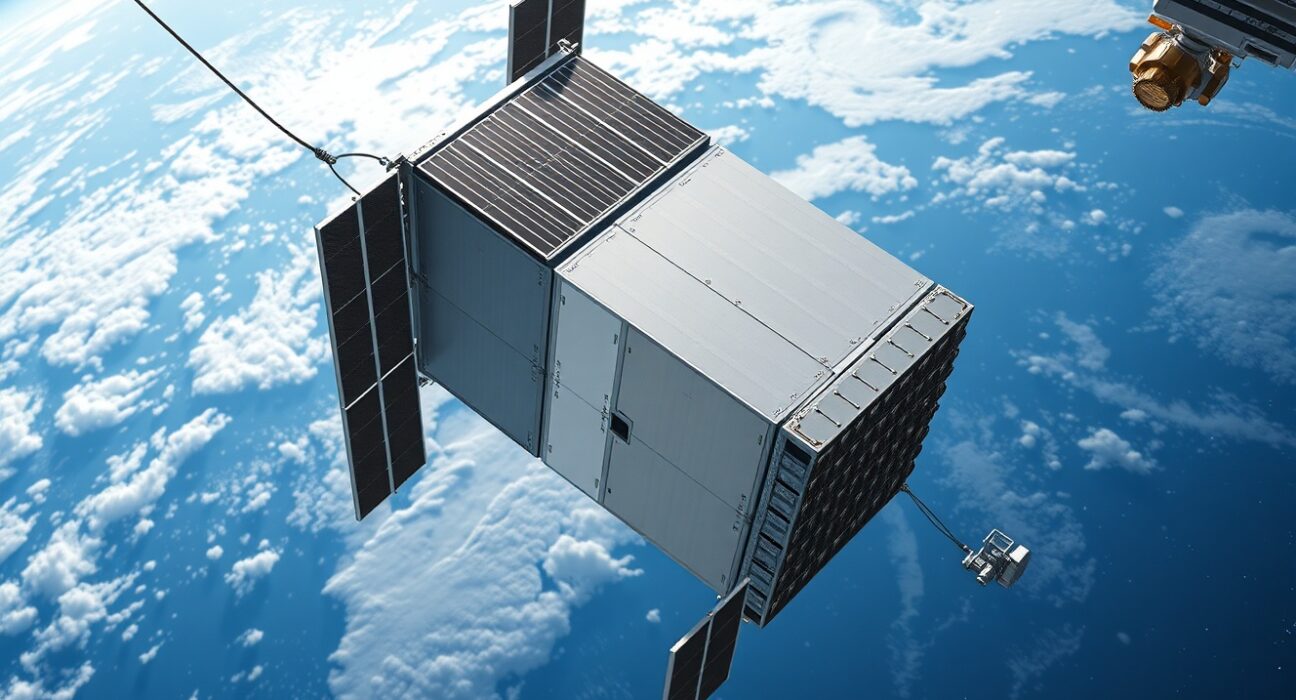
SpaceX reportedly seeks a staggering $1.75 trillion valuation, and its ambitious plan for orbital data centers forms a cornerstone of that financial narrative. This vision emerges as terrestrial data center expansion faces mounting social and regulatory opposition, potentially creating a new frontier for computing. The company’s confidential IPO filing for a $75 billion raise places extraordinary weight on this futuristic capability, according to discussions on Bitcoin World’s Equity podcast. Consequently, the engineering and economic feasibility of space-based computing infrastructure moves from science fiction to a central Wall Street debate.
SpaceX Orbital Data Centers and the $1.75 Trillion Valuation Question
The core proposition is audacious: relocate critical data processing and storage infrastructure to low Earth orbit. SpaceX CEO Elon Musk positions this not merely as a technical experiment but as a fundamental component of the company’s long-term growth story. This strategic pivot arrives amid a significant shift in the data center landscape on Earth. Notably, communities across the United States are increasingly opposing new data center construction due to concerns over land use, water consumption for cooling, and massive energy demands. Therefore, space presents a theoretically unconstrained alternative, albeit one requiring monumental technological leaps.
Industry analysts like Sean O’Kane observe a “rapidly forming trend” over the past year. The logic, as noted in the podcast discussion, suggests that for executives like Musk and Amazon’s Jeff Bezos, “The engineering challenge may be less than the social challenge back here.” This calculus reframes the problem from a purely technical domain to a socio-political one. Building in space avoids local zoning boards, environmental impact reviews, and community pushback, though it introduces profound new hurdles in radiation hardening, heat dissipation in a vacuum, and ultra-reliable autonomous operation.
The Competitive Landscape for Space-Based Computing
SpaceX is not alone in chasing this vision. The market is evolving into a next-generation battleground, echoing the competition between SpaceX’s Starlink and Amazon’s Project Kuiper satellite internet constellations. Jeff Bezos’s Blue Origin is also developing satellite networks with potential data center applications. Furthermore, startups are entering the fray. A Y Combinator-backed company, originally named Starcloud, recently achieved “unicorn” status after a $170 million funding round, highlighting intense investor interest in the concept.
The Unique SpaceX Business Model Advantage
SpaceX holds a distinct and potentially decisive advantage: vertical integration. As a premier launch provider, the company can book the revenue from launching its own (or others’) data center satellites. Sean O’Kane highlighted this critical point: “They are the vehicle that gets the data centers to space. They get to book that as revenue for SpaceX.” This creates a powerful, self-reinforcing business loop. More data center deployments mean more launch contracts for SpaceX, boosting its financial metrics as a public company. This synergy between its launch division and its constellation operations is a unique value proposition not easily replicated by pure-play data center or satellite firms.
The technical path likely builds upon existing Starlink infrastructure. Starlink satellites already possess significant onboard computing power for network routing and signal processing. Scaling this into dedicated, high-performance computing modules represents a logical, albeit complex, evolution. However, experts like Tim Fernholz, who has written extensively on the physics involved, point to severe constraints. These include managing the immense waste heat generated by servers in the vacuum of space, where convection cooling is impossible, and protecting sensitive electronics from cosmic radiation and solar flares.
Earthly Realities and the AI Compute Demand Curve
The push for orbital infrastructure intersects with uncertain demand forecasts for artificial intelligence computing. Recent months have seen some AI labs reassess their projected needs, leading to potential pullbacks in terrestrial data center leasing. If this trend solidifies, it could undermine the economic urgency for massively expensive orbital alternatives. As Anthony Ha noted in the podcast, even optimistic projections for space-based compute capacity represent “just a drop in the bucket” compared to global needs. The realistic role, therefore, is likely as a specialized supplement for latency-tolerant or geopolitically sensitive workloads, not a replacement for ground-based clouds.
Key Technical and Economic Hurdles:
- Heat Rejection: In space, waste heat can only be dissipated via radiation, requiring massive radiator surfaces.
- Radiation Hardening: Cosmic rays can cause bit flips and hardware degradation, necessitating expensive, fault-tolerant designs.
- Launch Costs: While SpaceX has reduced costs, launching thousands of tons of server hardware remains prohibitively expensive for general-purpose computing.
- Latency: While low Earth orbit latency is low for communication, the round-trip for data processing adds complexity compared to a local data center.
- Maintenance & Upgrades: Physical repair or hardware upgrades of orbiting data centers is currently infeasible, demanding extreme reliability.
The Investor Narrative and Future Expectations
Beyond pure engineering, the orbital data center vision serves a powerful narrative function. Kirsten Korosec pointed out that it “creates excitement” and signals a company working on the future, not the past. For a company approaching public markets with a valuation predicated on decades of future growth, such a forward-looking, aspirational project is invaluable. It allows investors to value SpaceX on its transformative potential across space access, global communications, and now off-world infrastructure, rather than solely on current financials from launch services and Starlink subscriptions.
Conclusion
The viability of SpaceX orbital data centers remains an open and formidable engineering question. However, its role in justifying the company’s targeted $1.75 trillion valuation is already clear. It represents a strategic bet on overcoming space’s physical challenges being more manageable than Earth’s social and regulatory ones. Furthermore, it leverages SpaceX’s unique position as both builder and user of launch capacity. While these space-based facilities will not replace terrestrial data centers, they could carve out a high-value niche. Ultimately, the success of this vision will depend on achieving dramatic reductions in launch costs, breakthroughs in space-hardened computing, and the sustained growth of AI and global data demand. The IPO will test whether Wall Street buys the story behind the stars.
FAQs
Q1: What is an orbital data center?
An orbital data center is a computing facility housed on satellites in space, designed to process and store data without being located on Earth’s surface.
Q2: Why would SpaceX want to put data centers in space?
SpaceX cites avoiding growing social and regulatory opposition to terrestrial data centers, which face issues over land, water, and energy use. Space offers a theoretically limitless expansion path.
Q3: How do orbital data centers justify SpaceX’s high valuation?
They represent a massive new potential revenue stream and growth market, fitting into a long-term narrative of SpaceX as a multi-planetary infrastructure company, which investors may reward with a higher valuation.
Q4: What are the biggest technical challenges?
The primary challenges are managing server waste heat in the vacuum of space, protecting electronics from intense radiation, and achieving the necessary reliability for hardware that cannot be physically repaired.
Q5: Who are SpaceX’s competitors in this area?
Competitors include Amazon (via Project Kuiper and Blue Origin), and several startups like the Y Combinator-funded Starcloud, all exploring various models for space-based computing.
Disclaimer: The information provided is not trading advice, Bitcoinworld.co.in holds no liability for any investments made based on the information provided on this page. We strongly recommend independent research and/or consultation with a qualified professional before making any investment decisions.