

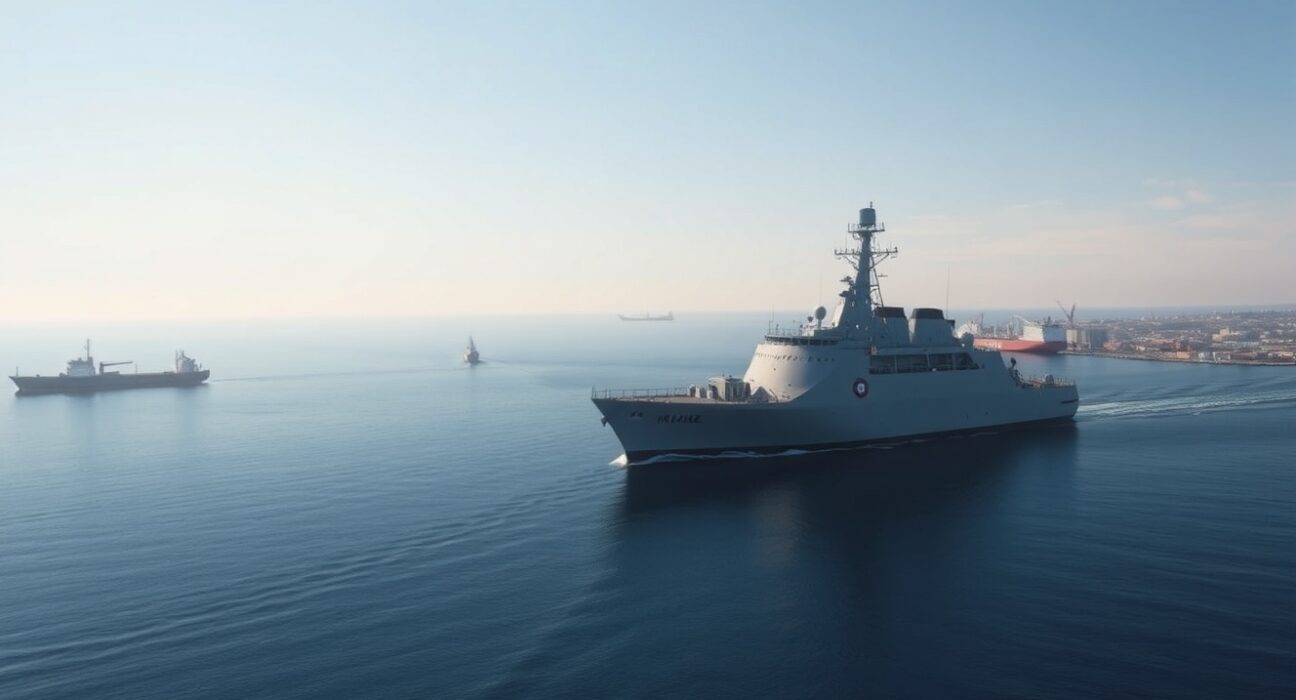
Iran has firmly signaled its intention to retain control over the Strait of Hormuz, a critical chokepoint for global oil shipments. The Wall Street Journal reported this stance, citing Iranian government officials who communicated the position to mediators. This declaration follows a statement by Yadollah Javani, head of the political bureau for Iran’s Islamic Revolutionary Guard Corps (IRGC). Javani asserted that the United States could never open the strait by military means. He further claimed that Iran has cornered Washington by blockading the waterway and responding symmetrically to threats. This development escalates tensions in a region already fraught with geopolitical risk.
Understanding the Strait of Hormuz Control
The Strait of Hormuz connects the Persian Gulf with the Gulf of Oman and the Arabian Sea. It is a narrow passage, only 21 miles wide at its narrowest point. Approximately 20% of the world’s oil passes through this waterway daily. This makes the strait a vital artery for global energy security. Iran’s geographic position gives it significant leverage over this passage. The country has repeatedly threatened to close the strait in response to sanctions or military pressure. Maintaining control over the Strait of Hormuz is therefore a cornerstone of Iran’s national security and economic strategy.
Iran’s position is not new. However, the recent WSJ report highlights a hardening of this stance. The IRGC’s political bureau, led by Javani, plays a key role in shaping this policy. Javani’s remarks suggest a calculated strategy to use the strait as a bargaining chip. By blockading it, Iran aims to create economic pressure on the U.S. and its allies. This symmetrical response means Iran matches any U.S. escalation with a direct countermeasure in the same domain.
IRGC Political Bureau: The Strategic Mind
Yadollah Javani is a prominent figure within Iran’s military-political establishment. As head of the IRGC’s political bureau, he influences both military doctrine and public messaging. His statement that the U.S. could never open the strait by military force reflects deep confidence in Iran’s defensive capabilities. The IRGC has invested heavily in anti-ship missiles, fast attack boats, and naval mines. These assets are designed to make any military intervention costly and difficult.
Javani’s claim that Iran has cornered Washington suggests a strategic victory in the realm of asymmetric warfare. By threatening the strait, Iran forces the U.S. to consider the economic consequences of any conflict. This approach mirrors tactics used in other theaters, such as the Persian Gulf tanker wars of the 1980s. The IRGC political bureau thus serves as the ideological and strategic engine behind Iran’s maritime policy.
US-Iran Tensions: A Timeline of Escalation
Tensions between the U.S. and Iran have simmered for decades. The 2015 nuclear deal temporarily eased them, but the U.S. withdrawal in 2018 reignited hostilities. Since then, a series of incidents have brought the two nations close to direct confrontation. In 2019, Iran shot down a U.S. drone over the strait. The U.S. responded with cyberattacks on Iranian missile systems. In 2020, a U.S. airstrike killed IRGC General Qasem Soleimani. Iran retaliated by launching ballistic missiles at U.S. bases in Iraq.
The current standoff over the Strait of Hormuz control represents the latest flashpoint. Iran’s message to mediators is clear: any attempt to challenge its authority in the waterway will be met with resistance. The U.S. has maintained a naval presence in the region, conducting patrols and exercises. However, Iran’s asymmetric capabilities make a full-scale blockade difficult to break without significant escalation.
Global Oil Supply at Risk
The potential disruption of oil flows through the Strait of Hormuz poses a direct threat to global energy markets. A prolonged closure could send oil prices soaring, triggering economic instability worldwide. Major consumers like China, India, Japan, and South Korea rely heavily on oil from the Persian Gulf. Any interruption would force these nations to seek alternative sources, driving up costs.
The following table illustrates the volume of oil passing through the strait daily:
| Country/Region | Oil Imports via Strait (million barrels/day) | Share of Total Imports |
|---|---|---|
| China | 5.5 | 35% |
| India | 3.0 | 25% |
| Japan | 2.5 | 30% |
| South Korea | 2.0 | 28% |
These figures underscore the strait’s importance. Any threat to its control sends shockwaves through financial markets. The International Energy Agency (IEA) has emergency stockpiles, but these would only cover a few weeks of disruption. The world watches closely as Iran reinforces its position.
Military Capabilities and Asymmetric Warfare
Iran’s military strategy in the Strait of Hormuz relies on asymmetric warfare. The IRGC Navy operates a fleet of small, fast attack craft armed with anti-ship missiles. These boats can swarm larger vessels, making them difficult to defend against. Iran also possesses a vast arsenal of naval mines, which can be deployed covertly to block shipping lanes. Anti-ship missiles, such as the Noor and Qader, have ranges of over 100 miles and can target vessels from shore-based launchers.
In addition, Iran has invested in unmanned aerial vehicles (UAVs) for surveillance and attack. These drones can provide real-time intelligence on U.S. naval movements. The IRGC also uses cyber warfare to disrupt navigation systems and communications. This multi-layered approach makes any military attempt to secure the strait a complex and risky endeavor.
Expert Analysis on Iran’s Strategy
Defense analysts point out that Iran’s strategy is not about winning a conventional war. Instead, it aims to impose unacceptable costs on any aggressor. Dr. Farzin Nadimi, a senior fellow at the Washington Institute, notes that Iran’s focus on the strait is a form of coercive diplomacy. By threatening the global oil supply, Tehran forces the international community to engage diplomatically. This approach has worked in the past, leading to negotiations over sanctions relief.
The IRGC political bureau’s role in this strategy cannot be overstated. Javani’s statements are carefully calibrated to signal resolve without triggering immediate conflict. The message to mediators serves as both a warning and an invitation to negotiate. Iran wants to maintain control, but it also wants to avoid a full-scale war. This balancing act defines the current standoff.
Economic Impacts on Iran and the Region
Iran’s own economy suffers from the tension. Sanctions have crippled its oil exports, reducing them from 2.5 million barrels per day in 2018 to under 500,000 barrels per day in 2024. However, Iran still earns revenue from oil smuggled through the strait. Maintaining control allows Iran to project power and protect this illicit trade. The IRGC is deeply involved in this smuggling, using the strait as a conduit for revenue.
Regional neighbors, including Saudi Arabia, the UAE, and Oman, have a vested interest in keeping the strait open. They have built alternative pipelines to bypass the chokepoint, but these are insufficient to replace the strait’s capacity. Any disruption would harm these economies as well. The Gulf Cooperation Council (GCC) has called for de-escalation, but Iran’s stance makes diplomacy difficult.
International Reactions and Mediation Efforts
The international community has reacted with concern to Iran’s latest statements. The United Nations has urged restraint. European mediators, including France and Germany, have engaged in backchannel talks with Tehran. Russia and China, both allies of Iran, have called for a diplomatic solution but have not publicly condemned Iran’s position. The U.S. has reiterated its commitment to freedom of navigation. The U.S. Navy’s Fifth Fleet, based in Bahrain, remains on high alert.
Mediation efforts have so far failed to produce a breakthrough. Iran’s insistence on maintaining control leaves little room for compromise. The mediators are exploring options such as a temporary truce or a mutual de-escalation agreement. However, the IRGC’s hardline stance, as articulated by Javani, suggests that Iran will not back down easily.
Conclusion
Iran’s determination to maintain control over the Strait of Hormuz represents a significant challenge to global stability. The IRGC political bureau, through statements by Yadollah Javani, has made it clear that Iran will resist any U.S. attempt to open the waterway by force. This position threatens global oil supply and raises the risk of military confrontation. The situation demands careful diplomacy and a clear understanding of Iran’s asymmetric capabilities. As the world watches, the Strait of Hormuz remains a flashpoint where strategic control could shape the future of energy security.
FAQs
Q1: Why is the Strait of Hormuz control so important to Iran?
Iran views control over the Strait of Hormuz as essential for its national security and economic leverage. The strait is a chokepoint for global oil trade, and controlling it allows Iran to project power and counter U.S. pressure.
Q2: What did Yadollah Javani say about the Strait of Hormuz?
Javani, head of the IRGC political bureau, stated that the U.S. could never open the strait by military means. He claimed Iran has cornered Washington by blockading the waterway and responding symmetrically.
Q3: How would a closure of the Strait of Hormuz affect global oil prices?
A prolonged closure would disrupt approximately 20% of global oil supply, likely causing prices to spike sharply. Major importers like China, India, Japan, and South Korea would face severe supply shortages.
Q4: What military capabilities does Iran have in the Strait of Hormuz?
Iran relies on asymmetric warfare, including fast attack boats, anti-ship missiles, naval mines, UAVs, and cyber warfare. These assets are designed to make any military intervention costly.
Q5: Has Iran threatened to close the Strait of Hormuz before?
Yes, Iran has periodically threatened to close the strait in response to sanctions or military pressure. This tactic has been used since the 1980s as a form of coercive diplomacy.
Q6: What are the international reactions to Iran’s stance?
The UN has urged restraint, while European mediators are engaged in talks. The U.S. maintains a naval presence and reaffirms freedom of navigation. Russia and China have called for diplomacy without condemning Iran.
Disclaimer: The information provided is not trading advice, Bitcoinworld.co.in holds no liability for any investments made based on the information provided on this page. We strongly recommend independent research and/or consultation with a qualified professional before making any investment decisions.
