

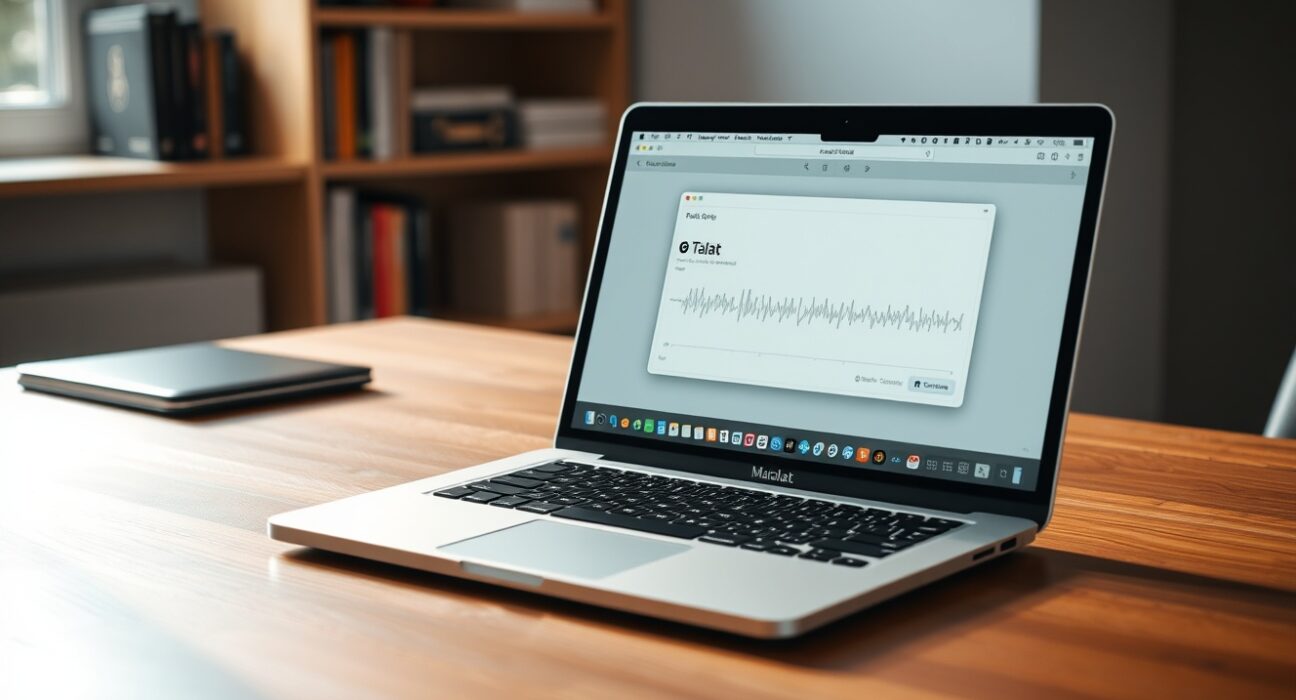
In an era where cloud-based AI services dominate the productivity landscape, a groundbreaking Mac application called Talat emerges with a compelling proposition: your meeting notes, transcriptions, and summaries never leave your computer. Developed by Yorkshire-based programmer Nick Payne, this $49 one-time purchase application represents a significant shift toward privacy-conscious AI tools that prioritize user data sovereignty over cloud convenience.
Talat’s AI Meeting Notes Revolutionize Privacy Standards
The AI-powered notetaking market has experienced explosive growth recently, with industry leader Granola achieving a $250 million valuation through its popular subscription service. However, Talat developer Nick Payne identified a critical gap in this expanding market. “While hosted transcription models deliver impressive results,” Payne explained in an exclusive interview, “the tradeoff requires providing not just my data, but my audio data; my actual voice.” This fundamental privacy concern drove Payne to create an alternative that processes everything locally on users’ Mac computers.
Traditional AI notetaking applications typically route audio through cloud servers for processing. Consequently, sensitive business discussions, confidential negotiations, and personal conversations pass through third-party infrastructure. Talat completely eliminates this vulnerability by performing all transcription and summarization directly on the user’s device. The application leverages Apple’s Neural Engine hardware specifically designed for on-device AI processing.
The Technical Breakthrough Behind Local AI Processing
Payne’s journey to creating Talat began with what he describes as “a series of happy accidents.” Initially fascinated by how applications could capture system audio without video recording, Payne discovered Apple’s Core Audio Taps API. This relatively undocumented interface allows developers to access Mac audio streams directly. To simplify working with this technology, Payne created AudioTee, an open-source audio library that formed the foundation for his subsequent work.
The real breakthrough arrived when Payne encountered FluidAudio, a Swift framework enabling fully local, low-latency audio AI on Apple devices. This technology allows small, efficient transcription models to run directly on Mac hardware. “FluidAudio does a lot of the heavy lifting,” Payne noted, describing how it abstracts complex audio processing tasks. The framework makes it possible to achieve near real-time transcription without sending data to external servers.
Architecture and Performance Considerations
Talat’s architecture represents a sophisticated balance between performance and privacy. The 20MB application defaults to using Qwen3-4B-4bit for summarization tasks, a model optimized to run efficiently on Apple’s M-series processors. Remarkably, this model functions effectively even on modest hardware configurations. For transcription, users can select between two Parakeet variants developed by Nvidia or configure custom models through Ollama integration.
The application’s configurability extends beyond model selection. Users maintain complete control over their data pipeline through features including automatic export to Obsidian, webhook notifications when meetings conclude, and MCP server integration for on-demand data access. This flexibility distinguishes Talat from more rigid, cloud-dependent alternatives.
Privacy Implications in the AI Productivity Space
The privacy-focused approach of Talat arrives at a critical moment in technology adoption. Recent surveys indicate growing concern among professionals about data sovereignty, particularly in regulated industries like finance, healthcare, and legal services. Cloud-based AI services typically retain transcripts for model improvement and quality assurance, creating potential compliance issues for sensitive discussions.
Industry analyst Michael Chen observes, “The shift toward local AI processing represents more than a technical preference—it’s becoming a business necessity for organizations handling confidential information.” This trend aligns with broader movements toward edge computing and decentralized data processing across multiple technology sectors.
| Feature | Cloud-Based Solutions | Talat (Local Processing) |
|---|---|---|
| Data Storage | Company servers | User’s device only |
| Subscription Model | Monthly/Annual fees | One-time purchase |
| Internet Requirement | Mandatory | Optional for some features |
| Account Creation | Required | Not required |
| Data for Training | Often used | Never used |
Market Position and User Experience
Talat enters a competitive landscape dominated by feature-rich cloud services. While applications like Granola offer extensive integrations and advanced capabilities, Talat focuses on core functionality with uncompromising privacy. The application captures audio from meeting platforms including Zoom, Microsoft Teams, and Google Meet, providing real-time transcription with speaker identification.
Key features include:
- Real-time transcription with editable speaker assignments
- Local LLM summarization generating key points and action items
- Full search functionality across notes, transcripts, and summaries
- Segment editing and organization tools for post-meeting refinement
- Export capabilities to popular note-taking applications
Currently available as a pre-release version for $49, Talat offers 10 free recording hours for evaluation. The application requires M-series Mac computers (M1 or later) to leverage Apple’s Neural Engine hardware. Upon reaching version 1.0, the price will increase to $99, though Payne and co-developer Mike Franklin commit to maintaining the one-time purchase model for the core application.
Future Development Roadmap
The development team plans several enhancements for upcoming releases. Planned integrations include Google Calendar synchronization and Notion connectivity, expanding Talat’s utility within existing productivity ecosystems. Additionally, the developers intend to add more built-in model options and refine the user interface based on early adopter feedback.
Payne emphasizes that Talat’s development philosophy centers on user control. “We’re leaning into configurability and letting users control where their data goes,” he explained. This approach contrasts sharply with the walled-garden ecosystems common in productivity software, potentially appealing to users seeking greater autonomy over their digital tools.
Broader Industry Implications
Talat’s emergence signals a potential inflection point in AI application development. As privacy regulations tighten globally and user awareness increases, demand for locally-processed AI tools may accelerate. This trend could pressure established cloud-based providers to offer enhanced privacy options or develop their own local processing alternatives.
Technology ethicist Dr. Anya Sharma comments, “Applications like Talat demonstrate that privacy and functionality aren’t mutually exclusive. They provide a viable alternative for users who value data sovereignty, potentially influencing how larger companies approach product development in this space.”
The success of privacy-focused applications could reshape investment patterns in the AI sector. While venture capital has predominantly flowed toward cloud-centric models, Talat’s bootstrapped development demonstrates alternative pathways for creating sustainable AI businesses.
Conclusion
Talat’s AI meeting notes application represents a significant advancement in privacy-conscious productivity tools. By processing all data locally on users’ Mac computers, the application addresses growing concerns about cloud-based AI services while delivering practical functionality for professionals. The one-time purchase model further distinguishes Talat from subscription-based alternatives, offering long-term value for users seeking reliable meeting documentation without ongoing fees.
As AI integration deepens across workplace tools, solutions prioritizing user privacy and data sovereignty will likely gain importance. Talat’s approach demonstrates that technical innovation can align with ethical data practices, potentially influencing broader industry standards for AI-powered applications. For professionals handling sensitive information or simply preferring greater control over their digital footprint, Talat offers a compelling alternative in the increasingly crowded AI productivity landscape.
FAQs
Q1: How does Talat ensure privacy compared to cloud-based alternatives?
Talat processes all audio transcription and summarization directly on your Mac using Apple’s Neural Engine. Your data never leaves your device, eliminating the privacy risks associated with cloud processing where audio and transcripts typically pass through third-party servers.
Q2: What are the system requirements for running Talat?
Talat requires a Mac with an M-series processor (M1 or later) to leverage Apple’s Neural Engine hardware for efficient local AI processing. The application is optimized for macOS and cannot run on Intel-based Macs or other operating systems.
Q3: Can I use Talat without an internet connection?
Yes, Talat’s core transcription and summarization features work completely offline once installed. Internet access is only required for optional features like cloud LLM integration or specific export functions, but the primary functionality operates independently.
Q4: How does the pricing model work for Talat?
Talat uses a one-time purchase model rather than subscriptions. The pre-release version costs $49 with 10 free recording hours for evaluation. After version 1.0 launches, the price will increase to $99, with no recurring fees for the core application.
Q5: What meeting platforms does Talat support for audio capture?
Talat captures audio from popular meeting applications including Zoom, Microsoft Teams, Google Meet, and other standard conferencing platforms. The application accesses system audio through macOS APIs rather than integrating directly with specific platforms.
Disclaimer: The information provided is not trading advice, Bitcoinworld.co.in holds no liability for any investments made based on the information provided on this page. We strongly recommend independent research and/or consultation with a qualified professional before making any investment decisions.