
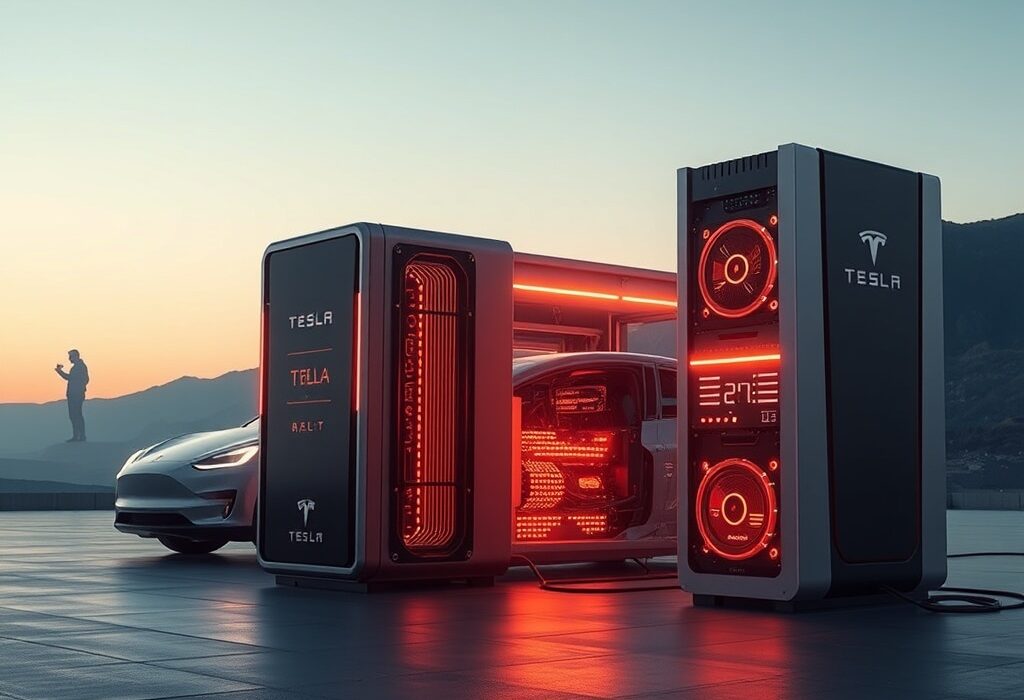
In the rapidly evolving landscape of technology, where breakthroughs in AI and blockchain often dominate headlines, the saga of Tesla Dojo offers a compelling narrative. For years, the crypto community and tech enthusiasts alike watched as Elon Musk championed this ambitious AI supercomputer, promising to revolutionize autonomous driving and even humanoid robotics. The vision was grand: an in-house powerhouse that would cement Tesla’s status not just as an automaker, but as a leading AI company. Yet, the journey of Dojo took an unexpected turn, culminating in its recent shutdown – a development that sparks crucial questions about the future of specialized AI infrastructure and the strategic pivots required in high-stakes technological races.
What Exactly Was Tesla Dojo, and Why Did It Matter?
At its core, Tesla Dojo was a custom-built supercomputer, specifically engineered to train the neural networks underpinning Tesla’s “Full Self-Driving” (FSD) software. Imagine a digital dojo, a training ground where Tesla’s AI models would hone their skills, learning to navigate the complexities of real-world driving. The stakes were incredibly high, as beefing up Dojo went hand-in-hand with Tesla’s audacious goal to achieve full autonomy and bring a robotaxi service to market.
FSD (Supervised), Tesla’s advanced driver assistance system, is already deployed in hundreds of thousands of Tesla vehicles. While it can perform automated driving tasks, it still mandates human attentiveness behind the wheel. This technology also forms the foundation of Tesla’s limited robotaxi service, launched in Austin using Model Y SUVs. Despite these advancements, it’s noteworthy that Tesla rarely attributed its self-driving successes directly to Dojo. In fact, over the past year, mentions of Dojo from Elon Musk and the company had become increasingly scarce, hinting at a shifting focus long before the official announcement.
Elon Musk‘s Grand Vision: The AI Supercomputer Dream
Elon Musk has consistently argued that Tesla is far more than just an automotive manufacturer. He has passionately pitched it as an AI company, one that has purportedly “cracked the code” to self-driving cars by meticulously mimicking human perception. This vision contrasts sharply with most other autonomous vehicle companies that typically blend various sensors—like lidar, radar, and cameras—with high-definition maps to achieve localization and perception.
Tesla’s distinctive approach relies almost exclusively on cameras to capture vast amounts of visual data. This data is then fed into advanced neural networks, which are tasked with processing it rapidly and making split-second driving decisions. The underlying promise was that Dojo-trained AI software would eventually be pushed out to Tesla customers via over-the-air updates, continuously improving the driving experience. The sheer scale of FSD deployment has allowed Tesla to accumulate millions of miles worth of video footage, creating an unparalleled dataset for AI training. The hypothesis was simple: more data equals smarter models, bringing the automaker closer to achieving true full self-driving.
However, this “brute force” approach of simply throwing more data at a model has its skeptics. Anand Raghunathan, a professor of electrical and computer engineering at Purdue University, points out potential limitations:
- Economic Constraints: The cost of collecting, storing, and processing ever-increasing volumes of data can become prohibitively expensive.
- Data Saturation: There might be a point where adding more data doesn’t necessarily translate into more meaningful information or significant improvements in model performance. The quality and relevance of data are often more critical than sheer quantity.
Despite these doubts, the trend for the short term remains clear: more data is being used, and that necessitates immense compute power to store, process, and train complex AI models. This is precisely where Tesla Dojo was designed to shine.
The Quest for Autonomous Self-Driving Tech and Custom Chips
Tesla’s commitment to a vision-only approach for its self-driving tech was the primary driver behind the need for a dedicated supercomputer like Dojo. The neural networks powering FSD must be trained on colossal amounts of driving data to accurately recognize and classify objects in real-time, subsequently making instantaneous driving decisions. This ambitious goal essentially aims to replicate the speed and accuracy of the human visual cortex and brain function digitally.
To achieve this, Tesla needed a system capable of storing and processing all the video data collected from its global fleet of vehicles, running millions of simulations to refine its AI models. Initially, Tesla relied heavily on Nvidia GPUs for its AI training. However, the company sought to reduce its dependence on expensive, high-demand Nvidia chips and innovate with its own custom hardware program. The aim was to create a more efficient system tailored specifically for AI workloads, with increased bandwidth and reduced latencies.
At the heart of this custom hardware initiative was Tesla’s proprietary D1 chip. Unveiled at AI Day in 2021, the D1 chip was a significant step towards semiconductor autonomy. Produced by TSMC using 7-nanometer nodes, the D1 boasted 50 billion transistors and a large die size of 645 square millimeters, promising exceptional power and efficiency for complex AI tasks. While not as powerful as Nvidia’s A100 chip, it represented Tesla’s bespoke solution.
Tesla also had plans for a next-generation D2 chip, designed to overcome information flow bottlenecks by integrating the entire Dojo tile onto a single silicon wafer. However, the exact number of D1 chips ordered or received, and the timeline for Dojo supercomputers running on D1 chips, remained largely undisclosed, adding to the project’s enigmatic nature.
The Pivot: From Dojo’s Demise to Strategic AI Training Partnerships
After years of development and significant investment, the news broke in mid-August 2025: Tesla had decided to shut down the Tesla Dojo project and disband its dedicated team. This dramatic turn of events saw key figures like Dojo lead Peter Bannon depart, alongside approximately 20 workers who went on to form their own AI chip and infrastructure company, DensityAI. The loss of specialized talent, particularly in a niche internal tech project, can be a critical blow.
Just weeks before this announcement, Tesla had secured a substantial $16.5 billion deal with Samsung for its next-generation AI6 chips. This AI6 chip is now central to Tesla’s strategy, envisioned to power everything from FSD and Optimus humanoid robots to high-performance AI training in data centers. Elon Musk clarified the decision on X, stating, “Once it became clear that all paths converged to AI6, I had to shut down Dojo and make some tough personnel choices, as Dojo 2 was now an evolutionary dead end.” He suggested that “Dojo 3 arguably lives on in the form of a large number of AI6 [systems-on-a-chip] on a single board,” indicating a shift in architectural approach rather than an abandonment of the underlying goal.
This pivot wasn’t entirely without precedent. In August 2024, Tesla began promoting Cortex, its “giant new AI training supercluster being built at Tesla HQ in Austin.” Musk had described Cortex as having “massive storage for video training of FSD & Optimus.” Tesla’s Q4 2024 shareholder deck provided updates on Cortex, with no mention of Dojo, further underscoring the shift in focus. By Q2 2025, Tesla had expanded Cortex significantly, deploying an additional 16k H200 GPUs at Gigafactory Texas, bringing Cortex to a total of 67k H100 equivalents, enabling V13 of supervised FSD. This clearly demonstrates a strategic move towards leveraging established, powerful GPU hardware from partners like Nvidia.
The Future of AI Chips and Tesla’s AI Ambitions
The original promise of Tesla Dojo was profound: by taking control of its own AI chips production, Tesla aimed to rapidly scale compute power for AI training at a reduced cost, while simultaneously lessening its dependence on Nvidia’s increasingly expensive and hard-to-secure GPUs. The project was viewed as an “insurance policy” that could potentially yield significant dividends, unlocking new revenue streams from robotaxis and software services.
Morgan Stanley, in a September 2023 report, even predicted that Dojo could add a staggering $500 billion to Tesla’s market value. Musk himself, during a Q2 2024 earnings call, had expressed aspirations of “a path to being competitive with Nvidia with Dojo.” However, a critical challenge for Dojo’s custom D1 chips was their specialization for computer vision labeling and training, making them less versatile for general-purpose AI training. Adapting them for broader AI applications would have necessitated extensive software rewriting, a monumental task given that almost all existing AI software is optimized for GPUs.
Musk’s pronouncements on Dojo’s progress were frequent but often lacked concrete details or verifiable milestones. For instance, he suggested in June 2023 that Dojo had been “online and running useful tasks for a few months,” and Tesla projected it would be among the top five most powerful supercomputers by February 2024, aiming for 100 exaflops by October 2024. These ambitious targets, requiring hundreds of thousands of D1 chips or Nvidia equivalents, were never publicly confirmed as achieved.
The shutdown of Dojo, therefore, signals a pragmatic shift. While Tesla will still invest $500 million in a supercomputer facility in Buffalo, it will no longer be for Dojo. This strategic pivot highlights Tesla’s agility in adapting to market realities and technological evolution. Instead of battling the established GPU ecosystem, Tesla is now embracing partnerships with industry giants like Nvidia, AMD, and Samsung, leveraging their expertise in advanced AI chips to accelerate its AI ambitions for FSD and Optimus. This move suggests a focus on integration and optimization rather than complete in-house autonomy for core hardware, allowing Tesla to concentrate on its unique AI software and data advantages.
A New Chapter for Tesla’s AI Journey
The story of Tesla Dojo is a powerful testament to the ambition and inherent risks of cutting-edge technological development. What began as a bold vision to redefine AI infrastructure in-house, promising semiconductor autonomy and unprecedented compute power for self-driving tech, ultimately transformed into a strategic pivot. The decision to shut down Dojo, while initially appearing as a setback, can be viewed as a calculated move by Elon Musk and Tesla to streamline their approach, embrace collaborative partnerships, and focus resources on proven solutions like Nvidia GPUs and the forthcoming AI6 chips from Samsung. This pragmatic shift ensures Tesla remains at the forefront of AI innovation, albeit through a different, arguably more efficient, path. The lessons learned from Dojo will undoubtedly inform Tesla’s future endeavors in AI training and the relentless pursuit of fully autonomous vehicles and humanoid robots, solidifying its position in the competitive AI landscape.
To learn more about the latest AI market trends, explore our article on key developments shaping AI models and institutional adoption.
Disclaimer: The information provided is not trading advice, Bitcoinworld.co.in holds no liability for any investments made based on the information provided on this page. We strongly recommend independent research and/or consultation with a qualified professional before making any investment decisions.