
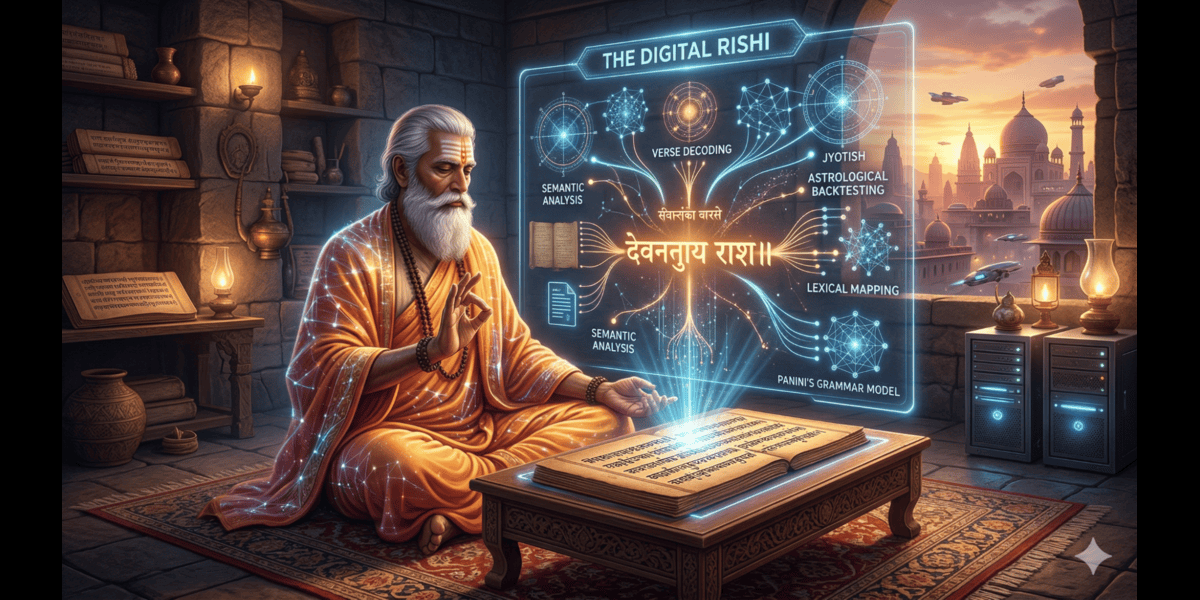
For millennia, the path of the Rishi—the “seer”—was one of profound isolation, deep meditation, and the painstaking memorization of thousands of verses. In the dust-filtered light of ancient libraries, scholars spent lifetimes cross-referencing palm-leaf manuscripts, debating the nuances of a single Sutra, and attempting to reconcile the vast, often contradictory, layers of Vedic, Hellenistic, and Perso-Arabic wisdom.
Fast-forward to 2026, and the “Digital Rishi” has arrived. This isn’t a replacement for human intuition, but a silicon-based extension of it. As Artificial Intelligence (AI) and Large Language Models (LLMs) evolve, we are witnessing a historical pivot. We are moving beyond the era of simple “calculation”—where computers merely did the math for Panchangs—into the era of “Interpretation and Research,” where machine learning is finally beginning to speak the complex, multi-layered language of the gods.
I. The Linguistic Bridge: Why Sanskrit is the Ultimate Code
To understand why AI is so effective at interpreting Sanskrit, we must first recognize that Sanskrit is perhaps the most “computational” natural language ever devised. The 4th-century BCE grammarian Panini created the Ashtadhyayi, a set of nearly 4,000 rules that function remarkably like a modern programming language.
Panini’s grammar is essentially a generative system. Just as a software developer uses logic gates and syntax to build an application, Panini used “meta-rules” to define how sounds and words morph into complex philosophical concepts. Modern Natural Language Processing (NLP) models thrive on this kind of structure.
In 2026, researchers are using AI not just to translate Sanskrit into English, but to “decode” the nested logic of the Sutras. Because one word in Sanskrit can have dozens of meanings depending on the context (Dhvani), AI uses “attention mechanisms” to scan the surrounding verses, the historical period of the text, and even the specific lineage of the author to determine the most accurate interpretation. This eliminates the “literalist trap” where a machine (or a novice scholar) might mistake a poetic metaphor for a literal command.
II. Beyond the Literal: Contextual Deep-Diving
The biggest challenge in ancient research has always been the “Semantic Fog.” In a text like the Brihat Parashara Hora Shastra, a single verse might describe a planetary alignment that seems disastrous on the surface. However, when cross-referenced with the Upadesha Sutras of Jaimini or the Tajika Neelakanthi, that same alignment might be revealed as a “Yoga” for immense spiritual growth.
AI acts as a “Universal Commentary.” It can hold the entire corpus of Vedic literature in its active “memory” simultaneously. When a researcher inputs a specific interpretative problem—say, the role of Ketu in the 12th house—the AI doesn’t just look for that phrase. It performs a Semantic Search:
- Cross-Reference: It identifies how that placement was interpreted in the 10th-century Perso-Arabic texts versus 2nd-century Hellenistic manuscripts.
- Synthesis: It looks for the common denominator—the “root principle”—that survives across cultures and centuries.
- Refinement: It filters out interpretations that were added during the medieval period as “local color” rather than “universal truth.”
This allows for a level of research that would take a human scholar decades to achieve. We are finally able to see the “Genetic Code” of astrology—the fundamental truths that remain constant even as the cultural wrapping changes.
III. Comparative Astrology: Bridging the Systems
One of the most exciting frontiers for the Digital Rishi is Comparative Systems Research. For too long, the astrological world has been siloed. Vedic practitioners rarely consulted Hellenistic techniques, and the Perso-Arabic Tajika system was often treated as a secondary tool.
AI is the bridge. By feeding thousands of historical charts and their corresponding life events into machine learning models, researchers are finding where these systems overlap. For instance, AI analysis has recently shown that the “Profections” of Hellenistic astrology share a mathematical and interpretive DNA with the Vimsottari Dasha system of India.
By identifying these “Universal Constants,” AI is helping to build a unified theory of time and destiny. It allows us to ask: What is the core archetype of Mars? Is it the “Ares” of the Greeks, the “Mangala” of the Vedas, or the “Mirrikh” of the Persians? AI strips away the cultural labels and identifies the underlying “Vibrational Signature” that all these systems were trying to describe.
IV. Evidence-Based Research: Backtesting the Ancients
Perhaps the most controversial, yet transformative, application of AI is Statistical Backtesting. For centuries, astrology has been criticized for being “anecdotal.” A teacher says a specific Yoga leads to wealth because they saw it in three charts.
The Digital Rishi changes the game. We can now take a specific ancient rule—for example, the claim that a particular D60 (Shashtiamsa) deity produces a “Healer”—and test it against a database of 50,000 known doctors, surgeons, and therapists.
This isn’t just about proving the ancients right or wrong; it’s about refining the rules. We might find that the rule only works if Mercury is also in a “Kendrastha” position. This “conditional logic” is exactly what AI excels at. It allows us to move from “Generic Astrology” (which is often vague and hit-or-miss) to Precision Jyotish where the probability of an outcome is calculated with the same rigor as a weather forecast or a stock market prediction.
V. The Ethics of the “AI Guru”
As we integrate AI into the realm of the sacred, we face a profound ethical question: Can a machine have “Anubhava” (direct experience)?
The traditional view is that a Guru or a Daivagna (astrologer) must be a person of high character and spiritual practice. They provide the “Light” (Jyoti) to the data. The consensus in 2026 is that AI should be viewed as the ultimate Siddhantic Assistant.
The AI provides the research, the cross-references, the statistical probabilities, and the semantic nuances. But the Application—the human conversation, the empathy, and the ethical guidance—remains the domain of the human. The “Digital Rishi” provides the map, but the human seeker must still walk the path.
VI. Conclusion: The New Renaissance
We are living through a second “Axial Age.” The first was when the great sages sat by the rivers and intuited the laws of the universe. This second age is one of Rediscovery.
By using AI to decode Sanskrit, we aren’t creating something new; we are finally developing the “eyes” to see what was always there. The Digital Rishi is helping us peel back the layers of translation errors, cultural biases, and mathematical “drift” to reveal a science that is as precise as physics and as deep as the soul.
The future of research isn’t about choosing between “Tradition” and “Technology.” It’s about using the highest technology of the 21st century to honor the highest wisdom of the 1st.
Disclaimer: The information provided is not trading advice, Bitcoinworld.co.in holds no liability for any investments made based on the information provided on this page. We strongly recommend independent research and/or consultation with a qualified professional before making any investment decisions.