

On June 4th, Zcash was trading at $624, defying the broader market weakness and looking like one of the cycle’s quiet success stories. Twenty-four hours later, it was sitting at $309. Reason? A critical soundness flaw in the Orchard shielded pool, present since May 2022 and undetected for four full years, had been disclosed by security researcher Taylor Hornby, who found it using AI-assisted analysis tools.
Not only that, Arthur Hayes publicly exited his position mid-crash. This allowed some analysts to raise the possibility of ZEC heading to zero if the selloff continued.
However, the recovery came fast, buyers returned, and ZEC climbed back above $435 within days, with developers confirming they found no evidence that the flaw had ever been exploited.
They further proposed an Ironwood upgrade, introducing a new shielded pool with verifiable supply integrity, which sparked a further 45% rebound from the lows. By most technical standards, the response was competent, and the chain survived.
But something shifted in how investors were reading the situation. And it wasn’t about Zcash specifically.
The Real Question the Market Started Asking
The Zcash episode wasn’t just a story about one privacy coin’s vulnerability. It was a very public reminder that the question “can I actually verify what’s happening on this chain?” isn’t academic; it has direct financial consequences.
The core lesson from Zcash’s June saga was pointed: even privacy coins need mechanisms for users to audit fundamental properties like supply. Verifiability, it turns out, isn’t optional; it’s the foundation of trust. When that foundation is opaque, a single disclosure can wipe billions from market cap in hours, regardless of whether an exploit ever actually occurred. The uncertainty alone was enough.
CandyChain Was Designed to Be Read, Not Trusted Blindly
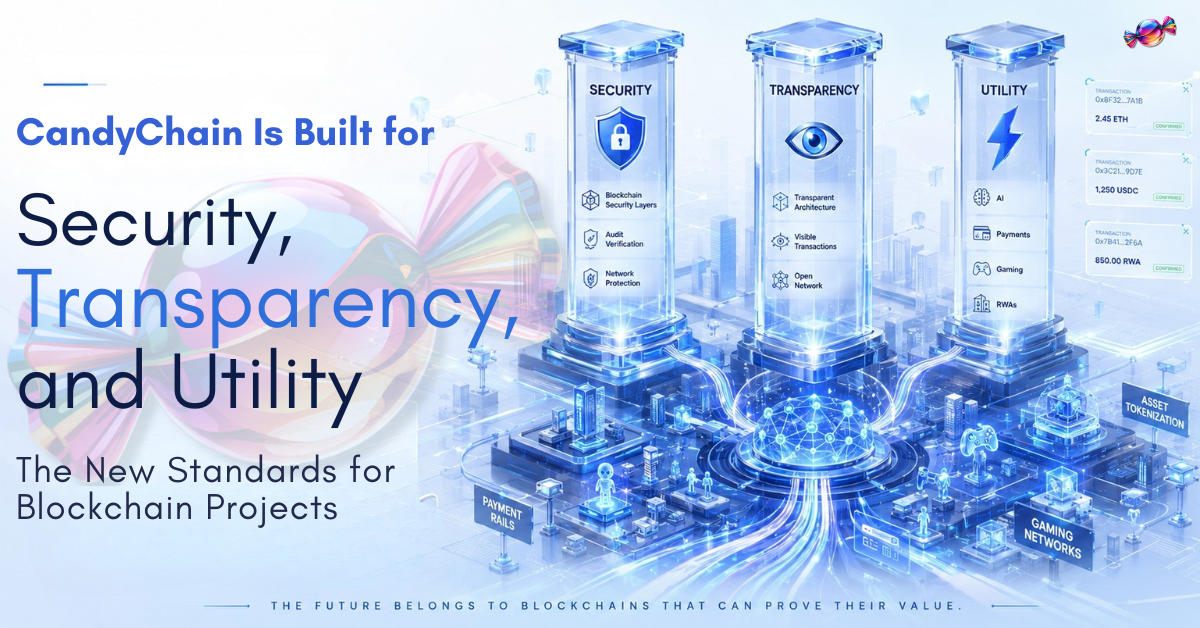
CandyChain is an AI-integrated Layer-1 blockchain where transparency is architectural, not cosmetic. Every wallet balance, every transaction, every token mint event is publicly accessible in real time at streams.candychain.io. There is no shielded pool and no unverifiable state. Anyone running a node, checking the explorer, and curious about what’s happening on the network can see exactly what’s there. The whole process works not because the team says so, but because the chain is built that way.
The security audit being conducted by BlockShield Security Audits covers the full infrastructure stack, consensus protocol, node security, EVM layer, validator economics, and network topology. The full report will be published in Q3 2026 and will be independently verifiable through BlockShield’s own publications when it does.
This is precisely the kind of infrastructure disclosure the Zcash episode taught the market to demand. Not reassurance. Evidence.
An Ecosystem Built on Activity, Not Assumptions
Products are already running in their Beta phase on CandyChain, and every interaction generates verifiable on-chain data. CandyBet processes real prediction market bets and returns 1% cashback on every wager, regardless of outcome, making it structurally different from every other prediction market operating today. CandyRush mints RUSH tokens directly to user wallets in real time through gameplay, actual blockchain assets, not platform credits. CandySwap handles DEX trading natively. CANDY Pulse delivers market intelligence, and Candy Vault takes care of RWA tokenisation.
Their collaboration with Cardaxo connects on-chain earnings to a virtual crypto card that works anywhere in the physical world.
The cherry on top of the cake is CandyAgent, which will be launching in Q3 2026. They are proposed autonomous AI agents with their own wallets earning CANDY continuously across prediction, yield, and trading functions around the clock. In a market that just watched AI-assisted analysis expose a four-year-old blockchain flaw, the arrival of AI-native infrastructure with full on-chain transparency carries a different kind of weight.
The Presale That Doesn’t Ask You to Look Away
The CANDY Coin pre-seed is live at $0.0004 per coin, against a target DEX listing price of $0.0100. Four structured rounds, 25x between current entry and listing target, with the pre-seed as the only active round. First 500 participants receive a 20% bonus, 10% Early Bird stacked with 10% Referral, plus a free Cardaxo Virtual Card. Vesting is 10% at TGE, the remainder releasing linearly over 18 months with no cliff.
The Zcash saga didn’t damage crypto. It educated it. Investors who came out the other side of that week are asking better questions, about verifiability, about audits, about what “transparent” actually means when the pressure is on.
CandyChain has straightforward answers to all of them.
For informational purposes only. Not financial advice. Always conduct your own research before investing.
Disclaimer: The information provided is not trading advice, Bitcoinworld.co.in holds no liability for any investments made based on the information provided on this page. We strongly recommend independent research and/or consultation with a qualified professional before making any investment decisions.
