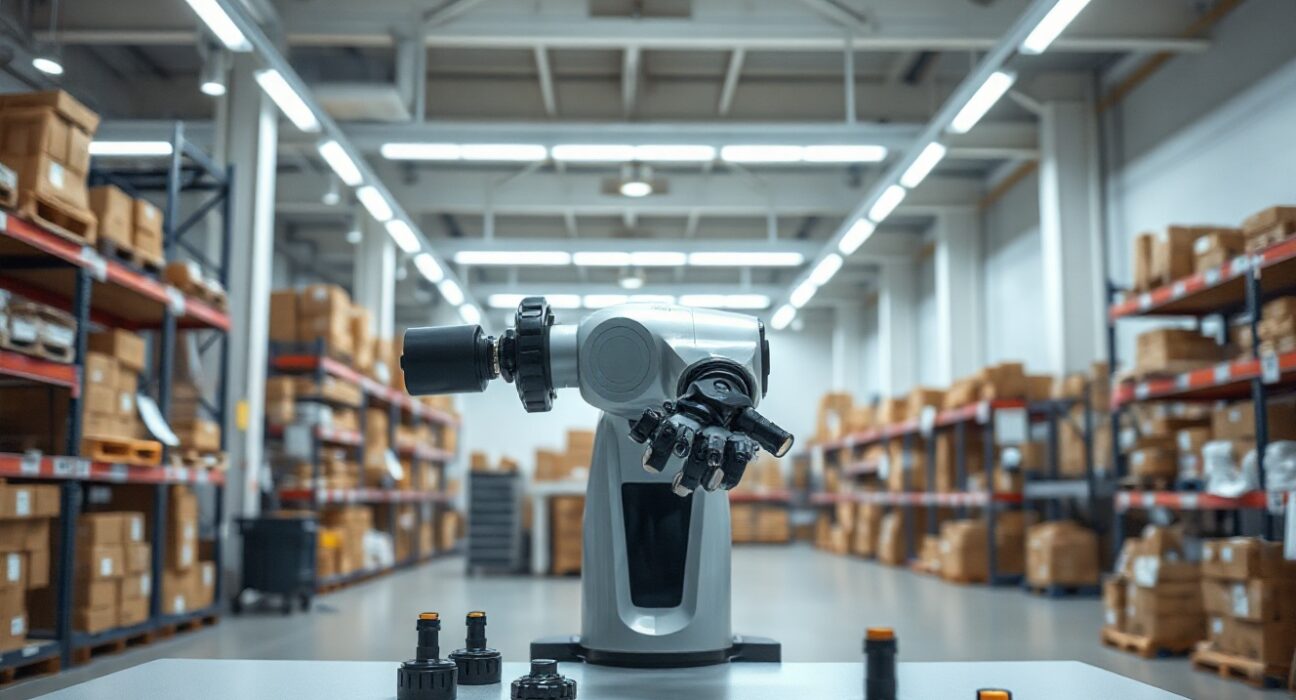
Humanoid robots may still be years away from replacing factory workers on a large scale, but the manufacturing industry is not waiting. Facing persistent labor shortages and rising demand for flexibility, manufacturers are turning to startups that promise a different kind of automation — one that adapts to the task, rather than the other way around.
That is the core bet behind Theker, a Barcelona-based AI robotics startup that has just raised $85 million in what it calls Europe’s largest ever robotics Series A round. The company’s approach is deliberately generalist: instead of building robots trained for a single, repetitive action, Theker designs machines that can be physically reconfigured — swapping out hands, arms, or entire form factors — depending on whether the job involves sorting packages, packing clothing, or handling bottles and cans in a warehouse.
“If you always have to put the same cookie in the same box, that works perfectly, but most processes aren’t like that,” co-founder Carla Gómez Cano told Bitcoin World. Theker is built for that messier reality.
A generalist approach to industrial robotics
Unlike humanoid robots from companies like Boston Dynamics, which are designed around a fixed physical form, Theker’s machines are modular. Their structure can be resized or reconfigured depending on the task at hand. This flexibility is intended to address a long-standing limitation in factory automation: traditional robots are highly efficient at one task, but expensive and difficult to repurpose.
Theker’s early backers signal where its ambitions begin. Inditex, the parent company of Zara, has signed on as an early customer. But the startup’s broader goal is to move beyond retail logistics into heavier industrial settings like manufacturing, where the complexity and scale of manual tasks is even greater.
The Series A round was led by American venture capital firm CRV and includes strategic investors such as Samsung and Aglaé Ventures, the investment vehicle tied to LVMH chairman Bernard Arnault. Gómez Cano said Samsung is not yet a customer, but the two are in advanced discussions. She noted that having Samsung as a customer, supplier, and investor simultaneously would give Theker both revenue and credibility in manufacturing at scale.
From pilots to real deployments
Gómez Cano emphasized that Theker was not built to run pilots. “We skip innovation departments entirely and go straight to logistics or operations, where deals are real and timelines are shorter,” she said. To demonstrate delivery capability, the company has opened a showroom in central Barcelona and plans to open others across Europe, the U.S., and Asia.
Theker will also grow its headcount across technology, deployment, and sales. The company has already received 15,000 job applications. “We have to filter like crazy,” Gómez Cano said. She estimated the team could grow from dozens to up to 120 people by the end of the year, then added: “I am saying that, but I also said that we’d raise $30 or $40 million!”
That the startup raised more than double its initial target also reinforces its conviction to remain headquartered in Barcelona, a growing robotics hub. “It has never been a barrier to acceleration for us, so we are making the most of it,” Gómez Cano said.
Why this matters for manufacturing
Theker’s funding round is one of the largest ever for a European robotics startup, and it reflects a broader shift in industrial automation. Manufacturers are increasingly looking for flexible solutions that can adapt to changing production lines and product mixes, rather than investing in highly specialized machines that become obsolete when processes change.
If Theker can deliver on its promise of reconfigurable, generalist robots, it could help accelerate automation in industries that have been difficult to mechanize — particularly those involving varied, non-repetitive tasks. That would be a significant step beyond the current state of factory robotics, where most machines are still trained for a single purpose.
Conclusion
Theker’s $85 million Series A is a strong signal that investors believe the future of factory automation lies in flexibility, not specialization. With backing from Inditex, Samsung, and LVMH’s investment arm, the startup has both the capital and the strategic partnerships to scale. Whether it can deliver on its ambitious vision — moving from retail logistics into heavy manufacturing — will be the key question in the years ahead.
FAQs
Q1: What makes Theker’s robots different from traditional factory robots?
A1: Theker’s robots are modular and reconfigurable. Their hands, arms, and overall form can be swapped out or resized depending on the task, unlike traditional robots that are designed for a single, repetitive action.
Q2: Who are Theker’s main investors and customers?
A2: The Series A was led by CRV and includes Samsung and Aglaé Ventures (LVMH). Inditex (Zara’s parent company) is an early customer. Samsung is in advanced discussions to potentially become a customer as well.
Q3: Where is Theker based and what are its expansion plans?
A3: Theker is headquartered in Barcelona, Spain. It plans to open additional showrooms across Europe, the U.S., and Asia, and grow its team to up to 120 people by the end of the year.
Disclaimer: The information provided is not trading advice, Bitcoinworld.co.in holds no liability for any investments made based on the information provided on this page. We strongly recommend independent research and/or consultation with a qualified professional before making any investment decisions.