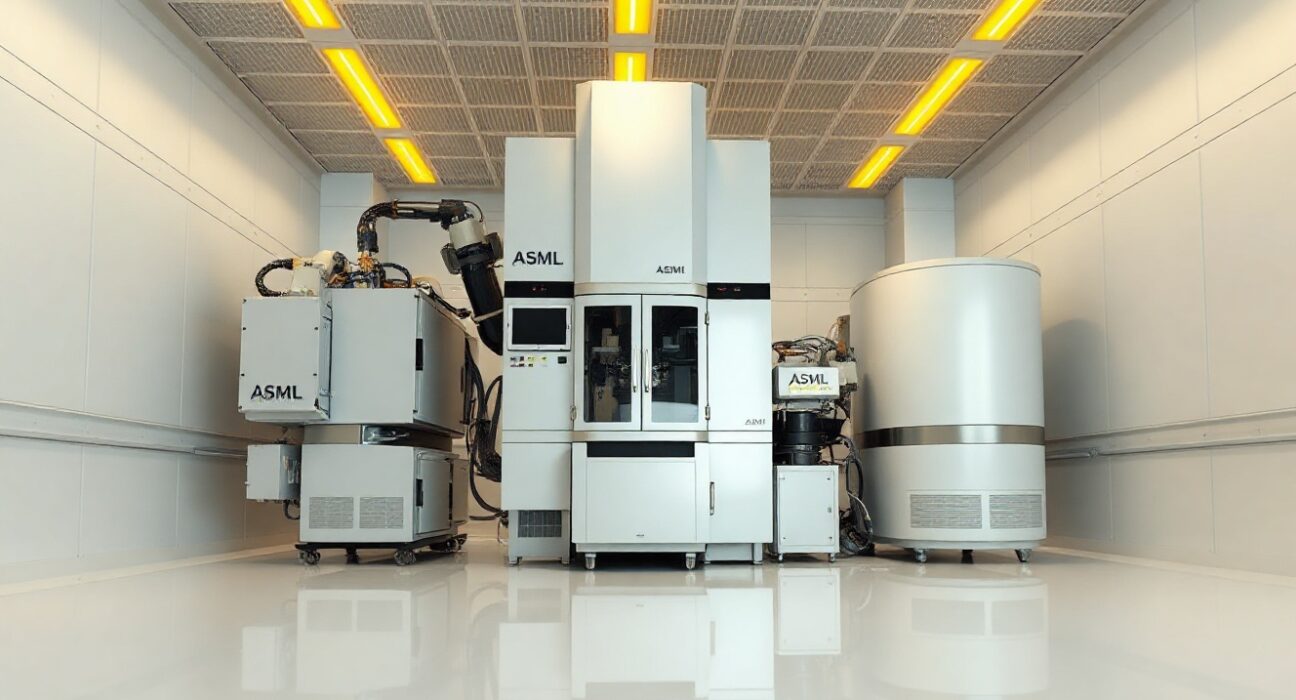
The Biden administration has made a serious allegation against Dutch chip equipment giant ASML, claiming its most advanced extreme ultraviolet (EUV) lithography machine may have ended up in China — a move that would represent a catastrophic breach of export controls in place since 2020. U.S. Commerce Secretary Howard Lutnick has reportedly raised the concern directly with ASML executives in recent meetings, according to Bloomberg, citing unnamed senior administration officials. ASML, the world’s sole supplier of EUV machines, categorically denies the claim.
The Core Allegation and the Denial
Bloomberg reports that Lutnick and his team believe they have evidence that ASML shipped EUV-related components and transport equipment to China, though they have repeatedly declined to show this evidence — either to Bloomberg or to ASML itself. The Commerce Department did not respond to Bloomberg’s requests for comment on whether it has proof of a complete EUV system on Chinese soil. ASML says no such machine exists in China and has never existed there. The company tracks every machine it has ever shipped, CEO Christophe Fouquet told this publication in an interview six weeks ago. He stated that all EUV systems are either in active use with monitored customers or have been dismantled and returned to ASML.
Why This Matters Beyond the Chip Industry
ASML is not a household name, but it is arguably the most important company in the global AI buildout after Nvidia. Its EUV machines are the only tools on Earth capable of printing the microscopic circuit patterns that define the most advanced semiconductors — the chips that power everything from Apple’s iPhones to Nvidia’s AI accelerators. Every cutting-edge processor made by TSMC depends on ASML’s EUV technology, which took the company roughly two decades and billions of dollars to develop. There is no second supplier. If even one EUV machine made it into Chinese hands, it would represent one of the most consequential breaches of the export-control regime the U.S. has built to keep advanced AI capability out of Beijing’s military and industrial base.
ASML’s Internal Safeguards and Commercial Logic
Fouquet described a robust internal firewall: employees who can access EUV technology, documentation, and training are walled off from those who cannot, and ASML’s China-based staff sit on the wrong side of that wall by design. He argued that reverse-engineering an EUV machine is practically impossible without decades of prior knowledge — knowledge that no Chinese entity has had access to. There is also a strong commercial incentive for ASML to comply. The company expects roughly 20% of its 2026 revenue to come from already-permitted sales of older deep ultraviolet (DUV) tools to China. Risking the EUV ban entirely would put that revenue — and the company’s standing as Europe’s most valuable public company, with a market cap near $700 billion — on the line over a single illegal sale.
The Political and Competitive Landscape
The timing of the allegation is notable. The Commerce Department, under Lutnick’s leadership, agreed late last year to put up to $150 million of taxpayer money into xLight, a startup developing a next-generation light-source technology that has been described as a potential long-term challenge to ASML’s EUV monopoly. xLight’s CEO told this publication last year that the company sees itself as a future partner, not a rival, building hardware meant to plug into ASML’s machines. Separately, Peter Thiel — who has ties to Trump’s political orbit — has backed Substrate, a startup explicitly pursuing its own EUV-rival technology. A bipartisan bill moving through Congress would go further, calling for an effective ban on all ASML DUV shipments to China, which account for roughly a fifth of the company’s expected 2026 revenue. The bill cleared a key committee in April, and the Trump administration has not taken a formal position.
Conclusion
None of this proves the allegations are false. The U.S. government has not yet made its evidence public, and it is worth withholding judgment until it does. But the dispute underscores the high stakes of the global semiconductor race, the immense value of ASML’s monopoly, and the complex interplay between export controls, industrial policy, and competitive dynamics. For now, the claim remains unsubstantiated, and ASML’s denial stands on firm commercial and operational logic.
FAQs
Q1: What is an EUV lithography machine?
An extreme ultraviolet (EUV) lithography machine is the only tool capable of printing the most advanced semiconductor circuit patterns. It is essential for manufacturing cutting-edge chips used in AI, smartphones, and high-performance computing. ASML is the world’s sole supplier.
Q2: Why would an EUV machine in China be a major breach?
Export controls have barred ASML from selling EUV machines to China since 2020, under both the Trump and Biden administrations. Such a transfer would give China access to the most advanced chipmaking technology, potentially accelerating its military and AI capabilities.
Q3: What evidence does the U.S. have?
The Commerce Department has not made its evidence public. Officials claim to have evidence of EUV-related components and transport equipment being shipped to China, but they have declined to show it to ASML or to journalists. ASML denies any breach.
Disclaimer: The information provided is not trading advice, Bitcoinworld.co.in holds no liability for any investments made based on the information provided on this page. We strongly recommend independent research and/or consultation with a qualified professional before making any investment decisions.