
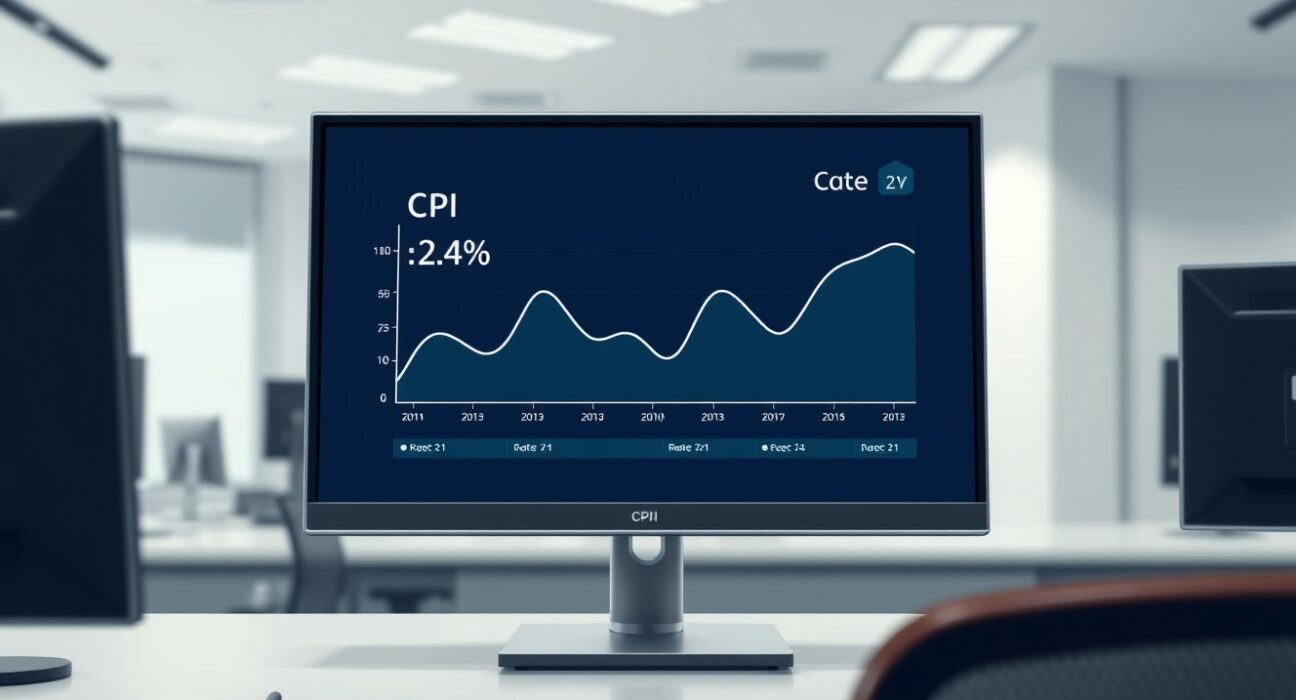
WASHINGTON, D.C. – March 12, 2025 – The U.S. Bureau of Labor Statistics reported today that the Consumer Price Index (CPI) held steady at an annual rate of 2.4% in February, precisely matching economist forecasts and providing a crucial signal of economic stability. This pivotal US CPI inflation data arrives as the Federal Reserve weighs its next move on interest rates, offering markets a moment of predictable calm after years of volatility.
US CPI Inflation Data Reveals Underlying Stability
The February Consumer Price Index report confirms a period of remarkable consistency. Consequently, the headline inflation figure of 2.4% marks the third consecutive month within a narrow 2.3% to 2.5% band. This stability follows the turbulent inflationary period of the early 2020s. Analysts immediately scrutinized the core CPI measure, which excludes volatile food and energy prices. Notably, core inflation also remained anchored at 2.8% year-over-year. This persistent gap between headline and core rates suggests underlying price pressures are moderating gradually, yet some stickiness remains in service-sector costs.
Market participants welcomed the data’s alignment with expectations. Furthermore, the report’s details showed a mixed picture across categories. For instance, shelter costs continued their slow deceleration, rising 4.1% annually compared to 4.3% in January. Meanwhile, energy prices provided a modest disinflationary push, declining 0.8% over the month. Key contributors to the steady rate included:
- Shelter Inflation: The slowest annual increase since mid-2023.
- Food Prices: Rose a modest 0.2% monthly, showing supply chain normalization.
- Used Vehicles: Prices fell 1.2%, continuing a nine-month deflationary trend.
- Apparel: Increased 0.5%, reflecting seasonal adjustments.
Federal Reserve Policy Implications and Market Reaction
The Federal Reserve now faces a critical juncture. This steady inflation print likely reinforces the central bank’s patient stance. Officials have repeatedly emphasized the need for sustained evidence before considering rate cuts. Therefore, the February data supports a “higher for longer” narrative, at least for the immediate future. Financial markets reacted with measured optimism. Treasury yields edged slightly lower, while equity futures indicated a positive open. The CME FedWatch Tool, a key gauge of market expectations, showed a slight increase in the probability of a June rate cut, though a July move remains the consensus.
Historical context is essential here. The current 2.4% rate sits comfortably above the Fed’s longstanding 2% target but represents a monumental decline from the 9.1% peak witnessed in June 2022. This disinflationary journey, while successful, has entered its most challenging phase—the “last mile.” Economists note that squeezing out the final percentage points often requires persistent tight monetary policy.
Expert Analysis on the Inflation Trajectory
Leading economists point to wage growth and housing metrics as the final hurdles. “The labor market remains robust, and wage growth, while cooling, still runs above 4%,” notes Dr. Anya Sharma, Chief Economist at the Brookings Institution. “This creates inherent inflationary pressure in services, which are labor-intensive. The Fed will want clear signs that wage growth is converging with productivity trends before declaring victory.”
Simultaneously, housing inflation, a major CPI component, exhibits a significant lag. Real-time measures of new rental leases show much cooler growth than the CPI’s shelter index captures. This suggests a further deceleration in shelter costs will materialize in CPI data over the next 6-12 months, providing a natural disinflationary tailwind. The table below summarizes key CPI components and their trends:
| CPI Component | Monthly Change (Feb) | Annual Change (Feb) | Trend |
|---|---|---|---|
| All Items | +0.3% | +2.4% | Steady |
| Core (ex Food & Energy) | +0.3% | +2.8% | Sticky |
| Shelter | +0.4% | +4.1% | Decelerating |
| Energy | -0.8% | -2.1% | Declining |
| Food at Home | +0.2% | +1.5% | Moderate |
Broader Economic Impact and Global Context
Steady US inflation carries significant implications for the global economy. The U.S. dollar serves as the world’s primary reserve currency. Therefore, predictable American monetary policy reduces volatility in international capital flows. Major trading partners and emerging markets particularly benefit from this stability. It allows their central banks greater policy flexibility without fearing sudden, destabilizing currency moves triggered by a shifting Fed.
Domestically, consumers are experiencing a gradual improvement in purchasing power. Real average hourly earnings, adjusted for CPI inflation, have shown positive growth for five consecutive months. This marks a meaningful shift after a prolonged period where price rises outstripped wage gains. However, sentiment remains cautious. Many households still feel the cumulative pinch of high prices over the past three years, particularly for essentials like groceries and housing.
Business investment decisions also hinge on this stability. Corporate planners require predictable input costs and financing rates to commit to long-term projects. The February CPI report, by meeting forecasts, reduces one major source of uncertainty. Consequently, we may see a modest uptick in capital expenditure plans in sectors sensitive to interest rates, such as manufacturing and construction.
The Path Forward for Monetary Policy
The Federal Open Market Committee (FOMC) meets next on March 18-19. Analysts universally expect the Fed to hold the federal funds rate steady at its current 5.25%-5.50% range. The focus will be entirely on the updated “dot plot” of rate projections and Chair Jerome Powell’s press conference. The central question is whether officials will maintain their median forecast for three rate cuts in 2025 or signal a more cautious, delayed timeline given the persistent core inflation.
Powell has consistently framed the decision as data-dependent. The February CPI report provides one clear data point of stability, but not a decisive all-clear signal. The Fed will require several more months of similar reports, coupled with softer labor market data, to gain the confidence needed to initiate an easing cycle. The risk of cutting rates prematurely and reigniting inflation is currently judged as greater than the risk of keeping policy tight for slightly too long.
Conclusion
The February US CPI inflation report delivers a message of controlled stability. Holding steady at 2.4%, the data aligns perfectly with forecasts and suggests the economy is navigating the final, delicate phase of disinflation. This outcome supports the Federal Reserve’s patient approach, giving policymakers more time to assess incoming data before adjusting interest rates. For markets and consumers, steady inflation provides a foundation for planning, though vigilance remains essential. The journey back to the Fed’s 2% target continues, with the February figures representing a firm and predictable step along that path.
FAQs
Q1: What does it mean that CPI inflation “held steady” at 2.4%?
The annual inflation rate did not increase or decrease from the previous month’s reading. It remained at 2.4%, indicating a pause in the disinflationary trend and suggesting price pressures are currently in equilibrium.
Q2: How does this inflation report affect the likelihood of Federal Reserve rate cuts?
It reinforces the Fed’s cautious stance. Because inflation remains above the 2% target and showed no further decline, it makes an immediate rate cut less likely. The Fed will likely wait for more consistent evidence of cooling, pushing potential cuts to mid-2025 or later.
Q3: What is the difference between headline CPI and core CPI mentioned in the report?
Headline CPI includes all categories, including volatile food and energy prices. Core CPI excludes these items to provide a clearer view of underlying, persistent inflation trends. In February, headline was 2.4%, while core was higher at 2.8%.
Q4: Why is shelter inflation still high, and when will it come down?
Shelter inflation in the CPI lags real-time market rents by 12-18 months. Current data on new leases shows much slower growth, meaning the shelter component in CPI should gradually decelerate throughout 2025, pulling overall inflation lower.
Q5: How does steady U.S. inflation impact the average consumer?
It provides predictability. Wages are now growing slightly faster than prices, improving real purchasing power. However, consumers are not yet feeling full relief because the cumulative price level is still much higher than it was three years ago, especially for housing and groceries.
Disclaimer: The information provided is not trading advice, Bitcoinworld.co.in holds no liability for any investments made based on the information provided on this page. We strongly recommend independent research and/or consultation with a qualified professional before making any investment decisions.