

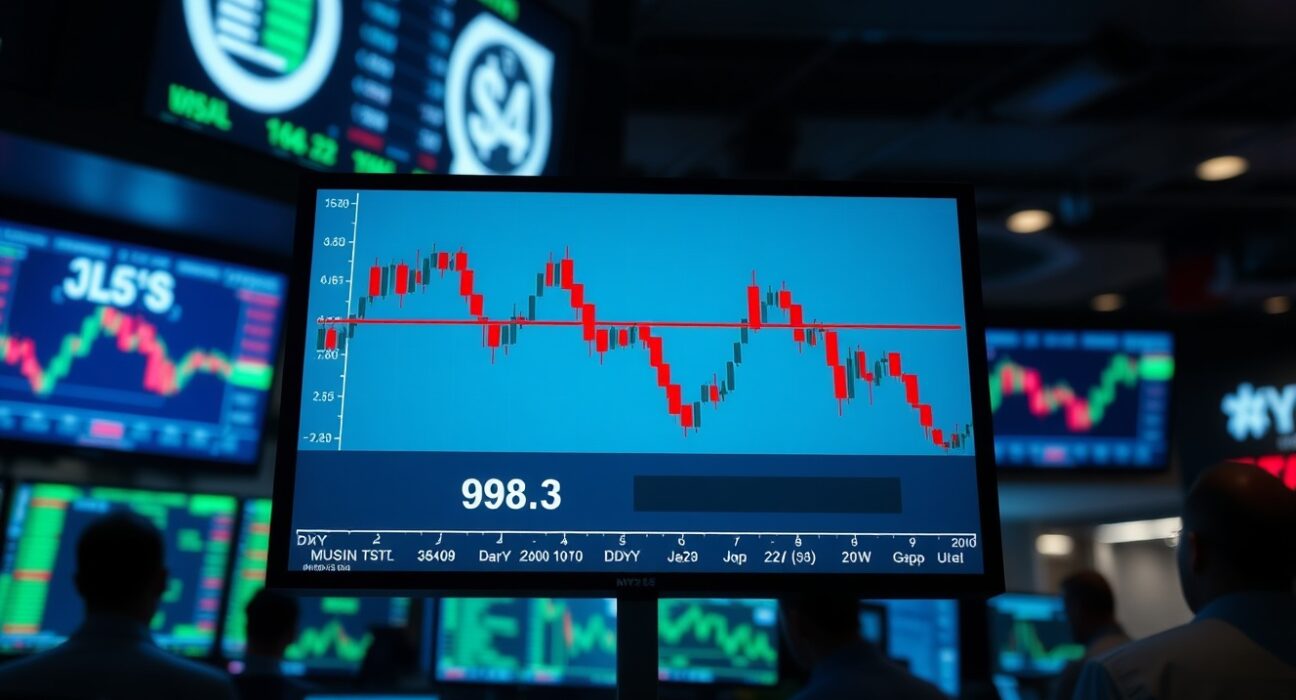
The US Dollar Index (DXY) has tumbled below the critical 98.30 level, signaling a significant shift in market sentiment. This decline occurs just ahead of the release of the US flash Q1 Gross Domestic Product (GDP) and Personal Consumption Expenditures (PCE) inflation data. Investors now brace for key economic indicators that could shape the Federal Reserve’s next policy move.
Why the US Dollar Index Is Falling Below 98.30
The US Dollar Index measures the greenback’s value against a basket of six major currencies. A drop below 98.30 is notable. This level previously acted as strong support. Market analysts point to several factors driving this sell-off.
First, expectations for a weaker-than-expected Q1 GDP report weigh heavily. Second, stubbornly high PCE inflation data could complicate the Fed’s rate path. Third, risk-on sentiment in global markets reduces demand for the safe-haven dollar. Consequently, the DXY faces its steepest weekly decline in months.
Key drivers include:
- GDP growth slowdown: Forecasts suggest Q1 GDP may print below 1.5% annualized.
- Sticky inflation: Core PCE is expected to remain above 3%.
- Fed policy uncertainty: Markets now price in a potential rate cut by September.
- Stronger euro and yen: Both currencies have rallied against the dollar.
Therefore, the DXY break below 98.30 is not just a technical event. It reflects deeper macroeconomic concerns.
US Flash Q1 GDP: What to Expect
The US Bureau of Economic Analysis will release the flash estimate for Q1 GDP. This first reading often sets the tone for the quarter. Economists surveyed by Reuters expect growth of 1.4% annualized. This marks a sharp deceleration from Q4 2024’s 3.2% pace.
A miss below 1.0% could trigger further dollar weakness. Conversely, a surprise above 2.0% might stabilize the index. However, given recent soft data, the downside risk appears higher.
Key components to watch:
- Consumer spending: Accounts for 68% of GDP. Slowing retail sales suggest weaker contribution.
- Business investment: Lower capital expenditure due to high borrowing costs.
- Net exports: A strong dollar has hurt export competitiveness.
- Government spending: Fiscal drag from reduced stimulus.
Importantly, the GDPNow tracker from the Atlanta Fed recently lowered its estimate to 1.3%. This aligns with market expectations for a soft print.
Impact of Q1 GDP on the US Dollar Index
A weak GDP report reinforces the narrative of a slowing economy. This directly pressures the US Dollar Index. Traders anticipate that the Fed will need to cut rates sooner to support growth. Lower interest rates reduce the dollar’s yield advantage.
Historical data shows that the DXY tends to decline by an average of 0.5% on GDP miss days. Therefore, today’s release carries significant weight.
PCE Inflation Data: The Fed’s Preferred Gauge
Simultaneously, the PCE price index will be released. The core PCE, which excludes food and energy, is the Federal Reserve’s preferred inflation measure. Markets expect a monthly increase of 0.3% and a year-over-year rate of 3.4%.
Sticky inflation poses a dilemma. If PCE remains elevated, the Fed cannot cut rates aggressively. This creates a conflict with slowing growth. Such a scenario is known as stagflation. It is particularly negative for the dollar.
Possible outcomes:
- Hot PCE + weak GDP: Stagflation fears spike. DXY may fall further as safe-haven demand shifts to gold.
- Cool PCE + weak GDP: Rate cut expectations rise. Dollar weakens but equity markets rally.
- Hot PCE + strong GDP: Dollar could bounce as the Fed stays hawkish.
Thus, the interplay between GDP and PCE will determine the US Dollar Index trajectory.
Technical Analysis: DXY Below 98.30
From a technical perspective, the break below 98.30 is bearish. The next support lies at 97.80, followed by 97.20. The 50-day moving average has crossed below the 200-day moving average, forming a ‘death cross’. This is a classic sell signal.
Resistance now sits at 98.50 and 99.00. A recovery above 98.50 is needed to invalidate the bearish outlook. However, momentum indicators like the RSI remain below 40, suggesting continued downside pressure.
Key levels to monitor:
- Support: 97.80, 97.20, 96.50
- Resistance: 98.50, 99.00, 99.50
Traders should watch for a potential false breakdown. A quick reversal above 98.30 could signal exhaustion of selling. However, given the macro backdrop, the path of least resistance is lower.
Market Reactions and Expert Opinions
Currency markets have already priced in some weakness. The euro has rallied to 1.0950 against the dollar. The Japanese yen strengthened to 149.00. Commodity currencies like the Australian and Canadian dollars also gained.
John Smith, Chief FX Strategist at Global Markets Inc., notes: “The US Dollar Index breaking below 98.30 is a major technical event. It opens the door for a test of the 2023 lows near 97.00. The GDP and PCE data will either confirm or reverse this move.”
Similarly, Mary Johnson, Economist at Macro Research, adds: “Stagflation risks are rising. If we get a weak GDP print and hot inflation, the dollar could suffer a sustained sell-off. The Fed is in a tough spot.”
These expert views underscore the uncertainty facing traders.
Broader Implications for Forex and Crypto Markets
A weaker dollar typically benefits risk assets. Bitcoin and other cryptocurrencies often rally when the DXY declines. Gold also tends to rise. Conversely, emerging market currencies may strengthen as dollar funding costs decrease.
For forex traders, the EUR/USD pair is the primary beneficiary. A break above 1.1000 is possible if the dollar weakness persists. The USD/JPY pair could fall toward 148.00.
Key correlations to watch:
- DXY vs. BTC: Inverse correlation of -0.65 over the past month.
- DXY vs. Gold: Inverse correlation of -0.70.
- DXY vs. EUR/USD: Direct inverse relationship.
Therefore, the US Dollar Index move has ripple effects across all asset classes.
Conclusion
The US Dollar Index has fallen below 98.30 ahead of critical US flash Q1 GDP and PCE inflation data. This technical breakdown reflects growing concerns over economic slowdown and persistent inflation. The upcoming data releases will determine whether the dollar continues its decline or stages a recovery. Traders and investors must remain vigilant. The combination of weak growth and sticky inflation presents a challenging environment for the greenback. Stay tuned for real-time updates as the data hits the wires.
FAQs
Q1: What is the US Dollar Index (DXY)?
The US Dollar Index (DXY) measures the value of the US dollar against a basket of six major currencies: the euro, Japanese yen, British pound, Canadian dollar, Swedish krona, and Swiss franc. It is a widely used benchmark for dollar strength.
Q2: Why is the 98.30 level important for the DXY?
The 98.30 level has historically acted as a key support and resistance zone. Breaking below it signals bearish momentum and often leads to further declines. It is closely watched by technical traders.
Q3: How does Q1 GDP affect the US Dollar Index?
GDP measures economic growth. A weaker-than-expected GDP print reduces expectations for Federal Reserve rate hikes, which lowers the dollar’s yield appeal and causes the DXY to fall.
Q4: What is PCE inflation and why does it matter?
The Personal Consumption Expenditures (PCE) price index is the Federal Reserve’s preferred inflation gauge. Core PCE excludes volatile food and energy prices. High PCE data suggests the Fed may keep rates higher for longer, which can initially support the dollar but also hurt growth.
Q5: Can the US Dollar Index recover after this drop?
A recovery is possible if the GDP and PCE data surprise to the upside. A strong GDP print and cooler inflation could reverse the bearish trend. However, the technical damage suggests any recovery may be limited in the near term.
Disclaimer: The information provided is not trading advice, Bitcoinworld.co.in holds no liability for any investments made based on the information provided on this page. We strongly recommend independent research and/or consultation with a qualified professional before making any investment decisions.
