
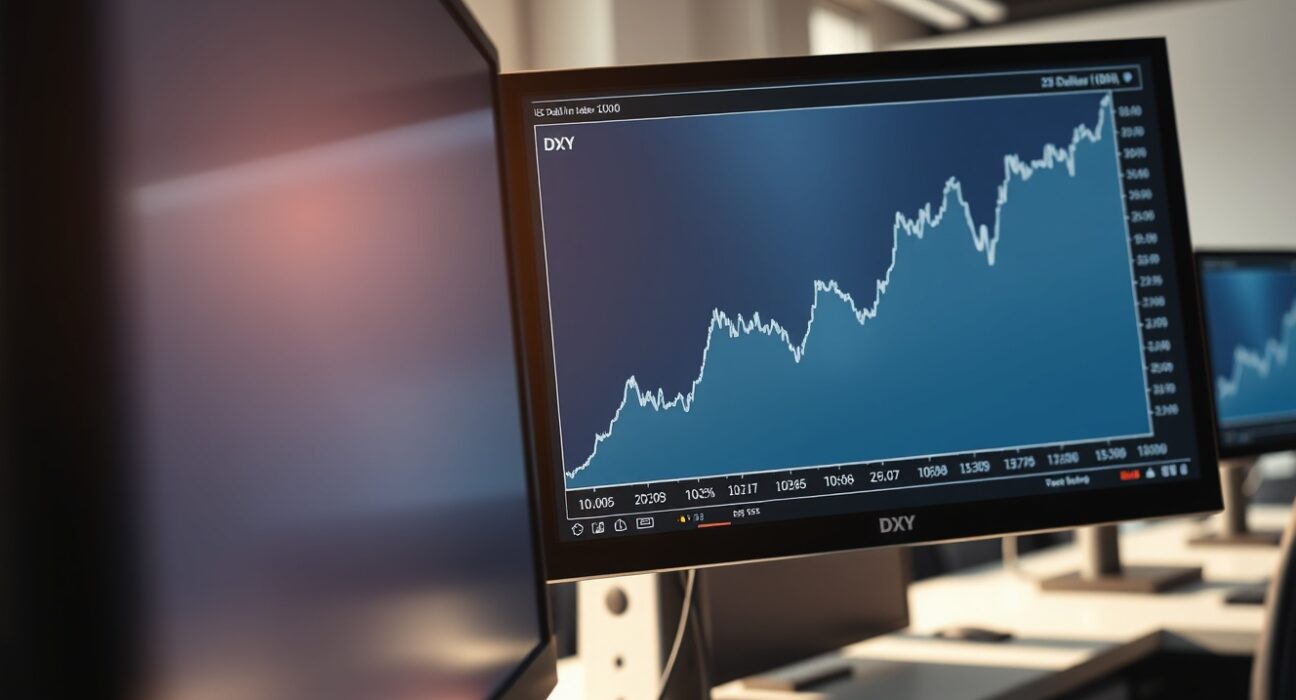
The US Dollar Index (DXY), a critical benchmark measuring the greenback’s strength against a basket of major currencies, has demonstrated significant resilience, climbing firmly toward the pivotal 100.00 psychological level. This notable ascent positions the index for a potential test of its year-to-date peak, with all market attention now laser-focused on the upcoming Federal Reserve policy meeting. Consequently, traders and analysts globally are scrutinizing every data point for clues on the future path of US interest rates.
US Dollar Index Technical Analysis and Price Forecast
Recent trading sessions have witnessed a sustained bullish momentum for the DXY. The index has successfully breached several key technical resistance levels, establishing a foundation for its current advance. Market technicians highlight the importance of the 100.00 handle, not just as a round number but as a zone that previously acted as both support and resistance throughout the year. A decisive break above this level could open the path toward the yearly high, a move that would signal broad-based dollar strength across the forex landscape. Furthermore, supporting moving averages have turned upward, adding confirmation to the current bullish structure.
Several key technical indicators currently align with this positive outlook. For instance, momentum oscillators remain in bullish territory, although some are approaching levels that may suggest a short-term consolidation. The price action itself, characterized by a series of higher highs and higher lows, defines the prevailing uptrend. Market participants are now evaluating whether this momentum can be sustained through the high-impact event risk posed by the Federal Open Market Committee (FOMC).
The Federal Reserve’s Pivotal Role in Currency Valuation
The primary catalyst behind the dollar’s recent fortitude is the shifting market expectation surrounding US monetary policy. The Federal Reserve maintains a dual mandate of price stability and maximum employment. With inflation data remaining persistently above the central bank’s 2% target, despite gradual cooling, the Fed’s communicated stance has remained cautiously hawkish. Investors are therefore pricing in a higher-for-longer interest rate environment compared to other major central banks, which directly boosts the dollar’s yield appeal.
This monetary policy divergence is a fundamental driver of forex flows. When the Fed signals a commitment to maintaining restrictive policy or delays projected rate cuts, it increases the relative attractiveness of US dollar-denominated assets. International capital tends to flow toward jurisdictions offering higher real returns, thereby increasing demand for the currency. The upcoming meeting is critical not only for the interest rate decision itself, which is widely expected to remain unchanged, but for the updated economic projections and the subsequent press conference by Chair Jerome Powell.
Expert Analysis on Market Positioning and Risks
Financial institutions and independent analysts provide crucial context for this move. “The dollar’s strength is fundamentally a reflection of relative economic resilience and monetary policy paths,” notes a senior strategist at a major global bank, referencing recent robust US jobs and retail sales data. “The market is positioning for a Fed that remains data-dependent but is in no rush to ease policy, especially while growth holds up.” This view is echoed across trading desks, where long-dollar positions have seen a noticeable increase in recent Commitment of Traders reports.
However, experts also caution about potential volatility and downside risks. The primary risk is a Fed communication perceived as more dovish than anticipated, perhaps emphasizing concerns about economic growth over inflation. Additionally, unexpected geopolitical developments or a sharp shift in global risk sentiment could trigger safe-haven flows that often benefit the dollar but in a more chaotic market environment. The table below summarizes the key factors influencing the DXY:
| Bullish Factors for DXY | Bearish Risks for DXY |
|---|---|
| Hawkish Fed policy expectations | Dovish Fed surprise |
| Strong relative US economic data | Unexpected US economic slowdown |
| Geopolitical uncertainty (safe-haven demand) | Rapid de-escalation of global tensions |
| Widening interest rate differentials | Aggressive policy tightening by other central banks |
Global Macroeconomic Context and Currency Impacts
The DXY’s trajectory does not occur in a vacuum. Its composition—weighted against the euro, Japanese yen, British pound, Canadian dollar, Swedish krona, and Swiss franc—means its strength reflects broad weakness in its counterparts. Recently, the euro has faced pressure from a stagnating Eurozone economy and a European Central Bank signaling a potential policy pivot. Simultaneously, the Japanese yen remains under stress due to the Bank of Japan’s ultra-accommodative stance, making it a primary funding currency.
This dynamic has real-world consequences. A stronger US Dollar Index makes:
- US exports more expensive, potentially hurting corporate earnings for multinational companies.
- Commodities priced in dollars (like oil and gold) more costly for foreign buyers, affecting global demand.
- Emerging market debt servicing more difficult, as many countries borrow in USD.
Therefore, the move toward 100.00 is monitored closely by policymakers and corporate treasurers worldwide, not just forex traders.
Conclusion
The US Dollar Index’s firm advance toward the 100.00 mark underscores a market consensus built on expectations of persistent Federal Reserve hawkishness and relative US economic outperformance. While technical analysis suggests a clear path toward testing the year-to-date peak, the immediate future hinges almost entirely on the nuance of the upcoming Fed communication. Traders should prepare for elevated volatility as the new projections and guidance are digested. Ultimately, the DXY’s ability to sustain levels at or above 100.00 will be a key barometer of global capital flows and monetary policy divergence for the remainder of the quarter.
FAQs
Q1: What is the US Dollar Index (DXY)?
The US Dollar Index is a geometrically weighted index that measures the value of the United States dollar relative to a basket of six major world currencies: the euro, Japanese yen, British pound, Canadian dollar, Swedish krona, and Swiss franc.
Q2: Why is the 100.00 level significant for the DXY?
The 100.00 level is a major psychological and technical benchmark. It represents a round number that often acts as a magnet for price action and has served as a key support and resistance zone throughout the index’s history, making a break above it a notable bullish signal.
Q3: How does Federal Reserve policy affect the US Dollar Index?
The Fed’s interest rate decisions and forward guidance directly influence the dollar’s yield attractiveness. Hawkish policy (higher rates, slower cuts) typically strengthens the DXY by attracting foreign investment into US assets, while dovish policy (lower rates, faster cuts) generally weakens it.
Q4: What are the main risks to the DXY’s current bullish forecast?
The primary risks include a Federal Reserve communication perceived as more dovish than expected, a sudden deterioration in US economic data, or a sharp shift in global risk sentiment that disrupts current capital flow patterns.
Q5: Who uses the US Dollar Index and why?
The DXY is used by forex traders, multinational corporations, investors, and policymakers to gauge the dollar’s overall strength, hedge currency exposure, inform international investment decisions, and understand the global macroeconomic environment.
Disclaimer: The information provided is not trading advice, Bitcoinworld.co.in holds no liability for any investments made based on the information provided on this page. We strongly recommend independent research and/or consultation with a qualified professional before making any investment decisions.