

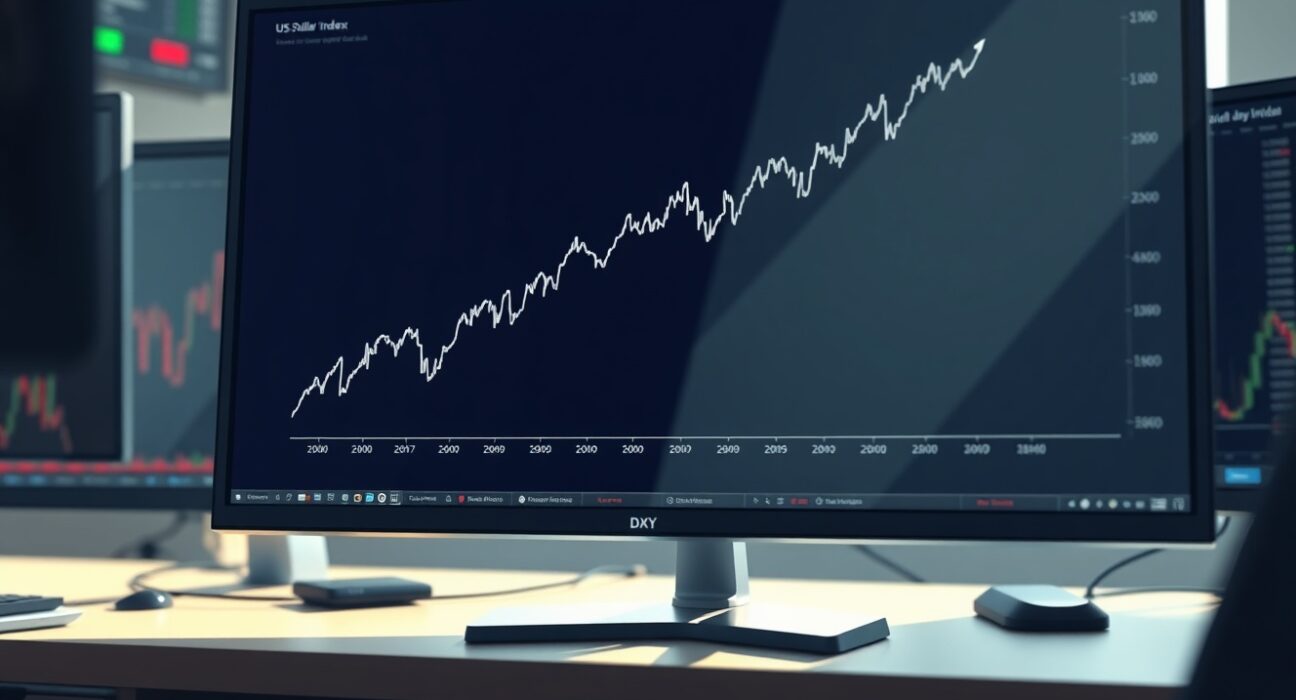
The US Dollar Index (DXY), a critical benchmark for the greenback’s strength, has recorded a third consecutive daily gain, marking a significant rally fueled by escalating global safe-haven demand. This sustained upward movement, clearly visible on intraday and daily charts, signals a profound shift in investor sentiment as market participants seek shelter in the world’s primary reserve currency. Consequently, analysts are closely monitoring technical levels and fundamental drivers behind this powerful trend.
US Dollar Index Charts Reveal Sustained Momentum
Technical analysis of the DXY chart shows a decisive breakout from recent consolidation. The index, which measures the dollar against a basket of six major currencies, has pushed above key resistance levels. Specifically, the 105.00 psychological barrier has been convincingly breached. Furthermore, moving averages are aligning bullishly, with the 50-day crossing above the 200-day, a pattern often interpreted as a “golden cross.” Daily trading volumes have also expanded significantly during this three-day ascent, confirming the strength behind the move. Market technicians note that the Relative Strength Index (RSI) is approaching overbought territory but has not yet signaled a reversal.
Key technical observations from the current DXY chart include:
- Breakout Confirmation: A clear close above the 105.50 level.
- Support Zone: Former resistance near 104.80 now acts as new support.
- Next Target: The November 2024 high of 106.20 is the immediate focus for bulls.
Drivers Behind the Safe-Haven Surge
Several interconnected factors are compelling investors to flock to the US dollar. Primarily, renewed geopolitical tensions in Eastern Europe and the South China Sea have unsettled global markets. Additionally, concerns over the pace of economic recovery in major economies outside the United States are prompting capital flight. The European Central Bank’s recent dovish stance, contrasted with the Federal Reserve’s data-dependent but vigilant posture, has widened the interest rate differential outlook. This monetary policy divergence makes dollar-denominated assets more attractive for yield-seeking capital.
Expert Analysis on Market Psychology
Financial strategists point to a classic “flight to quality” dynamic. “When uncertainty spikes, liquidity and safety become paramount,” notes Dr. Anya Sharma, Chief Economist at Global Macro Advisors. “The US Treasury market’s depth and the dollar’s role in global trade create a self-reinforcing cycle. As the dollar appreciates, it can pressure emerging market currencies and commodities, which in turn fuels further defensive positioning.” Historical data supports this view; during periods of market stress in 2020 and 2022, the DXY exhibited similar sharp rallies. Market sentiment indicators, like the CNN Fear & Greed Index, have recently shifted toward “fear,” correlating strongly with dollar strength.
Global Currency Market Impacts
The dollar’s strength exerts immediate pressure on its major counterparts. The euro (EUR/USD) has fallen to multi-week lows, testing the 1.0650 support level. Similarly, the Japanese yen (USD/JPY), often a safe-haven itself, has weakened past 152.00 as the Bank of Japan maintains its ultra-accommodative policy. Emerging market currencies face amplified pressure, increasing the cost of dollar-denominated debt servicing for many nations. Central banks in countries like South Korea and Indonesia have been observed intervening in forex markets to smooth volatility.
| Currency Pair | Change | Key Level Breached |
|---|---|---|
| EUR/USD | -1.8% | 1.0700 |
| GBP/USD | -1.5% | 1.2500 |
| USD/JPY | +2.1% | 152.00 |
| AUD/USD | -2.3% | 0.6500 |
Economic Implications and Forward Outlook
A stronger dollar has complex effects on the US and global economy. For the United States, it dampens inflation by making imports cheaper, which could influence the Federal Reserve’s policy timeline. However, it also makes US exports more expensive, potentially hurting corporate earnings for multinational companies. For the rest of the world, dollar strength tightens financial conditions, complicating efforts by other central banks to stimulate growth. The immediate forward path for the DXY depends heavily on incoming US inflation data and developments in global hotspots. If safe-haven demand persists, a test of the 107.00 level is plausible. Conversely, a de-escalation in geopolitical risks could trigger a sharp retracement as investors rotate back into risk assets.
Conclusion
The US Dollar Index’s three-day rally is a clear technical and fundamental response to heightened global risk aversion. Chart patterns confirm strong bullish momentum, while underlying drivers like geopolitical tension and monetary policy divergence provide the fundamental fuel. This surge in safe-haven demand for the dollar has wide-ranging consequences for currency pairs, global trade, and central bank policies. Market participants will now watch for either a consolidation of these gains or a catalyst that could unwind this defensive positioning.
FAQs
Q1: What is the US Dollar Index (DXY)?
The US Dollar Index is a measure of the value of the United States dollar relative to a basket of six major world currencies: the euro, Japanese yen, British pound, Canadian dollar, Swedish krona, and Swiss franc. It provides a broad indicator of the dollar’s international strength.
Q2: Why is the dollar considered a safe-haven asset?
The US dollar is considered a safe haven due to the size and stability of the US economy, the depth and liquidity of US financial markets (especially Treasury bonds), its role as the world’s primary reserve currency for trade and central bank holdings, and the perception of the United States as a politically stable entity.
Q3: How does a rising DXY affect the average American?
A stronger dollar can mean lower prices for imported goods, potentially easing inflation. It also makes foreign travel and buying foreign products cheaper. On the downside, it can hurt US companies that rely on exports by making their goods more expensive for foreign buyers, which could impact domestic employment in those sectors.
Q4: What are the main risks that could reverse this dollar rally?
A sudden de-escalation of geopolitical conflicts, a surprisingly dovish shift in Federal Reserve policy signals, or stronger-than-expected economic data from Europe or China could reduce safe-haven demand and weaken the dollar. A sharp decline in US equity markets might also see some unwinding of dollar-funded carry trades.
Q5: How do traders use the DXY chart?
Traders use the DXY chart to identify trends, support and resistance levels, and momentum signals for the overall dollar. It helps inform trades in individual currency pairs (like EUR/USD) and acts as a macro indicator for global risk sentiment. Breakouts above key levels, like the recent move past 105.00, are watched closely for confirmation of trend strength.
Disclaimer: The information provided is not trading advice, Bitcoinworld.co.in holds no liability for any investments made based on the information provided on this page. We strongly recommend independent research and/or consultation with a qualified professional before making any investment decisions.
