

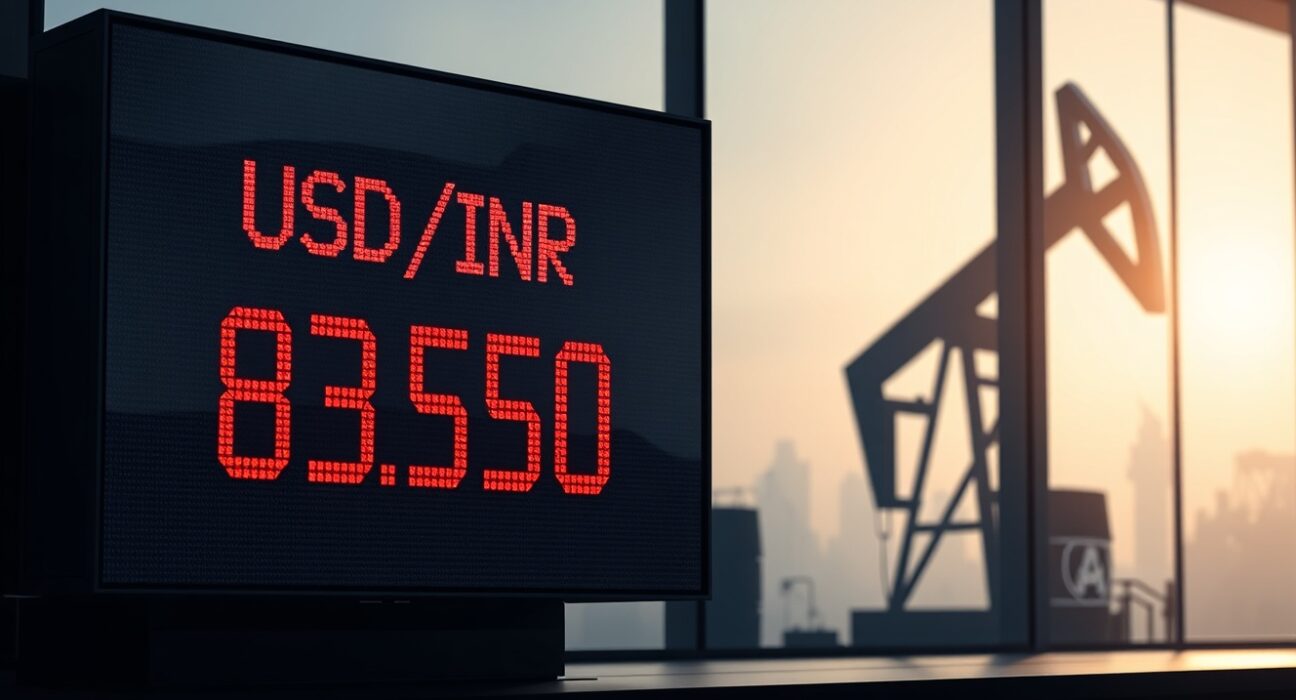
The Indian Rupee continues to face headwinds as the USD/INR pair remains firm, driven primarily by the relentless rise in global crude oil prices. This persistent pressure underscores a critical challenge for India’s import-dependent economy, where every dollar increase in oil prices widens the trade deficit and weakens the domestic currency. Traders and analysts now closely watch the Reserve Bank of India’s (RBI) next move as the currency tests key resistance levels.
USD/INR Stays Elevated Amid Crude Oil Surge
The USD/INR exchange rate has held steady above the 83.50 mark for consecutive sessions. This stability, however, masks the underlying stress on the Indian Rupee. Higher oil prices directly increase India’s import bill, as the country meets over 85% of its crude oil needs through foreign purchases. Consequently, demand for US dollars rises, pushing the USD/INR pair higher.
Market participants report that the RBI’s frequent intervention through state-run banks has prevented a sharper depreciation. The central bank sells dollars in the forward and spot markets to provide liquidity and curb volatility. Yet, this intervention only offers temporary relief. The fundamental pressure from oil remains the dominant driver.
How Oil Prices Directly Impact the Rupee
India imports roughly 4.5 million barrels of crude oil daily. When global benchmark Brent crude rises by $10 per barrel, India’s annual import bill increases by approximately $15 billion. This additional dollar demand creates a natural depreciation pressure on the Rupee. The correlation between Brent crude prices and USD/INR has strengthened in recent months, with a Pearson correlation coefficient exceeding 0.85 since January 2025.
Furthermore, higher oil prices feed into domestic inflation. India’s Consumer Price Index (CPI) remains sensitive to fuel and transportation costs. The RBI, tasked with maintaining inflation within its 2-6% target band, faces a difficult balancing act. It must support the currency without choking economic growth through aggressive rate hikes.
RBI’s Policy Response and Market Expectations
The Reserve Bank of India has adopted a multi-pronged strategy to manage the USD/INR volatility. First, it actively intervenes in the foreign exchange market. Second, it uses monetary policy tools to manage inflation expectations. Third, it has liberalized certain capital account transactions to attract dollar inflows.
In its latest monetary policy review, the RBI kept the repo rate unchanged at 6.50%. However, the tone remained hawkish. Governor Shaktikanta Das emphasized that the central bank remains ‘actively vigilant’ about currency stability. Market analysts interpret this as a signal that the RBI will not hesitate to hike rates if oil-driven inflation persists.
Key policy tools currently in play include:
- Spot market intervention: Direct dollar sales to curb Rupee depreciation.
- Forward market operations: Selling dollars in the forward market to manage future demand.
- Open market operations (OMO): Selling government bonds to absorb Rupee liquidity and support the currency.
- Voluntary retention route (VRR): Encouraging foreign portfolio investors to stay invested in Indian debt.
Global Factors Amplifying the Pressure
Beyond oil prices, several external factors compound the USD/INR pressure. The US Federal Reserve’s continued hawkish stance keeps the US dollar index (DXY) elevated. A strong dollar makes all emerging market currencies, including the Rupee, less attractive.
Geopolitical tensions in the Middle East add a risk premium to oil prices. Supply disruptions from OPEC+ production cuts further tighten the market. Additionally, risk aversion in global financial markets leads to capital outflows from emerging economies, weakening their currencies further.
Data from the Bombay Stock Exchange (BSE) shows that foreign portfolio investors (FPIs) have pulled out over $2 billion from Indian equities in the last two months. This outflow exacerbates the Rupee’s weakness, as FPIs convert their Rupee holdings back into dollars.
Impact on Indian Businesses and Consumers
The firm USD/INR has direct consequences for Indian businesses and households. Importers of crude oil, edible oils, and electronic components face higher costs. These costs eventually pass through to consumers, fueling inflation.
For example, Indian airlines, which purchase jet fuel in dollars, report shrinking profit margins. Companies like InterGlobe Aviation (IndiGo) and SpiceJet have already raised ticket prices to offset higher fuel costs. Similarly, companies importing machinery or raw materials face squeezed margins.
On the positive side, export-oriented sectors like IT services, pharmaceuticals, and textiles benefit from a weaker Rupee. Their revenues, earned in dollars, translate into higher Rupee earnings. However, this benefit is often offset by higher input costs for imported components.
Historical Context: Rupee Depreciation Trends
The Indian Rupee has depreciated steadily over the past decade. In 2014, USD/INR traded near 60. By 2020, it crossed 75. In 2023, it breached the 83 mark for the first time. The current level near 83.50 represents a new equilibrium, but analysts warn that a sustained oil price above $90 per barrel could push the pair to 85 or higher.
Historical data shows that during the 2014 oil price crash, the Rupee strengthened significantly. Conversely, the 2022 oil price spike following the Russia-Ukraine war pushed USD/INR to record highs. The pattern remains consistent: oil prices and the Rupee share an inverse relationship.
Expert Views and Market Outlook
Economists at major Indian banks offer cautious outlooks. ‘The RBI has the firepower to manage volatility, but it cannot fight the fundamental trend of a strong dollar and high oil prices,’ says Dr. A. K. Sharma, Chief Economist at a leading public sector bank. ‘We expect USD/INR to trade in a range of 83.00 to 84.50 in the near term.’
Foreign exchange strategists at global investment banks echo this view. They highlight that India’s foreign exchange reserves, currently at $590 billion, provide a significant cushion. However, reserves have declined by $15 billion in the last three months due to intervention. This drawdown, while manageable, signals the scale of pressure.
Conclusion
The USD/INR pair remains firmly anchored by the relentless rise in oil prices, keeping the Indian Rupee under sustained pressure. While the RBI’s proactive intervention provides short-term stability, the fundamental drivers—high crude prices, a strong US dollar, and global risk aversion—show no signs of abating. For businesses, investors, and consumers, understanding this dynamic is essential for navigating the months ahead. The path of oil prices will ultimately determine whether the Rupee can find relief or face further depreciation.
FAQs
Q1: Why does the USD/INR pair rise when oil prices increase?
Higher oil prices increase India’s import bill, requiring more dollars to purchase crude. This higher demand for the US dollar pushes the USD/INR exchange rate up, meaning the Rupee weakens.
Q2: How does the RBI intervene to support the Rupee?
The RBI sells US dollars from its foreign exchange reserves in the spot and forward markets. It also uses monetary policy tools like interest rate adjustments and open market operations to manage liquidity and inflation.
Q3: What is the current level of India’s foreign exchange reserves?
As of the latest data, India’s foreign exchange reserves stand at approximately $590 billion. This provides a significant buffer against currency volatility, though reserves have declined recently due to intervention.
Q4: Which sectors benefit from a weaker Rupee?
Export-oriented sectors like IT services, pharmaceuticals, textiles, and software development benefit because their dollar revenues convert into higher Rupee earnings. However, they may face higher costs for imported inputs.
Q5: Can the Rupee strengthen in the near future?
A sustained Rupee recovery requires a significant drop in global oil prices, a weaker US dollar, or strong capital inflows into India. Without these factors, the Rupee is likely to remain under pressure.
Disclaimer: The information provided is not trading advice, Bitcoinworld.co.in holds no liability for any investments made based on the information provided on this page. We strongly recommend independent research and/or consultation with a qualified professional before making any investment decisions.
