

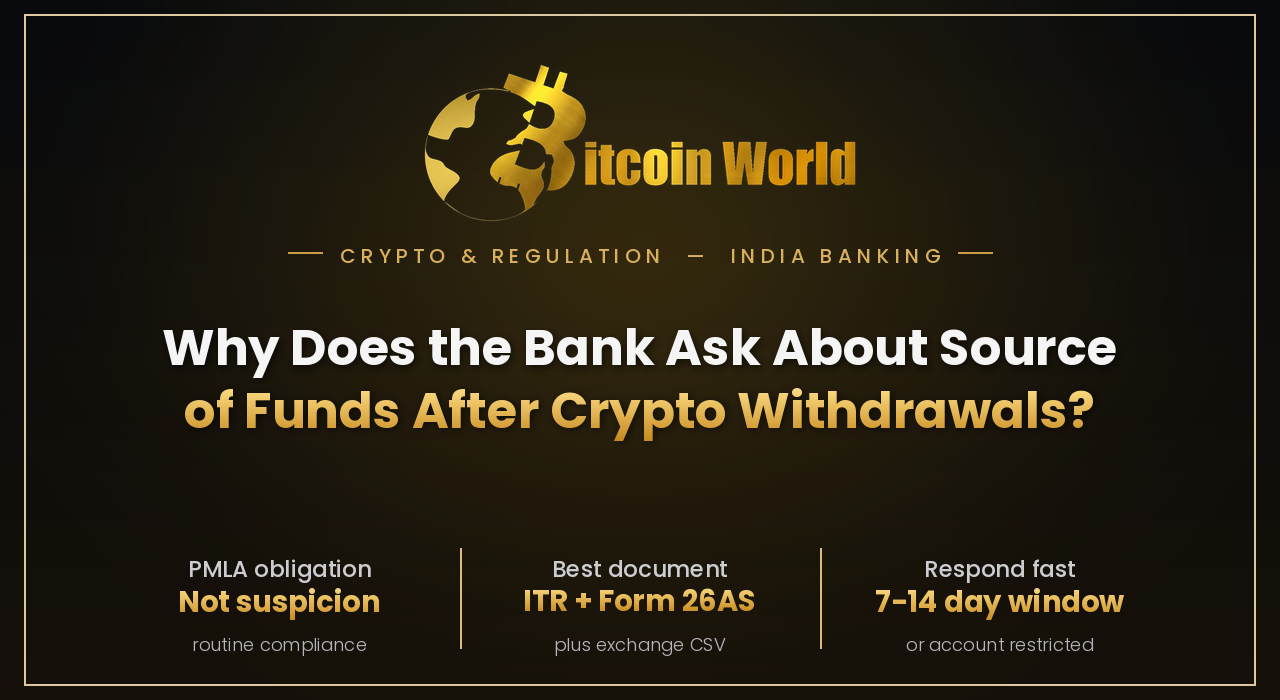
Why Does the Bank Ask About “Source of Funds” After Crypto Withdrawals in India?
Bank source of funds requests after crypto withdrawals in India are one of the most anxiety-inducing experiences for Indian crypto holders – and in the vast majority of cases, they are a routine compliance procedure, not an accusation. Under the Prevention of Money Laundering Act (PMLA), every regulated bank in India is required to monitor unusual or high-value deposits, including INR received from crypto exchange withdrawals, and to seek customer verification when transactions fall outside expected patterns. This article explains exactly why banks ask this question, the legal framework that compels them to do so, what documentation satisfies the request, and why having the right records prepared in advance makes the entire process take minutes instead of weeks.
Why Does a Bank Ask About “Source of Funds” After Crypto Withdrawals in India?
Bank source of funds requests for crypto withdrawals in India are triggered by PMLA obligations – banks are legally required to understand the origin of large or unusual deposits, not because they suspect you personally, but because the law requires them to document it.
- PMLA Section 12 obligation: Banks are classified as reporting entities under the Prevention of Money Laundering Act and must maintain records and verify the source of significant transactions.
- Crypto as a high-risk category: Regulatory guidance in India categorises VDA-related transactions as higher-risk – banks apply enhanced scrutiny to deposits originating from or linked to crypto activity.
- Unusual deposit pattern: A large INR deposit arriving from a crypto exchange – especially if it is significantly higher than your typical banking activity – triggers the bank’s internal AML monitoring system automatically.
- It is not a finding of wrongdoing: Receiving this request means your bank’s transaction monitoring flagged a pattern – not that you are under investigation. The vast majority of source-of-funds queries are resolved by providing basic documentation.
- Banks cannot ignore it: Failure to conduct source-of-funds checks exposes the bank itself to PMLA penalties – compliance officers apply this requirement broadly rather than risk a regulatory finding.
What Legal Framework Requires Banks to Ask This Question?
The legal basis for source of funds checks on crypto withdrawals in India sits across several overlapping frameworks that have all tightened since 2022.
- PMLA 2002 (Sections 12 and 12A): Requires reporting entities to maintain records of transactions above prescribed thresholds and to verify the identity and source of funds of customers conducting those transactions.
- RBI’s Know Your Customer (KYC) Master Directions: Requires banks to conduct Customer Due Diligence (CDD) at account opening and Enhanced Due Diligence (EDD) for transactions classified as higher risk – crypto-linked deposits fall under EDD in most bank frameworks.
- FATF Travel Rule (adopted in India in 2023): Virtual asset service providers must share sender and receiver information on transfers – this data reaches the banking system and flags crypto-origin transactions.
- March 2023 PMLA VASP Notification: The March 2023 PMLA notification classified all VDA service providers as reporting entities – covering centralized exchanges, wallet providers, and offshore platforms serving Indian users. This created a formal data trail between exchanges and the financial system.
- RBI’s EDD guidance from January 2026: Banks must apply AI-assisted KYC and Enhanced Due Diligence for accounts showing significant crypto-related flows – tightened from January 2026.
What Triggers a Source of Funds Request Specifically for Crypto Withdrawals?
Source of funds requests for crypto withdrawals are not random – they follow predictable triggers that every Indian crypto holder should understand.
- Large single withdrawal: A single INR deposit from a crypto exchange significantly above your account’s average monthly credit – thresholds vary by bank but are commonly set around ₹5 lakh to ₹10 lakh for routine monitoring.
- Sudden change in transaction pattern: If your account typically receives a salary and utility payments and then suddenly receives a large sum from an exchange, the pattern change itself triggers a flag.
- Multiple rapid deposits: Several exchange withdrawals within a short window – even if individually small – can trigger a structuring alert in the bank’s AML system.
- P2P trade receipts: INR received from multiple unknown individuals (as in P2P crypto selling) is flagged more aggressively than a single withdrawal from a known exchange.
- First-time crypto-related deposit: Some banks apply source-of-funds checks to any first-time deposit from a crypto exchange, regardless of size, as part of their onboarding risk assessment.
What Documentation Satisfies a Bank Source of Funds Request?
Responding to a bank source of funds request for crypto withdrawals requires a specific set of documents – having them prepared in advance reduces the process to a single bank visit or email.
- Exchange transaction history: A full CSV or PDF export of your trading history from the exchange for the relevant period – showing what you bought, when, and the INR purchase price.
- ITR acknowledgement: A copy of your most recent ITR filing acknowledgement confirming you have declared crypto income – this is the single most powerful document for satisfying the source-of-funds query.
- Form 26AS: Shows TDS deducted on your crypto transactions – confirms the exchange reported the transaction to the Income Tax Department and that your activity is within the formal tax system.
- Exchange withdrawal confirmation: The exchange’s withdrawal confirmation email or in-app receipt showing the INR amount, date, and your bank account details – confirms the money came from a registered exchange, not an unknown source.
- PAN-Aadhaar linked KYC: If the bank asks about your crypto activity more broadly, confirming that your exchange account is KYC-verified under the same PAN helps establish that the activity is documented and legal.
How Should Indian Crypto Users Prepare to Respond to These Requests?
Preparing for source of funds requests before they arrive is the most effective strategy – banks can freeze accounts pending documentation, and having everything ready means a same-day response.
- Download exchange records regularly: At the end of each financial year, download your complete transaction history from every exchange you use – store these securely.
- File ITR accurately and on time: A filed ITR covering your crypto activity is your most credible source-of-funds document – it proves the income was declared and taxed, removing any suggestion of concealment.
- Keep a crypto trading log: Maintain a simple spreadsheet of every purchase: date, coin, quantity, INR price paid. This is the foundation of both your ITR filing and any source-of-funds response.
- Use FIU-registered exchanges exclusively: Only exchanges registered with the FIU-IND are considered safe and legal – receipts from registered exchanges carry far more weight with bank compliance teams than withdrawals from unregistered platforms.
- Respond promptly: Source-of-funds requests typically have a 7 to 14-day response window – missing it can result in account restrictions. Treat every bank query as time-sensitive.
Frequently Asked Questions
Is a bank asking about source of funds after a crypto withdrawal a sign that I am under investigation in India?
No – a source of funds request after a crypto withdrawal in India is a routine AML compliance step, not an indication of investigation. Banks are legally required under PMLA to seek verification of unusual deposits, and crypto-linked INR inflows automatically fall into their higher-scrutiny category. Providing your ITR acknowledgement, Form 26AS, and exchange transaction history typically resolves the query within days – it is a documentation exercise, not a legal proceeding.
What is the best document to provide when a bank asks about source of funds from crypto in India?
The most effective document is your ITR acknowledgement showing that crypto income was declared and taxed in the relevant financial year – it confirms the activity is within India’s formal tax and compliance framework. Supporting this with a Form 26AS (showing TDS deducted), your exchange transaction history export, and the exchange withdrawal confirmation gives the bank everything it needs to close the query. Having all four documents ready before the request arrives reduces the response time to a single email or bank visit.
Can a bank close or freeze my account solely because I received INR from a crypto exchange withdrawal in India?
A bank cannot freeze or close your account solely because you received funds from a crypto exchange – trading on FIU-registered exchanges is fully legal, and INR withdrawals from those exchanges are legitimate banking transactions. A source-of-funds request is a documentation step, not an enforcement action. Account freezes related to crypto are almost exclusively caused by funds linked to fraud investigations (typically from P2P trades) – not by exchange withdrawals from a registered, KYC-verified platform.
Conclusion: Source of Funds Requests Are Compliance, Not Accusation – Documentation Is the Only Defence That Works
Bank source of funds requests after crypto withdrawals in India are a predictable, legally mandated feature of operating within India’s PMLA-regulated banking environment – not a sign that anything has gone wrong. The banks have no choice but to ask; you have every reason to answer. The practical imperative is preparation: file your ITR accurately and on time, download exchange records at the end of every financial year, use FIU-registered platforms exclusively, and store your withdrawal confirmations and Form 26AS together. When the request arrives – and for active crypto users in India, it likely will – a prepared trader resolves it in 24 hours with a single email. An unprepared one faces weeks of account restrictions while scrambling to find documents they should have kept all along.
Disclaimer: The information provided is not trading advice, Bitcoinworld.co.in holds no liability for any investments made based on the information provided on this page. We strongly recommend independent research and/or consultation with a qualified professional before making any investment decisions.
