

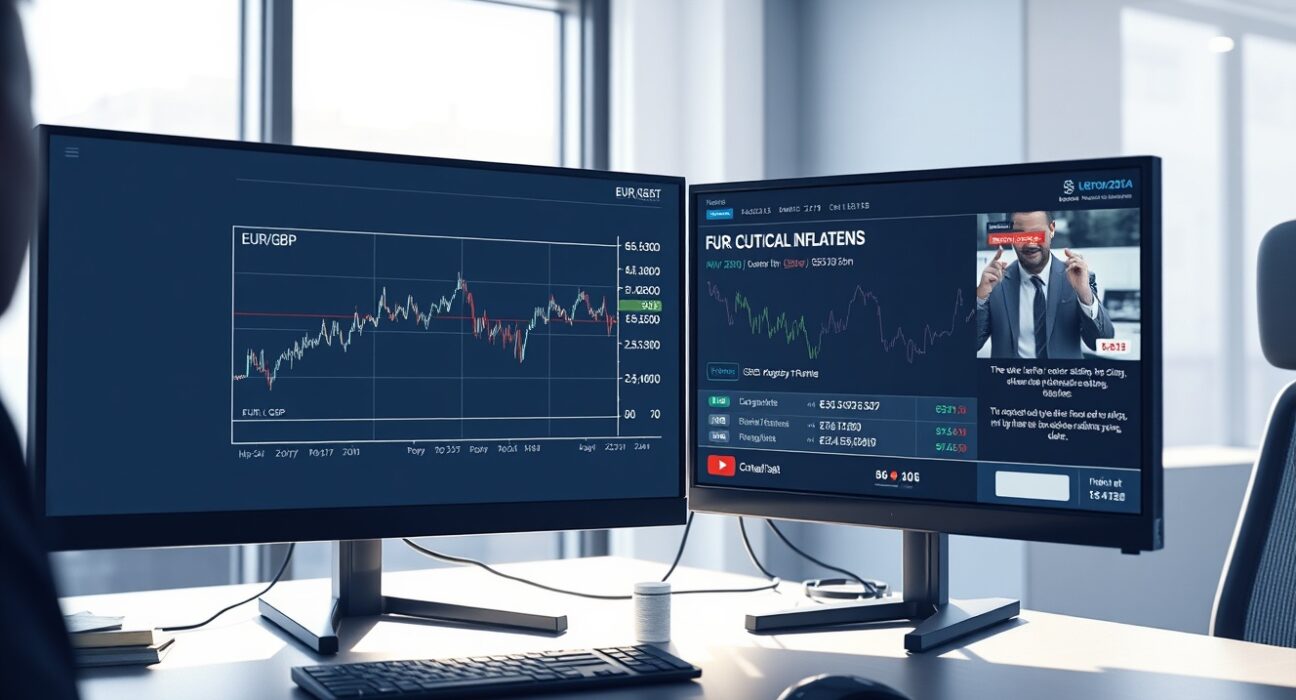
The EUR/GBP currency pair demonstrates remarkable stability in early 2025 trading sessions, maintaining a tight range as conflicting forces of escalating geopolitical tensions and persistent German inflation risks create market paralysis. Financial analysts across London, Frankfurt, and New York report unusual equilibrium in the cross-rate, with neither the euro nor pound gaining decisive momentum despite significant underlying pressures. This stability emerges from precisely balanced opposing forces that neutralize typical currency movements. Market participants currently face a complex decision-making environment where traditional indicators provide conflicting signals. Consequently, traders exercise unusual caution, resulting in reduced volatility and narrower trading bands than historical averages suggest for current conditions.
EUR/GBP Technical Analysis and Current Positioning
Technical charts reveal the EUR/GBP pair trading within a remarkably narrow 1.5% range throughout the first quarter of 2025. This consolidation pattern represents a significant departure from the 3.2% average quarterly range observed throughout 2024. Market data from the London Foreign Exchange Joint Standing Committee shows reduced trading volumes in the pair, down approximately 18% year-over-year. Meanwhile, the European Central Bank’s transaction reports indicate decreased speculative positioning in both directions. Several factors contribute to this technical stagnation. First, institutional investors maintain balanced exposure to both currencies. Second, algorithmic trading systems detect conflicting signals from fundamental indicators. Third, risk management protocols at major banks mandate reduced position sizes during periods of high uncertainty. Consequently, the market exhibits what analysts term “cautious equilibrium” rather than directional conviction.
Historical Context and Comparative Performance
Historical analysis provides crucial context for understanding current EUR/GBP dynamics. The pair’s 30-day realized volatility currently measures 5.8%, substantially below the 8.3% five-year average for this period. Comparative performance data reveals interesting patterns:
- Relative Stability: EUR/GBP shows 40% less volatility than EUR/USD and 35% less than GBP/USD
- Correlation Shifts: The 60-day correlation with European equity markets has decreased from 0.45 to 0.28
- Interest Rate Sensitivity: Response to central bank announcements has diminished by approximately 30%
This data suggests the market treats EUR/GBP as a relative value trade rather than directional speculation. Market makers report narrower bid-ask spreads during European trading hours but increased spreads during Asian sessions when liquidity typically decreases. The options market reflects this uncertainty through elevated implied volatility despite low realized moves, indicating traders anticipate potential breakouts while current conditions remain constrained.
Geopolitical Tensions Impacting European Currency Markets
Multiple geopolitical developments create headwinds for both the euro and British pound, effectively neutralizing their relative performance. Eastern European security concerns, Mediterranean energy disputes, and transatlantic trade negotiations all contribute to risk aversion among currency traders. The European Union’s diplomatic corps currently engages in simultaneous negotiations across three major fronts, creating policy uncertainty that affects economic forecasts. Specifically, ongoing discussions about European energy security directly impact both German industrial output and UK financial services. Additionally, Middle Eastern developments influence European energy import costs while affecting London’s role as a financial intermediary. These interconnected geopolitical factors create what economists term “symmetric uncertainty” for both currencies. Consequently, traditional safe-haven flows that might typically benefit one currency at the expense of the other instead create balanced pressure on the entire European currency complex.
Regional Conflict Analysis and Economic Implications
Regional conflicts near Europe’s borders generate specific economic impacts that influence currency valuations. Security analysts identify three primary conflict zones affecting European markets:
| Conflict Zone | Primary Impact on Euro | Primary Impact on Pound | Net EUR/GBP Effect |
|---|---|---|---|
| Eastern European Security | Increased defense spending pressures fiscal policy | London financial intermediation of capital flows | Neutral (balanced pressures) |
| Mediterranean Energy | Southern EU energy import disruption risks | UK energy trading and shipping insurance costs | Neutral (similar magnitude) |
| Transatlantic Relations | EU-US trade agreement uncertainty | UK-US financial services equivalence talks | Neutral (parallel negotiations) |
This balanced impact matrix explains why geopolitical developments fail to create sustained directional movement in EUR/GBP. Market participants report difficulty assessing which currency would benefit from resolution or escalation in any specific conflict. Therefore, traders maintain neutral positioning until clearer differentiation emerges between eurozone and UK geopolitical exposures.
German Inflation Dynamics and Eurozone Economic Pressures
German inflation data presents persistent upside risks that constrain European Central Bank policy options while simultaneously affecting euro valuation. The Federal Statistical Office reports German consumer prices maintaining elevated levels despite monetary tightening measures implemented throughout 2024. Services inflation proves particularly stubborn, remaining above 4% for eleven consecutive months. Meanwhile, producer price indices show continued pressure from energy transition costs and supply chain restructuring. These inflation dynamics create a complex policy environment for the ECB. On one hand, persistent inflation suggests potential for further rate hikes that could strengthen the euro through yield differentials. On the other hand, elevated rates risk depressing economic growth across the eurozone, potentially weakening the currency through growth differentials. This policy dilemma creates what market participants term “the inflation conundrum” where traditional relationships between inflation, interest rates, and currency values become less predictable.
Structural Inflation Drivers in Europe’s Largest Economy
Germany faces multiple structural inflation drivers that differentiate its experience from other eurozone members. Demographic shifts toward an aging population create persistent services inflation through healthcare and elderly care costs. Energy transition investments, while necessary for climate goals, generate embedded inflation in industrial production. Additionally, wage negotiations in Germany’s manufacturing sector establish patterns that influence broader eurozone labor costs. The Bundesbank’s quarterly analysis identifies three primary inflation transmission mechanisms:
- Wage-Price Spiral: Collective bargaining agreements in key industries establish benchmark increases
- Import Price Pass-Through: Euro depreciation against commodity currencies increases input costs
- Regulatory Inflation: Environmental and digital transition regulations embed compliance costs
These structural factors suggest German inflation may prove more persistent than cyclical models indicate. Consequently, the ECB faces difficult trade-offs between price stability and economic support. Market participants increasingly debate whether the eurozone’s largest economy requires differentiated policy consideration, though treaty limitations prevent country-specific monetary measures.
Comparative Central Bank Policies and Currency Implications
The European Central Bank and Bank of England pursue increasingly divergent policy paths despite facing similar economic challenges. ECB officials emphasize data-dependent approaches with particular focus on services inflation and wage growth. Meanwhile, Bank of England policymakers highlight labor market tightness and domestic demand pressures. This policy divergence would typically generate significant EUR/GBP movement, yet current geopolitical and inflation risks create offsetting forces. Market-implied policy rates derived from overnight index swaps show expectations for approximately 75 basis points of ECB tightening through 2025 versus 50 basis points from the Bank of England. However, these differentials fail to translate into sustained currency movements due to risk premium adjustments. Specifically, investors demand higher compensation for holding euro-denominated assets due to geopolitical uncertainties, while sterling assets carry inflation risk premiums. These offsetting risk adjustments neutralize what would otherwise be a significant interest rate differential effect.
Policy Transmission Mechanisms and Market Pricing
Central bank policies transmit to currency markets through multiple channels that currently exhibit unusual dynamics. The traditional interest rate differential channel remains active but weakened. The forward guidance credibility channel shows mixed signals as both central banks emphasize data dependence. The balance sheet policy channel demonstrates limited impact as quantitative tightening proceeds on pre-announced schedules. Market participants identify several unusual transmission patterns:
- Asymmetric Response: Currency markets react more strongly to dovish surprises than hawkish ones
- Non-Linear Effects: Small policy changes generate disproportionate risk premium adjustments
- Cross-Market Contagion: Bond market volatility spills into currencies despite fundamental disconnects
These transmission irregularities contribute to EUR/GBP stability by creating offsetting movements across different policy channels. When one channel suggests euro strength, another typically indicates pound resilience, resulting in limited net movement.
Market Participant Behavior and Trading Strategies
Professional traders and institutional investors adapt their approaches to navigate the unusual EUR/GBP stability. Hedge funds report reduced directional positioning in favor of relative value and volatility strategies. Asset managers maintain currency hedges at higher-than-usual levels despite the cost, reflecting uncertainty rather than conviction. Market makers adjust their quoting behavior, providing tighter spreads for smaller transactions but wider spreads for block trades that might signal informed trading. Several adaptive strategies emerge across different participant categories:
- Volatility Targeting: Systematic funds reduce position sizes as realized volatility declines
- Cross-Asset Hedging: Institutions use equity and bond positions to hedge currency exposures
- Option-Based Approaches: Traders implement strangles and straddles to profit from eventual breakouts
This behavioral adaptation creates self-reinforcing stability as reduced positioning decreases trading volume, which in turn lowers volatility, encouraging further position reduction. The market enters what technical analysts describe as a “compression phase” where energy builds for potential future movement but current conditions remain constrained.
Conclusion
The EUR/GBP exchange rate demonstrates remarkable stability amid conflicting fundamental forces. Geopolitical tensions create symmetric uncertainty for both currencies, while German inflation risks present policy dilemmas that constrain directional movement. Market participants navigate this environment through reduced positioning and adaptive strategies, contributing to the observed equilibrium. Technical indicators suggest the pair trades within historically narrow ranges, with volatility measures well below long-term averages. Looking forward, resolution of either geopolitical uncertainties or inflation dynamics could trigger significant movement, but current conditions favor continued range-bound trading. The EUR/GBP stability thus reflects not market consensus but rather balanced uncertainty across multiple dimensions of risk.
FAQs
Q1: Why is EUR/GBP so stable despite significant geopolitical risks?
The stability results from balanced pressures affecting both currencies similarly. Geopolitical developments create symmetric uncertainty rather than favoring one currency over the other, leading to offsetting movements that maintain equilibrium.
Q2: How does German inflation specifically impact EUR/GBP trading?
German inflation creates policy dilemmas for the ECB. Higher inflation suggests potential rate hikes that could strengthen the euro, but those same hikes risk slowing eurozone growth, potentially weakening the currency. These offsetting effects contribute to stability.
Q3: What trading strategies work best during periods of EUR/GBP stability?
Market participants increasingly use volatility-based approaches like strangles and straddles, reduce directional positioning in favor of relative value trades, and implement cross-asset hedging strategies that don’t rely on currency directionality.
Q4: Could EUR/GBP break out of its current range soon?
Breakout potential exists but requires asymmetric developments. Resolution of geopolitical tensions favoring one region over another, or divergent inflation outcomes between Germany and the UK, could trigger sustained movement.
Q5: How do central bank policies affect EUR/GBP when both face similar challenges?
Policy divergence exists but gets neutralized by risk premium adjustments. Investors demand higher compensation for different risks associated with each currency, offsetting what would otherwise be interest rate differential effects.
Disclaimer: The information provided is not trading advice, Bitcoinworld.co.in holds no liability for any investments made based on the information provided on this page. We strongly recommend independent research and/or consultation with a qualified professional before making any investment decisions.
