

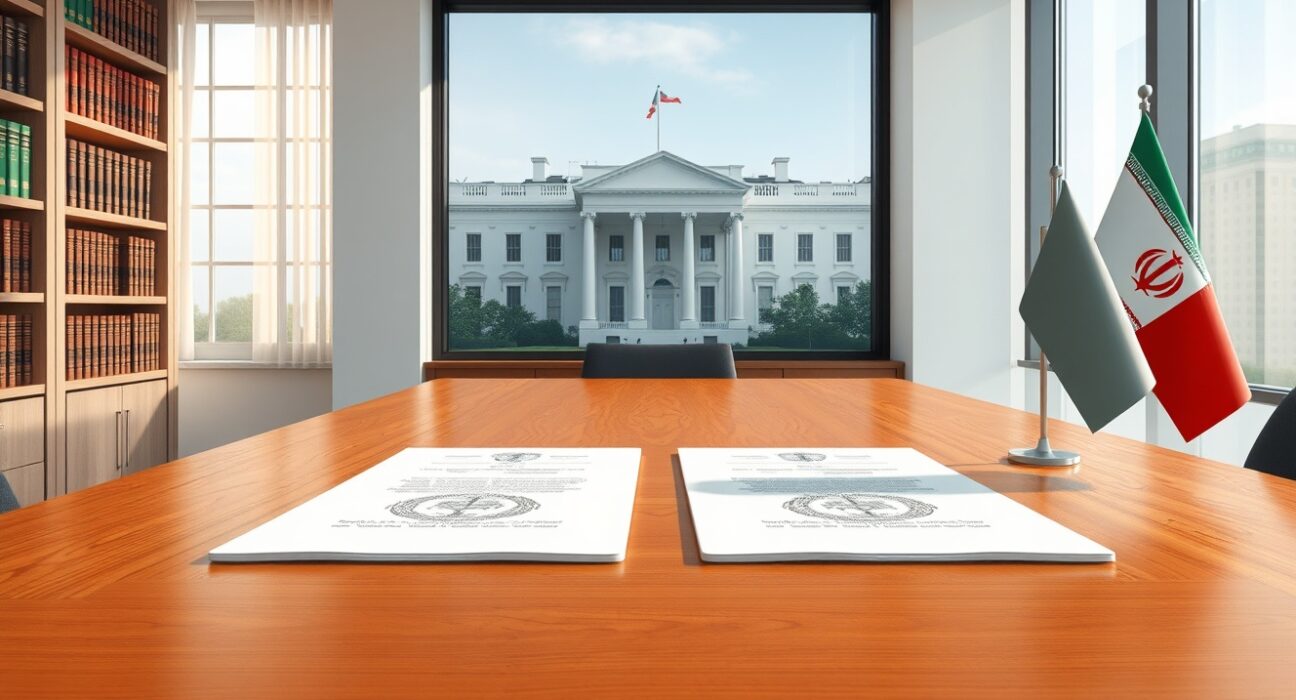
WASHINGTON, D.C. – In a significant development that could reshape Middle Eastern geopolitics, former President Donald Trump announced via social media on Tuesday that the United States is engaging in substantive discussions with Iran regarding comprehensive tariff and sanction relief. This announcement follows his confirmation of what he termed a “very productive regime change” within the Islamic Republic, marking a potential historic pivot in a decades-long adversarial relationship.
Trump Announces US-Iran Cooperation Framework
President Trump’s statement outlined a multi-faceted cooperative framework between the two nations. Consequently, the proposed agreement includes several unprecedented elements. Firstly, Iran would prohibit all uranium enrichment activities. Secondly, the United States would collaborate directly with Iranian authorities to excavate and remove deeply buried nuclear remnants. Furthermore, discussions are actively underway to relieve numerous economic sanctions and tariffs. Trump specifically claimed preliminary agreements on 15 distinct items, though he did not publicly list them. Additionally, he suggested the potential for a joint U.S.-Iran project concerning passage tolls in the strategically vital Strait of Hormuz.
This announcement immediately sparked intense analysis among foreign policy experts. Historically, the U.S.-Iran relationship has been characterized by deep mutual suspicion since the 1979 Iranian Revolution. The Joint Comprehensive Plan of Action (JCPOA), negotiated in 2015, previously aimed to curb Iran’s nuclear program in exchange for sanctions relief. However, the Trump administration unilaterally withdrew from that agreement in 2018, reinstating harsh sanctions under a “maximum pressure” campaign. Therefore, this new direction represents a stark reversal of that previous policy stance.
Analyzing the Claims of Regime Change
The reference to “regime change” requires careful contextual examination. Independent analysts and international news agencies have not reported any conventional governmental overthrow in Tehran. However, recent months have witnessed significant internal political shifts. Notably, the election of a new, more pragmatic president and a reshuffling of key security council positions suggest a potential moderation in Iran’s foreign policy approach. Experts speculate Trump may be referencing this political evolution rather than a violent coup. Verification from neutral observers remains crucial for assessing the stability and intentions of the current Iranian leadership.
Potential Impacts of Sanction and Tariff Relief
The prospect of lifting sanctions carries enormous economic implications for both Iran and global markets. U.S. sanctions have severely constrained Iran’s ability to export oil, access the international financial system, and import crucial goods. Relief could therefore trigger several immediate effects:
- Global Oil Supply: Iran could quickly ramp up oil exports, potentially increasing global supply by 1-2 million barrels per day. This increase might apply downward pressure on global oil prices.
- Iranian Economy: Unfrozen assets and renewed trade could stimulate Iran’s crippled economy, possibly reducing domestic discontent.
- Regional Dynamics: Increased Iranian revenue could alter the balance of power in the Middle East, affecting conflicts in Syria and Yemen, and influencing Iran’s support for proxy groups.
Moreover, tariff relief on non-oil goods would benefit specific sectors. For instance, the Persian rug industry, dried fruit and nut exports, and automotive part manufacturing could see rapid growth. Conversely, competing producers in neighboring countries might face new market pressures.
The Strait of Hormuz Joint Project Proposal
The suggestion of a cooperative project in the Strait of Hormuz is particularly noteworthy. This narrow chokepoint sees about 20% of the world’s oil shipments pass through it. Tensions have frequently flared there, with Iran previously threatening to disrupt traffic. A joint U.S.-Iran project could involve:
- Co-managed traffic control or safety initiatives.
- Joint environmental protection efforts.
- Shared infrastructure for toll collection or navigation aids.
Such cooperation would represent a monumental confidence-building measure. It could significantly de-escalate military tensions in the Persian Gulf. However, logistical and sovereignty challenges would be substantial. Regional allies, particularly Saudi Arabia and the United Arab Emirates, would likely scrutinize any agreement that enhances Iran’s role in the waterway.
Verification and International Response
As of this reporting, official confirmation from the current U.S. State Department or the Iranian government remains pending. Key details require verification, including:
| Claim | Status | Required Verification |
|---|---|---|
| 15 agreed items | Unconfirmed | Official documentation or joint statement |
| Nuclear remnant removal | Unconfirmed | IAEA access and technical plans |
| Strait of Hormuz project | Conceptual | Feasibility studies and regional consultations |
| Uranium enrichment prohibition | Unconfirmed | Iranian legislative or supreme leader approval |
International reactions have begun to surface. European Union diplomats expressed cautious optimism but emphasized the need for inclusive dialogue. Israeli officials reportedly conveyed deep concern to Washington, stressing the importance of maintaining pressure on Iran’s regional activities. Meanwhile, Russian and Chinese foreign ministries issued statements welcoming any dialogue that reduces global tensions.
Historical Context of US-Iran Negotiations
Understanding this announcement requires examining the fraught history of negotiations. The 2015 JCPOA involved seven parties (the P5+1 and the EU) and took years to finalize. A potential bilateral U.S.-Iran deal would represent a fundamentally different approach. Critics argue bilateral deals lack the multilateral enforcement mechanisms of the JCPOA. Proponents contend they can be more flexible and swiftly implemented. The success of any agreement will ultimately depend on robust verification protocols and the political will to implement them fully.
Conclusion
President Trump’s announcement of potential US-Iran cooperation on sanctions relief, nuclear cleanup, and Strait of Hormuz projects marks a potentially transformative moment in international relations. While the claims require thorough verification and face significant implementation hurdles, the direction signals a possible thaw in one of the world’s most persistent conflicts. The coming weeks will be critical for confirming details, gauging international reactions, and assessing the real-world impacts on global energy markets and Middle Eastern security. The prospect of Trump Iran sanctions relief moves from theoretical discussion to active negotiation, carrying profound implications for diplomacy and global stability.
FAQs
Q1: What did President Trump actually announce regarding Iran?
President Trump announced via social media that the U.S. is discussing tariff and sanction relief with Iran, confirmed a “productive regime change,” stated Iran would prohibit uranium enrichment, and proposed joint work on nuclear remnant removal and a Strait of Hormuz project.
Q2: Has there been an actual violent regime change in Iran?
No evidence suggests a violent overthrow. Analysts interpret the term as referencing significant internal political shifts, including the election of a new president and changes in key government positions, indicating a potential change in foreign policy direction.
Q3: What would be the global economic impact of lifting sanctions on Iran?
Lifting sanctions could allow Iran to export 1-2 million more barrels of oil per day, potentially lowering global oil prices. It would also reintegrate Iran’s economy into global markets, affecting trade flows for goods like petrochemicals, carpets, and agricultural products.
Q4: How does this announcement relate to the old Iran nuclear deal (JCPOA)?
This represents a potential alternative path. The JCPOA was a multilateral agreement. Trump’s announcement suggests a possible bilateral framework focusing on different elements, including physical nuclear cleanup and Strait of Hormuz cooperation, alongside enrichment limits.
Q5: What are the biggest challenges to implementing this proposed cooperation?
Key challenges include verifying Iran’s compliance with enrichment prohibitions, the technical difficulty of removing buried nuclear remnants, securing approval from Iran’s Supreme Leader, addressing concerns from U.S. regional allies like Israel and Saudi Arabia, and establishing trust for a joint project in the strategically sensitive Strait of Hormuz.
Disclaimer: The information provided is not trading advice, Bitcoinworld.co.in holds no liability for any investments made based on the information provided on this page. We strongly recommend independent research and/or consultation with a qualified professional before making any investment decisions.
