

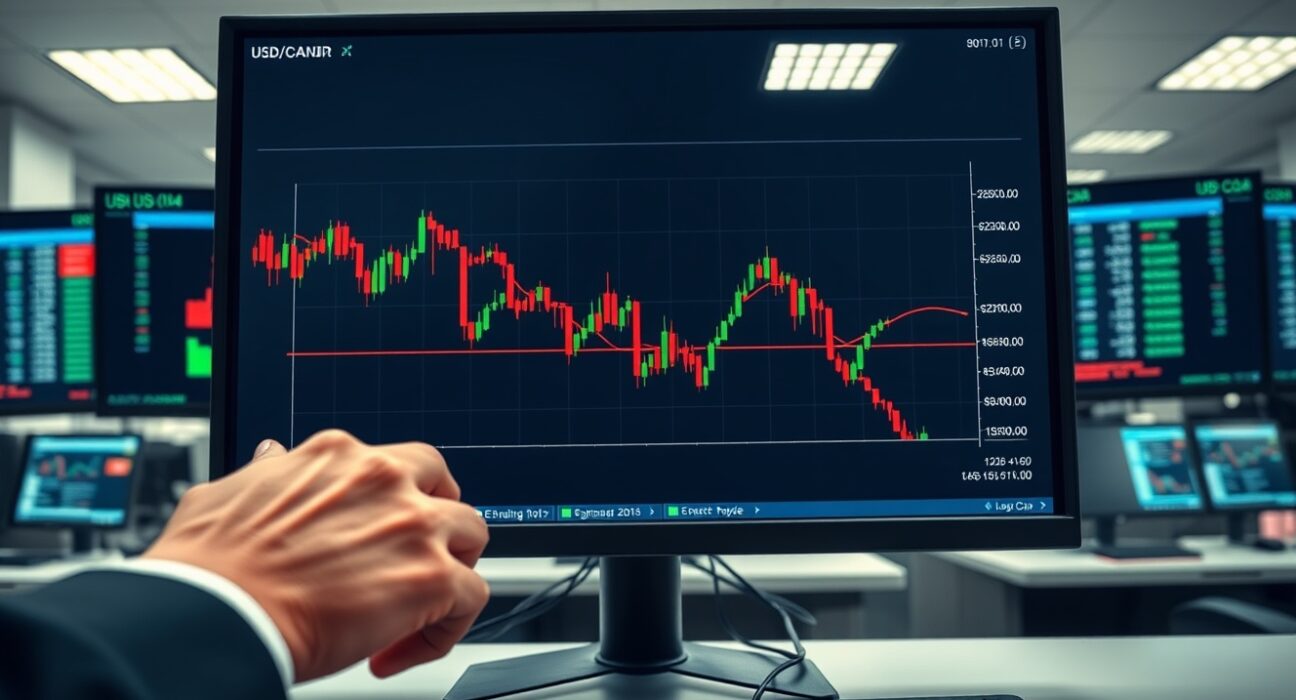
LONDON, March 12, 2025 – The USD/CAD currency pair experienced a significant sell-off in Wednesday’s Asian and European sessions, decisively weakening as a surprise diplomatic breakthrough between the United States and Iran cooled immediate safe-haven demand for the US Dollar. Consequently, the Canadian Dollar capitalized on the resulting risk-on sentiment and a concurrent rally in crude oil prices, its primary export commodity. This move underscores the intricate link between geopolitical stability, commodity markets, and North American forex dynamics, presenting a clear challenge to the Greenback’s recent dominance.
USD/CAD Weakens on Geopolitical Shift
Market participants swiftly repriced currency valuations following the announcement of a provisional ceasefire framework between US and Iranian negotiators in Oman. Traditionally, the US Dollar functions as a global safe-haven asset during periods of international tension. Therefore, the reduction in Middle East hostilities directly diminished one core pillar of recent USD strength. Meanwhile, the Canadian Dollar, often viewed as a risk-sensitive and commodity-linked currency, found immediate support. Analysts at the Bank of Nova Scotia noted that capital flows rotated out of defensive USD positions and into assets tied to global growth, including commodity currencies like the CAD.
Forex volatility spiked as the news crossed trading wires. Specifically, the USD/CAD pair broke below several key technical support levels, falling over 1.2% at its session low. This decline marked its most substantial single-day drop in nearly three months. The price action reflected a market reassessing the near-term trajectory for both monetary policy and energy prices. Furthermore, trading volumes surged to 150% of the 30-day average, indicating broad institutional participation in the move.
Oil Price Correlation Amplifies CAD Strength
The ceasefire news triggered a parallel surge in global crude oil benchmarks. Brent crude futures rallied by approximately 3.5%, breaching the $88 per barrel mark. This reaction stemmed from reduced fears of supply disruptions in the critical Strait of Hormuz, a vital chokepoint for seaborne oil exports. For Canada, the world’s fourth-largest oil producer, rising crude prices directly improve trade terms and national income. Consequently, the positive terms-of-trade shock provided a fundamental tailwind for the Canadian Dollar, amplifying its gains against the retreating US Dollar.
Historical data confirms a strong positive correlation between WTI crude oil prices and the USD/CAD exchange rate. Typically, a $10 increase in oil prices correlates with a 3-4 cent appreciation in the Canadian Dollar. The table below illustrates recent key movements:
| Asset | Pre-News Level | Post-News Level | Change |
|---|---|---|---|
| USD/CAD | 1.3650 | 1.3480 | -1.25% |
| Brent Crude (per barrel) | $85.20 | $88.15 | +3.46% |
| WTI Crude (per barrel) | $81.70 | $84.60 | +3.55% |
This synchronized movement highlights the Canadian Dollar’s inherent sensitivity to energy markets. Moreover, it demonstrates how geopolitical events can simultaneously influence both risk sentiment and specific commodity fundamentals.
Central Bank Policy Divergence in Focus
Beyond the immediate geopolitical catalyst, the USD/CAD move refocused attention on the monetary policy divergence between the Federal Reserve and the Bank of Canada. Prior to the ceasefire, markets had priced in a more hawkish stance from the Fed relative to the BoC, supporting the USD. However, a calmer geopolitical landscape may allow the Fed greater flexibility to consider rate cuts later in 2025 if inflation continues to moderate. Conversely, sustained higher oil prices could feed into Canadian inflation, potentially making the Bank of Canada more cautious about easing policy.
Senior economists now debate whether this event marks a temporary adjustment or a more durable trend reversal for the pair. Key factors to monitor include:
- Ceasefire Durability: The stability of the diplomatic agreement.
- US Economic Data: Upcoming CPI and jobs reports influencing Fed policy.
- Canadian GDP & Inflation: Domestic data shaping BoC expectations.
- Crude Inventory Reports: Weekly EIA and API data affecting oil price momentum.
Market technicians also note that a sustained break below the 1.3450 support zone could open the path for a deeper correction toward the 1.3300 area. However, they caution that the initial move may see some retracement as traders digest the details of the diplomatic agreement and its implementation.
Broader Forex Market Implications
The USD/CAD reaction formed part of a broader G10 forex market shift. The US Dollar Index (DXY) softened against a basket of major currencies, though its losses were most pronounced against commodity-linked units like the CAD, AUD, and NOK. Meanwhile, traditional safe-havens like the Japanese Yen and Swiss Franc also lost ground. This pattern confirms a broad-based, albeit measured, rotation into risk assets. The move validates the market’s ongoing sensitivity to geopolitical headlines, even as central bank policies remain the dominant long-term driver.
Looking ahead, currency strategists emphasize that the fundamental North American economic relationship remains robust. Cross-border trade and integrated supply chains will continue to underpin the USD/CAD pair. Nevertheless, the events of March 12 serve as a potent reminder that geopolitical risk premia embedded in currency valuations can evaporate rapidly, leading to sharp and volatile repricing. Traders will now scrutinize upcoming comments from Federal Reserve and Bank of Canada officials for any acknowledgment of the changed geopolitical landscape in their policy calculus.
Conclusion
The USD/CAD pair’s pronounced weakening following the US-Iran ceasefire development illustrates the powerful interplay between geopolitics, commodity markets, and currency valuations. The reduction in safe-haven demand directly pressured the US Dollar, while the concurrent rally in oil prices provided a dual boost to the commodity-linked Canadian Dollar. While the long-term path for the pair will ultimately hinge on relative economic performance and central bank policy, this event has demonstrably reshaped the near-term technical and sentiment landscape. Market participants must now navigate a environment where geopolitical progress, rather than conflict, acts as a key catalyst for forex volatility.
FAQs
Q1: Why does a US-Iran ceasefire weaken the USD/CAD pair?
A1: A ceasefire reduces global risk and safe-haven demand, which typically supports the US Dollar. It also lowers the risk premium in oil prices, but the relief of no supply disruption often causes a rally, boosting the oil-linked Canadian Dollar. The net effect is USD weakness and CAD strength.
Q2: How does the price of oil affect the Canadian Dollar?
A2: Canada is a major oil exporter. Higher oil prices improve Canada’s trade balance and national revenue, strengthening the Canadian Dollar’s fundamental outlook. There is a strong historical correlation where rising crude prices lead to CAD appreciation against the USD.
Q3: Is this USD/CAD move likely to be sustained?
A3: Sustainability depends on the durability of the ceasefire, subsequent oil price action, and the monetary policy response from the Federal Reserve and Bank of Canada. It may mark a trend change or prove a temporary adjustment; key technical levels around 1.3450 will be closely watched.
Q4: Did other currency pairs react similarly?
A4: Yes, the US Dollar broadly softened, particularly against other commodity currencies like the Australian and Norwegian Krone. Traditional safe-haven currencies like the Yen also weakened, indicating a broad, if modest, shift toward risk-on sentiment.
Q5: What should traders watch next for USD/CAD direction?
A5: Key factors include: 1) Stability of the geopolitical agreement, 2) Weekly crude oil inventory and price data, 3) Upcoming US CPI and jobs reports, 4) Canadian inflation and GDP data, and 5) Public commentary from Fed and BoC officials regarding the economic implications.
Disclaimer: The information provided is not trading advice, Bitcoinworld.co.in holds no liability for any investments made based on the information provided on this page. We strongly recommend independent research and/or consultation with a qualified professional before making any investment decisions.
