

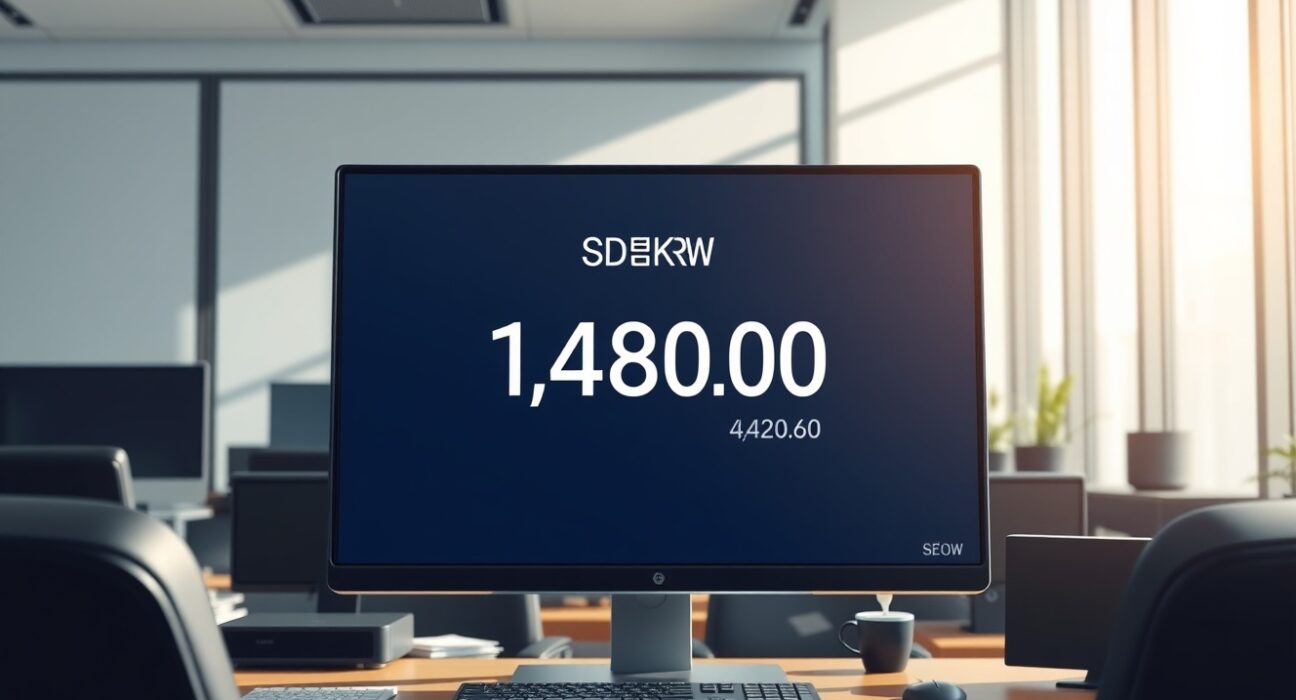
SEOUL, South Korea – April 2025: The USD/KRW exchange rate maintains its intraday position around the 1,480 level, demonstrating remarkable stability as the Bank of Korea advocates for a cautious wait-and-see approach. This measured stance emerges against a backdrop of escalating geopolitical tensions in the Middle East, particularly concerning Iran. Consequently, market participants closely monitor the central bank’s next moves while assessing global risk factors.
USD/KRW Exchange Rate Stability Amid Global Uncertainty
The Korean won shows resilience against the US dollar, trading within a narrow band around 1,480. This stability occurs despite multiple external pressures. Market analysts attribute this steadiness to several factors. First, South Korea’s robust export performance continues to support the currency. Second, foreign investment flows remain relatively stable. Third, the Bank of Korea’s clear communication strategy provides market certainty. However, underlying volatility indicators suggest caution remains warranted.
Historical data reveals interesting patterns. For instance, the USD/KRW pair averaged 1,320 throughout 2023 before climbing steadily. By late 2024, it reached the 1,450-1,500 range. This gradual appreciation of the dollar reflects broader global monetary policy divergence. The Federal Reserve maintains higher interest rates compared to many developed economies. Meanwhile, the Bank of Korea balances inflation control with growth support.
Technical Analysis and Market Sentiment
Technical indicators provide additional context for current price action. The 50-day moving average currently sits at 1,475, while the 200-day average remains at 1,465. These metrics suggest the pair trades slightly above medium-term trends. Furthermore, trading volume patterns indicate institutional participation dominates current movements. Retail investor activity shows cautious optimism but limited directional conviction.
Bank of Korea’s Deliberate Wait-and-See Posture
The Bank of Korea explicitly advocates for patience in current monetary policy decisions. Governor Rhee Chang-yong recently emphasized data dependency during the latest policy meeting. “We must carefully assess incoming economic indicators,” Rhee stated. “Geopolitical developments require particular attention.” This cautious approach reflects several considerations.
- Inflation Management: Consumer price increases remain above the 2% target but show moderating trends
- Growth Projections: Export recovery supports economic expansion despite domestic consumption weakness
- Financial Stability: Household debt levels necessitate careful policy calibration
- Currency Volatility: Excessive won weakness could import inflation, while excessive strength hurts exports
Monetary policy committee members express divided views according to meeting minutes. Some members highlight upside inflation risks from potential supply chain disruptions. Others emphasize downside growth risks from global economic slowing. This diversity of opinion naturally leads to more deliberate decision-making processes.
Geopolitical Risks: Iran Tensions and Market Implications
Escalating tensions involving Iran present significant risks to global financial markets. Recent developments in the Strait of Hormuz particularly concern energy-importing nations like South Korea. The country imports approximately 80% of its crude oil requirements. Consequently, any disruption to Middle Eastern shipping lanes directly impacts Korean energy security and costs.
Historical precedents demonstrate clear patterns. During previous Middle Eastern crises, the Korean won typically weakened against safe-haven currencies. For example, during the 2019 Gulf tensions, USD/KRW briefly spiked above 1,200. However, current circumstances differ substantially. South Korea’s foreign exchange reserves now exceed $400 billion, providing substantial buffer capacity. Additionally, bilateral currency swap arrangements with major economies enhance stability.
| Event | Date | USD/KRW Movement | Duration |
|---|---|---|---|
| 2019 Gulf Tensions | June 2019 | +3.2% | 2 weeks |
| 2022 Russia-Ukraine Conflict | February 2022 | +5.8% | 3 weeks |
| 2024 Red Sea Disruptions | January 2024 | +2.1% | 10 days |
Energy Security Considerations
South Korea’s strategic petroleum reserves currently stand at approximately 90 days of consumption. This substantial buffer provides some insulation from short-term supply disruptions. However, prolonged tensions could strain these reserves. Energy analysts note that alternative shipping routes exist but increase transportation costs and delivery times. These additional expenses eventually translate to higher import bills and potential inflationary pressure.
Global Monetary Policy Divergence and Currency Impacts
The Federal Reserve’s monetary policy trajectory significantly influences USD/KRW dynamics. Current expectations suggest the Fed will maintain higher interest rates for longer than previously anticipated. This policy stance supports dollar strength globally. Meanwhile, other major central banks pursue different approaches. The European Central Bank recently began easing cycles, while the Bank of Japan maintains ultra-accommodative settings.
This policy divergence creates complex cross-currents for emerging market currencies. The Korean won often behaves as a “risk-on” currency during stable global conditions. However, it demonstrates resilience during stress periods compared to peers. Analysis of currency correlations reveals interesting patterns. USD/KRW shows 0.85 correlation with USD/CNY but only 0.45 correlation with USD/JPY. These relationships influence trading strategies and risk management approaches.
Carry Trade Dynamics
Interest rate differentials between South Korea and the United States currently favor dollar holdings. The approximately 150 basis point gap encourages some carry trade activity. However, regulatory measures implemented in 2023 limit speculative positioning. Financial authorities monitor foreign exchange derivatives markets particularly closely. These surveillance efforts aim to prevent excessive volatility while maintaining market functionality.
Economic Fundamentals Supporting Korean Won Stability
Several structural factors underpin the Korean won’s relative stability. First, the current account remains in substantial surplus, exceeding $60 billion annually. This surplus provides natural support for the domestic currency. Second, foreign direct investment inflows continue at steady rates. Third, portfolio investment shows balanced flows between equity and fixed income segments.
Export performance deserves particular attention. South Korea’s technology and automotive sectors maintain strong global competitiveness. Semiconductor exports, especially memory chips, show recovery signs after the 2023 downturn. Automotive exports benefit from electric vehicle adoption trends globally. These export strengths generate consistent foreign currency earnings that support the won.
- Technology Exports: Semiconductor shipments increased 15% year-over-year in Q1 2025
- Automotive Sector: Electric vehicle exports grew 22% during the same period
- Battery Technology: Korean manufacturers maintain 35% global market share
- Shipbuilding: Order backlogs exceed 3 years of production capacity
Market Expectations and Forward Guidance
Financial market participants currently anticipate limited near-term movement in USD/KRW. Options pricing suggests 70% probability of the pair trading between 1,470 and 1,490 over the next month. However, risk reversals show slight skew toward won weakness, reflecting geopolitical concerns. This pricing indicates markets assign higher probability to negative shocks than positive surprises.
The Bank of Korea’s forward guidance emphasizes flexibility. Policy statements repeatedly mention “data-dependent” and “meeting-by-meeting” approaches. This language intentionally avoids committing to specific policy paths. Instead, it preserves maximum optionality for responding to evolving conditions. Market participants generally appreciate this transparency while recognizing its inherent limitations for prediction.
Institutional Investor Positioning
Asset manager surveys reveal cautious positioning. Global fund managers maintain underweight positions in Korean equities relative to benchmarks. However, fixed income allocations show modest overweight stances. This divergence reflects different assessments of growth prospects versus yield attractiveness. Currency positioning remains relatively neutral, with neither strong bullish nor bearish consensus emerging.
Conclusion
The USD/KRW exchange rate demonstrates stability around the 1,480 level as the Bank of Korea maintains its wait-and-see approach. This cautious stance reflects balanced consideration of domestic economic conditions and external geopolitical risks, particularly concerning Iran. Market participants recognize the central bank’s deliberate methodology while monitoring multiple risk factors. Ultimately, the Korean won’s medium-term trajectory will depend on global risk sentiment, energy price developments, and relative monetary policy paths. The current equilibrium around 1,480 appears sustainable absent major external shocks, but vigilance remains essential given elevated geopolitical tensions.
FAQs
Q1: Why is the USD/KRW exchange rate important for South Korea’s economy?
The USD/KRW rate directly impacts export competitiveness, import costs, inflation, and foreign investment flows. South Korea’s export-oriented economy particularly sensitive to currency valuations.
Q2: How do Iran tensions specifically affect the Korean won?
Iran tensions threaten Middle Eastern shipping lanes, potentially disrupting South Korea’s oil imports. This risk can increase energy costs and import bills, potentially weakening the won through trade balance effects.
Q3: What tools does the Bank of Korea have to influence the exchange rate?
The Bank of Korea can utilize interest rate adjustments, foreign exchange intervention, verbal guidance, and macroprudential measures. However, it generally prefers market-determined rates with occasional smoothing operations.
Q4: How does the Federal Reserve’s policy affect USD/KRW?
Higher US interest rates typically strengthen the dollar against most currencies, including the won. The interest rate differential between the US and South Korea influences capital flows and carry trade activity.
Q5: What economic indicators most influence the Bank of Korea’s decisions?
The Bank of Korea closely monitors inflation data, employment figures, export performance, household debt levels, and global economic conditions. Geopolitical developments receive increasing attention in risk assessments.
Disclaimer: The information provided is not trading advice, Bitcoinworld.co.in holds no liability for any investments made based on the information provided on this page. We strongly recommend independent research and/or consultation with a qualified professional before making any investment decisions.
