

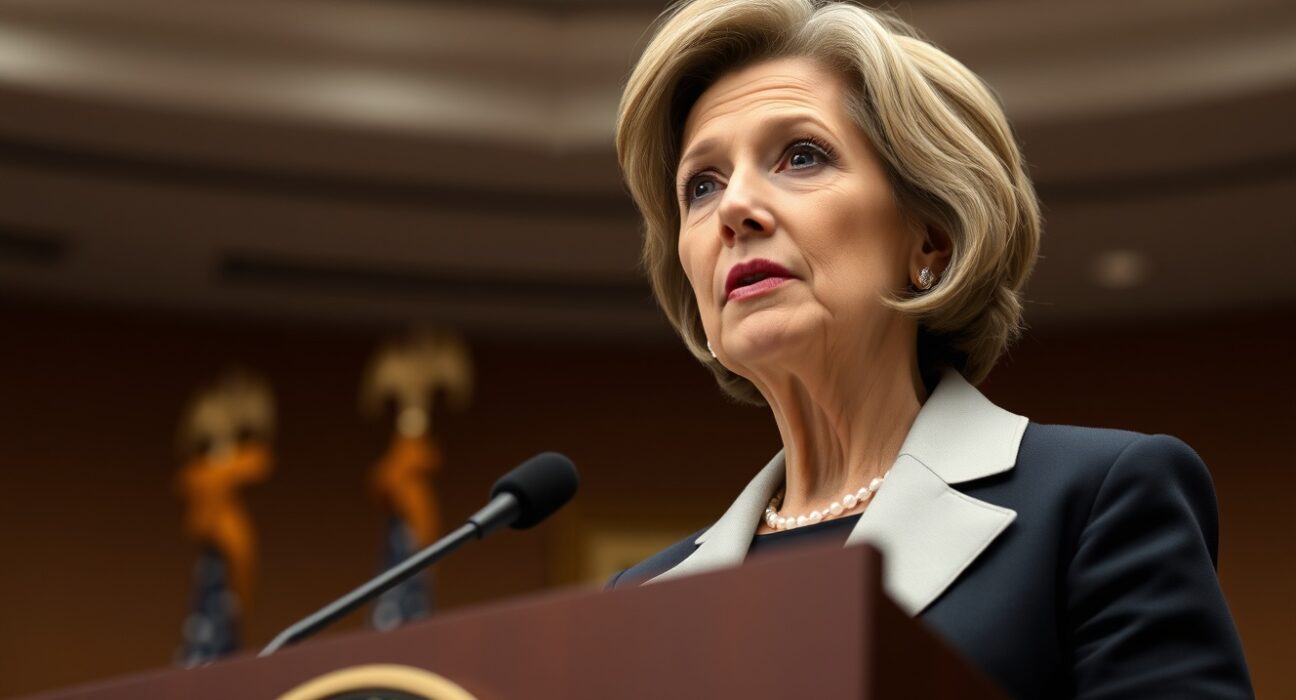
Federal Reserve President Mary Daly delivered crucial insights about potential monetary policy shifts during recent remarks in San Francisco, California, on April 15, 2025. She specifically indicated that interest rate reductions remain a viable option if geopolitical tensions with Iran de-escalate significantly. This statement carries substantial implications for financial markets and the broader economic landscape throughout 2025. Market participants immediately analyzed her comments for signals about the Federal Reserve’s policy trajectory amid ongoing global uncertainties.
Federal Reserve Rate Cut Conditions Explained
San Francisco Federal Reserve President Mary Daly outlined specific conditions that could prompt monetary policy easing. She emphasized that resolving the Iran conflict quickly would represent a critical development. Additionally, subsequent declines in oil prices would provide necessary economic relief. These factors together could create appropriate conditions for adjusting interest rates downward. The Federal Reserve constantly monitors multiple economic indicators when making policy decisions.
Geopolitical tensions directly influence global energy markets through supply chain disruptions. Consequently, oil price volatility creates inflationary pressures that central banks must address. The Federal Reserve’s dual mandate requires balancing maximum employment with price stability. Therefore, external shocks like Middle East conflicts complicate monetary policy decisions significantly. Recent data shows oil prices have fluctuated between $85 and $105 per barrel throughout early 2025.
Historical Context of Geopolitics and Monetary Policy
Previous Federal Reserve responses to geopolitical events provide important context for current discussions. During the 1990-1991 Gulf War, the Fed maintained relatively stable interest rates despite oil price spikes. Conversely, the 2014-2015 period saw policy normalization as Middle East tensions eased. The current situation presents unique challenges because global supply chains remain fragile post-pandemic. Furthermore, strategic petroleum reserves in major economies have diminished from previous drawdowns.
Several key factors differentiate the current geopolitical landscape:
- Global energy transition: Reduced fossil fuel investment limits supply responsiveness
- Strategic alliances: Changing international relationships affect conflict resolution
- Economic interdependence: Complex trade networks amplify disruption impacts
- Technological advancements: Alternative energy sources provide partial insulation
Oil Price Dynamics and Inflation Pressures
Energy costs represent a fundamental component of consumer price indices worldwide. The Federal Reserve’s preferred inflation measure, the Personal Consumption Expenditures Price Index, incorporates energy prices directly. Research indicates that sustained $10 oil price increases typically add 0.2-0.4 percentage points to headline inflation. However, the transmission mechanism has evolved with changing consumption patterns and energy efficiency improvements.
Recent analysis from the Energy Information Administration reveals important trends:
| Period | Average Oil Price | Core Inflation | Headline Inflation |
|---|---|---|---|
| Q4 2024 | $92.45 | 2.8% | 3.2% |
| Q1 2025 | $98.75 | 2.9% | 3.5% |
| Projected Q2 2025 | $88-102 | 2.7-3.1% | 3.0-3.8% |
Federal Reserve economists monitor these relationships continuously. They particularly watch for second-round effects where energy costs influence broader price expectations. Labor market conditions also interact with energy prices through transportation and production costs. The current employment situation remains relatively strong with unemployment below 4%. This combination creates complex policy considerations for Federal Reserve officials.
Monetary Policy Framework for 2025
The Federal Reserve operates within a structured decision-making process guided by economic data. Policy meetings occur eight times annually with additional emergency sessions when necessary. Each Federal Reserve president contributes regional economic perspectives to national discussions. Mary Daly’s comments reflect the San Francisco district’s exposure to technology and international trade sectors. These sectors demonstrate particular sensitivity to both interest rates and geopolitical developments.
Several institutional factors shape current monetary policy approaches:
- Forward guidance: Clear communication about future policy intentions
- Data dependence: Decisions based on incoming economic indicators
- Risk management: Balancing upside and downside economic risks
- International coordination: Considering other central banks’ actions
Financial markets currently price approximately 50 basis points of rate cuts for 2025. However, this expectation remains contingent on inflation progress and external developments. The Federal Reserve’s Summary of Economic Projections provides quarterly updates on policy expectations. Market participants will scrutinize the next release for confirmation of Daly’s conditional outlook.
Expert Perspectives on Policy Flexibility
Former Federal Reserve officials and academic economists provide additional context for current discussions. Dr. Janet Yellen, former Fed Chair and Treasury Secretary, recently emphasized policy flexibility importance. She noted that pre-pandemic monetary frameworks required updating for current global realities. Similarly, Dr. Ben Bernanke highlighted communication challenges during geopolitical uncertainty periods. His research suggests forward guidance becomes particularly valuable when external shocks dominate economic outcomes.
Several research institutions have published relevant analyses recently. The Brookings Institution examined historical Fed responses to Middle East conflicts. The Peterson Institute for International Economics studied oil price transmission mechanisms. The National Bureau of Economic Research analyzed inflation expectations during geopolitical crises. These studies collectively suggest cautious, data-dependent approaches typically produce optimal outcomes.
Economic Implications and Market Reactions
Financial markets responded immediately to President Daly’s conditional rate cut comments. Treasury yields declined modestly across the curve, particularly in intermediate maturities. Equity markets showed mixed reactions with energy sectors underperforming broader indices. Currency markets reflected expectations for potential dollar weakness if rate cuts materialize. Commodity prices adjusted based on perceived conflict resolution probabilities.
Several economic sectors demonstrate particular sensitivity to these developments:
- Transportation: Direct exposure to fuel cost fluctuations
- Manufacturing: Energy-intensive production processes
- Consumer discretionary: Household budget impacts from energy costs
- Financial services: Interest rate sensitivity and risk assessment
The housing market represents another critical transmission channel for monetary policy. Mortgage rates have stabilized near 6.5% after previous Federal Reserve tightening. Potential rate cuts could improve housing affordability for prospective buyers. However, supply constraints continue limiting market responsiveness to interest rate changes. Construction costs also remain elevated due to material price pressures.
Conclusion
Federal Reserve President Mary Daly’s comments provide important clarity about monetary policy possibilities. Her conditional outlook for Federal Reserve rate cuts depends heavily on geopolitical developments and energy market dynamics. The Iran conflict resolution represents a crucial variable for 2025 economic outcomes. Similarly, oil price movements will significantly influence inflation trajectories and policy responses. Market participants should monitor both diplomatic developments and economic data releases closely. The Federal Reserve maintains policy flexibility to respond appropriately to evolving conditions while pursuing its dual mandate objectives.
FAQs
Q1: What specific conditions did Mary Daly mention for potential rate cuts?
President Daly identified two primary conditions: resolution of the Iran conflict and subsequent declines in oil prices. She emphasized that both developments together would create appropriate conditions for considering monetary policy easing.
Q2: How do oil prices influence Federal Reserve decisions?
Oil prices directly affect inflation through energy costs and indirectly through production and transportation expenses. Sustained oil price increases typically add to headline inflation, complicating the Fed’s price stability mandate.
Q3: What is the current Federal Funds Rate target range?
As of April 2025, the Federal Funds Rate target range stands at 4.75-5.00%. This represents the outcome of previous tightening cycles aimed at controlling inflation.
Q4: How often does the Federal Reserve meet to discuss monetary policy?
The Federal Open Market Committee holds eight regularly scheduled meetings per year. Additional emergency meetings may occur when economic conditions require immediate attention.
Q5: What economic indicators does the Fed monitor most closely?
The Federal Reserve monitors multiple indicators including inflation measures (PCE and CPI), employment data, GDP growth, wage growth, consumer spending, and various business activity surveys.
Disclaimer: The information provided is not trading advice, Bitcoinworld.co.in holds no liability for any investments made based on the information provided on this page. We strongly recommend independent research and/or consultation with a qualified professional before making any investment decisions.
