

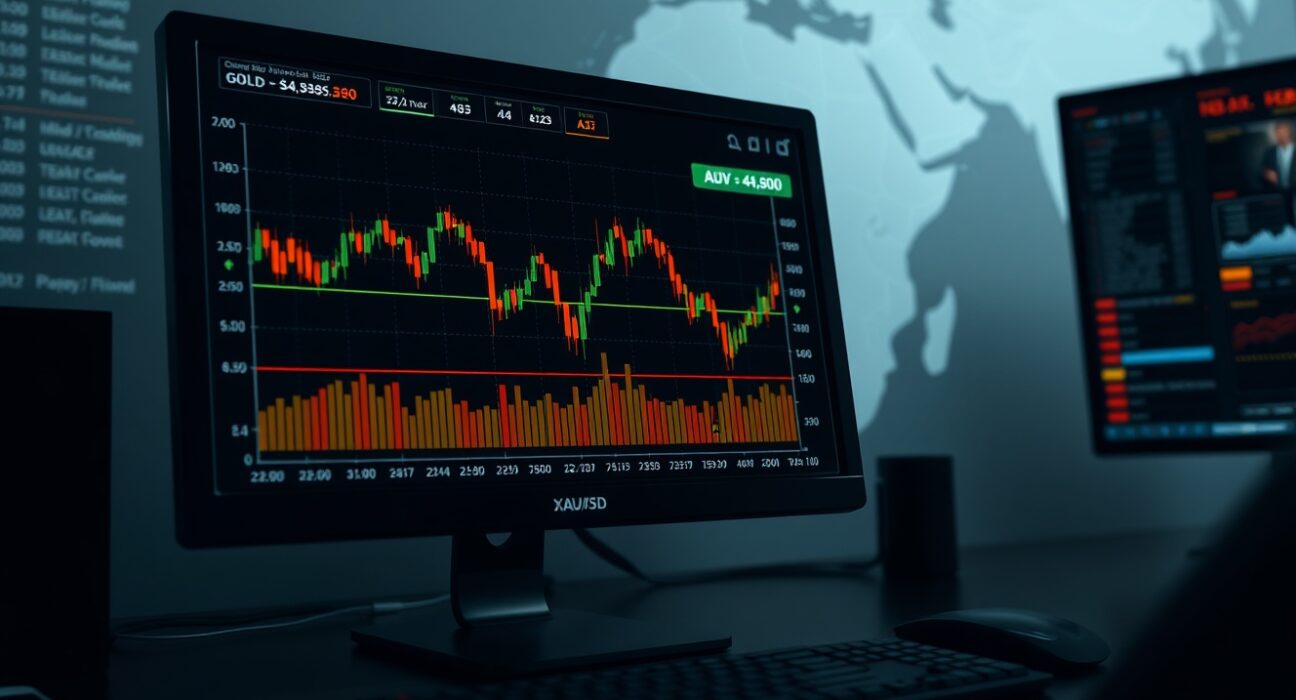
Gold prices (XAU/USD) consolidated below the pivotal $4,850 level in early 2025 trading, as global investors shifted their focus from economic data to high-stakes geopolitical diplomacy. The precious metal’s traditional role as a safe-haven asset faces a significant test with the potential de-escalation of tensions in the Middle East. Consequently, market participants are now parsing every development from the renewed US-Iran peace negotiations. These talks represent a potential watershed moment for regional stability and, by extension, for assets like gold that thrive on uncertainty.
Gold Price Forecast: Technical Landscape Amid Geopolitical Shifts
Technical analysis reveals a market at a critical juncture. The XAU/USD pair has established a strong support zone between $4,800 and $4,820, a level tested multiple times in recent sessions. However, the failure to sustain a break above $4,850 indicates persistent selling pressure. Key moving averages, such as the 50-day and 200-day Exponential Moving Averages (EMAs), are currently acting as dynamic resistance levels. Market technicians note that a daily close above $4,900 would invalidate the current bearish structure and potentially open the path toward the $5,000 psychological barrier. Conversely, a decisive break below $4,780 could trigger a swift correction toward the $4,700 support cluster.
Critical Technical Levels for XAU/USD:
- Immediate Resistance: $4,850 – $4,870
- Major Support: $4,800 – $4,820
- Bullish Target: $4,950 upon breakout
- Bearish Target: $4,700 upon breakdown
The Geopolitical Catalyst: Anatomy of US-Iran Diplomacy
The current round of peace talks, facilitated by Oman and Qatar, marks the most substantive dialogue between Washington and Tehran in nearly a decade. The primary agenda reportedly centers on a mutual return to compliance with the 2015 nuclear deal, known formally as the Joint Comprehensive Plan of Action (JCPOA), alongside discussions on regional security frameworks. For commodity markets, the implications are profound. A successful détente could reduce the longstanding geopolitical risk premium baked into oil prices, which often has a correlative effect on gold. Historically, easing tensions in the oil-rich Middle East tends to diminish immediate demand for inflation hedges and crisis assets.
Expert Analysis on Market Correlations
Financial analysts from institutions like the World Gold Council and major investment banks emphasize the complex relationship. “Gold’s reaction to geopolitical events is rarely linear,” notes a senior strategist at a global asset management firm, referencing public commentary from the firm’s quarterly reports. “While de-escalation can remove a short-term bid for safety, it also alters fundamental drivers like inflation expectations and dollar strength. For instance, a peace deal could bolster global growth prospects, potentially leading central banks to maintain tighter monetary policy for longer, which presents a headwind for non-yielding assets.” This analysis underscores the multi-faceted impact beyond simple risk-on/risk-off dynamics.
Macroeconomic Backdrop and Gold’s Dual Role
Beyond geopolitics, gold continues to navigate a challenging macroeconomic environment. Central banks, particularly the Federal Reserve and the European Central Bank, maintain a data-dependent stance on interest rates. Higher real yields, which result from elevated interest rates, increase the opportunity cost of holding gold. However, robust central bank purchasing of physical gold, led by institutions in China, India, and Turkey, provides a consistent floor for prices. According to data from the International Monetary Fund (IMF), central banks added over 1,000 tonnes to global reserves in 2024, a trend expected to continue in 2025 as part of long-term de-dollarization strategies.
Key Macro Factors Influencing Gold:
- Central Bank Policy: Path of interest rates and quantitative tightening.
- Currency Markets: Strength of the US Dollar (DXY Index).
- Inflation Trends: Persistence of core inflation metrics globally.
- Physical Demand: Jewelry and industrial offtake, especially from Asia.
Historical Precedents and Market Psychology
Examining past episodes of geopolitical de-escalation offers valuable context. Following the initial signing of the JCPOA in 2015, gold prices experienced a period of consolidation but did not enter a prolonged bear market. Instead, other factors like the Federal Reserve’s rate hike cycle and Chinese market volatility became dominant drivers. This pattern suggests that while a positive outcome from US-Iran talks may cap gold’s near-term upside, its long-term trajectory remains tied to broader monetary and currency trends. Market psychology currently reflects this balanced view, with trading volumes in gold futures and ETFs remaining elevated, indicating sustained investor interest rather than a wholesale exit.
Conclusion
The gold price forecast remains tightly bound to the outcome of US-Iran diplomacy. While XAU/USD faces technical resistance below $4,850, its fundamental story is bifurcated. Positive diplomatic news may suppress the geopolitical risk premium, yet structural support from central bank buying and ongoing economic uncertainties provides a durable foundation. Traders and long-term investors alike should monitor the $4,800-$4,850 range for a decisive breakout, which will likely signal the market’s collective judgment on whether peace talks or macroeconomic forces will dictate the next major trend for the precious metal.
FAQs
Q1: Why are US-Iran peace talks important for the gold price?
The talks are crucial because gold often acts as a safe-haven asset during geopolitical instability. A reduction in Middle East tensions could decrease the immediate demand for gold as a crisis hedge, potentially removing a key price support.
Q2: What is the main technical level to watch for XAU/USD?
The $4,850 level is the immediate technical resistance. A sustained break above could target $4,950, while a failure and drop below $4,800 support may signal a deeper correction.
Q3: How do central bank policies affect gold alongside geopolitics?
Higher interest rates increase the opportunity cost of holding non-yielding gold. Even if geopolitics calm, aggressive monetary tightening from the Fed or ECB can limit gold’s upside, creating a complex interplay of drivers.
Q4: Are central banks still buying gold in 2025?
Yes, data indicates central bank gold purchasing remains a strong trend in 2025, driven by diversification strategies. This institutional demand creates a structural floor for gold prices independent of short-term geopolitical news.
Q5: What other assets are sensitive to US-Iran talks besides gold?
Crude oil prices are highly sensitive, as the Middle East is a key production region. Additionally, global equity markets, regional ETFs, and currencies like the US Dollar and Swiss Franc often react to shifts in geopolitical risk sentiment.
Disclaimer: The information provided is not trading advice, Bitcoinworld.co.in holds no liability for any investments made based on the information provided on this page. We strongly recommend independent research and/or consultation with a qualified professional before making any investment decisions.
