

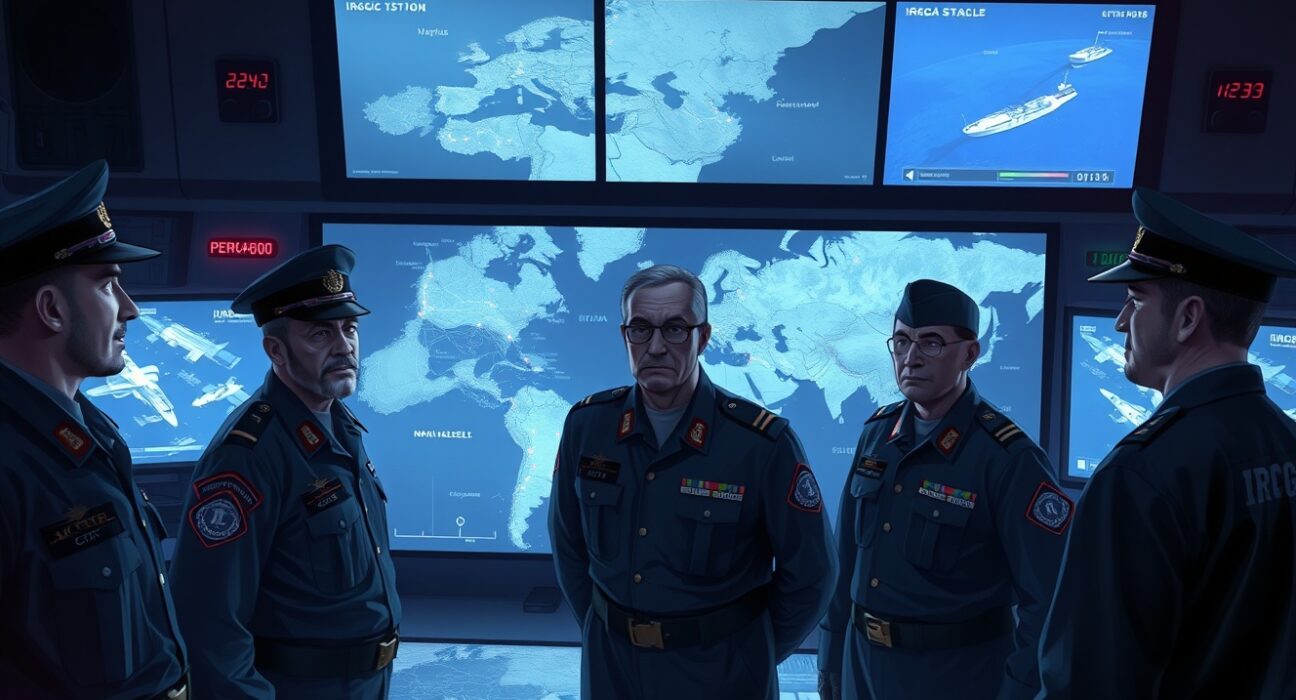
The Islamic Revolutionary Guard Corps (IRGC) has issued a stark warning, threatening to obliterate the United States’ remaining assets in the Middle East. This announcement, made through official channels, escalates an already volatile regional security environment. The statement directly targets US military installations, naval vessels, and strategic infrastructure across the region. This development demands immediate attention from global security analysts and policymakers.
IRGC Warns US Assets in Middle East: The Official Statement
The IRGC’s warning came through a formal communiqué on Monday. It explicitly names several key locations where US forces maintain a presence. The statement uses forceful language, promising a decisive and overwhelming response to any perceived aggression. This marks a significant shift in tone from previous diplomatic engagements. The IRGC frames this as a defensive measure to protect Iran’s national security interests.
Key points from the IRGC statement include:
- Direct threat to US military bases in Qatar, Bahrain, and the United Arab Emirates.
- Warning about US naval assets in the Persian Gulf and the Strait of Hormuz.
- Assertion that Iran has the capability to target these assets with precision.
- Call for regional allies to distance themselves from US military operations.
This rhetoric aligns with a pattern of escalating tensions between Tehran and Washington. The IRGC’s history of asymmetric warfare capabilities adds credibility to the threat. Regional governments now face a difficult balancing act between their security alliances and potential retaliation.
Context: US Military Assets in the Middle East
The United States maintains a substantial military footprint across the Middle East. This includes approximately 30,000 troops stationed in various countries. Key installations include Al Udeid Air Base in Qatar, Camp Arifjan in Kuwait, and Naval Support Activity Bahrain. These bases serve as critical hubs for air operations, logistics, and naval patrols.
A breakdown of major US assets in the region:
| Country | Key Base | Primary Function |
|---|---|---|
| Qatar | Al Udeid Air Base | Air operations, command center |
| Bahrain | NSA Bahrain | Naval fleet support |
| Kuwait | Camp Arifjan | Ground forces logistics |
| UAE | Al Dhafra Air Base | Surveillance, refueling |
These assets are not just symbolic. They provide the US with rapid response capabilities for counterterrorism and deterrence missions. The IRGC’s warning targets the logistical and operational backbone of these forces. Any successful attack would severely degrade US power projection in the region.
Escalation Timeline: From Diplomacy to Threats
The current crisis did not emerge overnight. It follows a series of diplomatic failures and military confrontations. In early 2025, negotiations over Iran’s nuclear program collapsed. The US imposed new sanctions, which Iran called a violation of previous agreements. Subsequent proxy attacks on US bases in Iraq and Syria increased in frequency.
Key events leading to this warning:
- January 2025: US drone strike kills an IRGC commander in Syria.
- March 2025: Iran seizes a commercial tanker in the Strait of Hormuz.
- April 2025: US deploys an additional aircraft carrier strike group to the region.
- May 2025: IRGC test-fires a new ballistic missile with a 2,000 km range.
This timeline shows a clear pattern of reciprocal escalation. Each action by one side provokes a stronger response from the other. The IRGC’s latest warning represents a rhetorical red line. Crossing it could trigger a direct military confrontation.
Expert Analysis: The Risk of Miscalculation
Military analysts describe the current situation as extremely dangerous. Dr. Leila Hosseini, a security expert at the Institute for Regional Studies, notes that the IRGC’s doctrine emphasizes preemptive strikes. She states that the warning serves both a deterrent and a mobilizing purpose. It signals to domestic audiences that Iran will not back down. Simultaneously, it warns the US that any move will meet a swift response.
Other experts highlight the role of non-state actors. Iran’s network of proxies, including Hezbollah and various Iraqi militias, could execute attacks without direct IRGC involvement. This provides a layer of plausible deniability. However, the IRGC’s explicit threat removes ambiguity. The US now must treat any attack on its assets as a potential casus belli.
The risk of miscalculation is high. Both sides have limited channels for direct communication. The absence of a hotline or crisis management mechanism increases the chance of accidental escalation. A single drone incursion or naval incident could spiral into a wider conflict.
Impact on Regional Security and Global Markets
The IRGC’s warning has immediate and far-reaching consequences. Oil prices surged by 5% within hours of the statement. The Strait of Hormuz, a chokepoint for 20% of global oil supply, now faces heightened risk. Insurance premiums for tankers transiting the region have already doubled.
Regional governments are scrambling to respond. Saudi Arabia and the UAE have called for de-escalation. They fear being caught in the crossfire of a US-Iran conflict. Their economies depend on stable energy markets and foreign investment. Any disruption would harm their Vision 2030 diversification plans.
Key impacts include:
- Oil price volatility: Brent crude could spike above $120 per barrel.
- Shipping disruptions: Major shipping lines may reroute away from the Persian Gulf.
- Investment flight: Foreign capital may withdraw from Gulf stock markets.
- Humanitarian risk: Civilian populations near military bases face increased danger.
The global community watches with concern. The United Nations Security Council has scheduled an emergency session. Diplomatic efforts by European and Asian powers aim to prevent a full-blown crisis. However, the IRGC’s uncompromising stance leaves little room for negotiation.
Historical Parallels: Lessons from Past Conflicts
This situation echoes previous US-Iran confrontations. The 1988 Operation Praying Mantis saw the US Navy destroy Iranian oil platforms and naval vessels. The 2019 attacks on Saudi Aramco facilities demonstrated Iran’s ability to strike critical infrastructure. The 2020 assassination of General Qasem Soleimani triggered a period of intense but contained retaliation.
Each of these events followed a pattern of escalation and de-escalation. However, the current context differs in several ways. First, Iran’s missile and drone capabilities have advanced significantly. Second, the US has reduced its troop presence in the region, making remaining assets more vulnerable. Third, the breakdown of the JCPOA nuclear deal removes a key diplomatic framework.
These differences suggest that the current crisis may not follow historical precedents. The IRGC’s warning could be a bluff, a negotiating tactic, or a genuine preparation for conflict. The US must interpret the signal correctly to avoid a costly war.
Conclusion
The IRGC’s warning to obliterate US remaining assets in the Middle East represents a serious escalation in an already tense region. This threat targets the logistical and operational backbone of American military power. The risk of miscalculation, combined with advanced Iranian capabilities, creates a volatile situation. Regional stability, global energy markets, and international security all hang in the balance. Diplomatic efforts must intensify to prevent a conflict that neither side can afford. The world now watches to see if words translate into action.
FAQs
Q1: What exactly did the IRGC warn about regarding US assets in the Middle East?
The IRGC warned that it would obliterate US military assets in the Middle East, including bases in Qatar, Bahrain, and the UAE, as well as naval vessels in the Persian Gulf. The warning was issued as a response to perceived US aggression and sanctions.
Q2: Which US military assets are most at risk from the IRGC threat?
The most at-risk assets include Al Udeid Air Base in Qatar, Naval Support Activity Bahrain, Camp Arifjan in Kuwait, and Al Dhafra Air Base in the UAE. These bases host critical air, naval, and logistics operations.
Q3: How has the US responded to the IRGC’s warning?
The US has not issued an official response yet, but the Pentagon has heightened alert levels for its forces in the region. Diplomatic channels are active, with the US calling for de-escalation while maintaining its military posture.
Q4: What are the potential global consequences if the IRGC follows through on its threat?
A direct attack on US assets could trigger a major military conflict. Oil prices would spike, global shipping through the Strait of Hormuz would be disrupted, and regional economies would suffer. Humanitarian crises could also emerge near targeted bases.
Q5: Is there any historical precedent for such a direct threat from the IRGC?
While the IRGC has issued threats before, the explicit language targeting all US remaining assets is rare. Previous threats were more limited in scope. This warning represents a significant rhetorical escalation compared to past statements.
Disclaimer: The information provided is not trading advice, Bitcoinworld.co.in holds no liability for any investments made based on the information provided on this page. We strongly recommend independent research and/or consultation with a qualified professional before making any investment decisions.
