

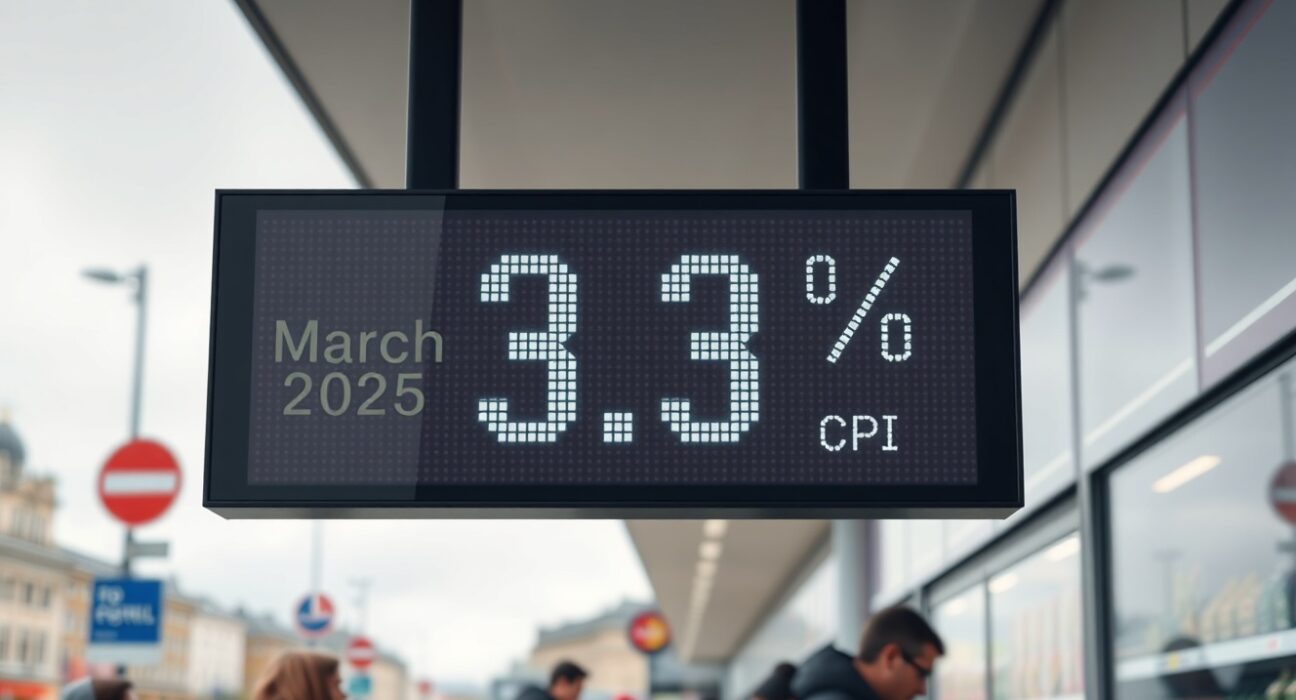
UK CPI inflation climbed to 3.3% year-on-year (YoY) in March 2025, matching economists’ expectations. This marks a significant increase from the 3.0% reading recorded in February 2025. The data, released by the Office for National Statistics (ONS) on April 16, 2025, underscores persistent price pressures within the British economy. This development arrives amid ongoing debates about the Bank of England’s monetary policy path.
Drivers Behind the UK CPI Inflation Climb to 3.3%
Several key sectors contributed to the UK CPI inflation climb. Core inflation, which excludes volatile food and energy prices, also rose. It increased from 3.5% in February to 3.7% in March. Services inflation, a closely watched measure by the Bank of England, remained elevated at 5.1%. This stubbornly high services component suggests that domestic price pressures are still strong.
Food and non-alcoholic beverage prices saw a monthly increase of 0.5%. Housing and household services, including electricity and gas, contributed significantly. Transport costs also added upward pressure, driven by higher fuel prices and airfares. These factors combined to push the headline rate higher.
Comparing March 2025 UK Inflation with Forecasts
The March figure exactly matched the consensus forecast from a Reuters poll of economists. This alignment provides some relief for markets. However, the details within the report reveal a more complex picture. The month-on-month (MoM) CPI change was 0.6%, up from 0.4% in February. This indicates that price increases accelerated during the month.
Producer price inflation also showed upward movement. Input prices rose by 1.2% MoM, while output prices increased by 0.8%. These upstream pressures may feed into consumer prices in the coming months. The data reinforces the view that inflation is proving stickier than previously anticipated.
Bank of England’s Response to Sticky Inflation
The Bank of England (BoE) faces a difficult decision. The Monetary Policy Committee (MPC) has maintained the base rate at 4.5% since February 2025. The latest inflation data reduces the likelihood of an early rate cut. Market expectations for a May 2025 rate reduction have fallen sharply. Traders now see only a 20% chance of a cut, down from 40% before the release.
BoE Governor Andrew Bailey has repeatedly emphasized a ‘data-dependent’ approach. He has warned that services inflation and wage growth remain too high. The March CPI report supports his cautious stance. The MPC will likely hold rates steady at its next meeting on May 8, 2025.
Impact on UK Households and Spending Power
The UK CPI inflation climb directly affects household budgets. Real wages, adjusted for inflation, have grown only modestly. The latest ONS data shows average weekly earnings grew by 5.6% YoY in February. However, with inflation at 3.3%, real wage growth stands at just 2.3%. This limits consumer spending capacity.
Essential items continue to see the steepest price rises. Key categories with above-average inflation include:
- Housing & utilities: Up 4.2% YoY
- Food & non-alcoholic drinks: Up 3.8% YoY
- Restaurants & hotels: Up 4.5% YoY
- Education: Up 5.1% YoY
These categories represent a larger share of spending for lower-income households. Therefore, the impact of inflation is unevenly distributed across society. The Resolution Foundation estimates that the poorest 20% of households face an effective inflation rate of 3.8%.
Market Reaction to the March CPI Data
Financial markets reacted swiftly to the UK CPI inflation release. The British pound strengthened against both the US dollar and the euro. Sterling rose 0.4% to $1.2950 and gained 0.3% against the euro to €1.1720. Bond yields also moved higher. The yield on the 10-year UK gilt increased by 8 basis points to 4.32%.
The FTSE 100 index opened lower, declining by 0.5% in early trading. Higher inflation expectations typically weigh on equity valuations, particularly for growth stocks. However, banking stocks rose on the prospect of higher-for-longer interest rates. This divergence reflects the complex market dynamics at play.
Global Context: Inflation Trends Across Economies
The UK is not alone in experiencing sticky inflation. The US CPI for March came in at 3.5% YoY, above the Federal Reserve’s 2% target. The Eurozone harmonized index of consumer prices (HICP) stood at 2.4% in March. However, the UK’s inflation rate remains the highest among G7 nations. This persistent differential has implications for currency markets and trade competitiveness.
Supply chain disruptions, rising energy costs, and tight labor markets are common themes across advanced economies. The UK’s specific challenges include Brexit-related trade frictions and a smaller labor force. These structural factors may keep UK inflation structurally higher than peers.
Timeline of UK Inflation: From Peak to Current Levels
UK CPI inflation peaked at 11.1% in October 2022. Since then, it has followed a downward but bumpy trajectory. Key milestones include:
- October 2022: Peak at 11.1%
- June 2023: Falls below 8% for first time in a year
- November 2023: Drops to 3.9%
- February 2024: Reaches 2-year low of 3.4%
- September 2024: Briefly touches 1.7% (below 2% target)
- December 2024: Rebounds to 2.5%
- March 2025: Rises to 3.3%
This timeline illustrates that the battle against inflation is far from over. The BoE’s target of 2% remains elusive. The current trajectory suggests that inflation may stay above target for the remainder of 2025.
Expert Analysis and Forward-Looking Perspectives
Economists have weighed in on the implications of the March CPI data. Samuel Tombs, Chief UK Economist at Pantheon Macroeconomics, noted that ‘the details of the report are more worrying than the headline. Services inflation remains entrenched above 5%, which will alarm MPC hawks.’
Ruth Gregory, Deputy Chief UK Economist at Capital Economics, offered a slightly more optimistic view. She stated that ‘while the March data is disappointing, we expect inflation to fall back towards 2.5% by the end of 2025 as energy price base effects fade.’ However, she cautioned that ‘the risks are skewed to the upside.’
The Institute for Fiscal Studies (IFS) highlighted the fiscal implications. Higher inflation increases government debt servicing costs. The UK’s debt interest payments are linked to the Retail Prices Index (RPI), which stood at 3.8% in March. This adds pressure on Chancellor Rachel Reeves’ fiscal headroom ahead of the Autumn Budget.
Conclusion
The UK CPI inflation climb to 3.3% YoY in March 2025 confirms that price pressures remain stubbornly elevated. While the headline figure matched expectations, the persistence of services inflation and core inflation signals a challenging path ahead. The Bank of England will likely maintain its cautious stance, keeping interest rates higher for longer. Households will continue to face cost-of-living pressures, particularly in essential categories. Financial markets have adjusted their expectations accordingly, with the pound strengthening and rate cut bets fading. The data reinforces the importance of monitoring inflation trends closely as the UK economy navigates this complex period.
FAQs
Q1: What is the current UK CPI inflation rate for March 2025?
The UK CPI inflation rate for March 2025 is 3.3% year-on-year, matching economists’ forecasts.
Q2: How does March 2025 inflation compare to previous months?
It represents an increase from 3.0% in February 2025 and 2.5% in December 2024, indicating a rising trend.
Q3: What are the main drivers of the UK CPI inflation climb?
Key drivers include housing and utilities, food prices, transport costs, and persistently high services inflation at 5.1%.
Q4: Will the Bank of England cut interest rates after this data?
The likelihood of a May 2025 rate cut has decreased significantly. The MPC is expected to hold rates at 4.5% at its next meeting.
Q5: How does UK inflation compare to other major economies?
The UK’s 3.3% rate is the highest among G7 nations, compared to 3.5% in the US and 2.4% in the Eurozone.
Disclaimer: The information provided is not trading advice, Bitcoinworld.co.in holds no liability for any investments made based on the information provided on this page. We strongly recommend independent research and/or consultation with a qualified professional before making any investment decisions.
