

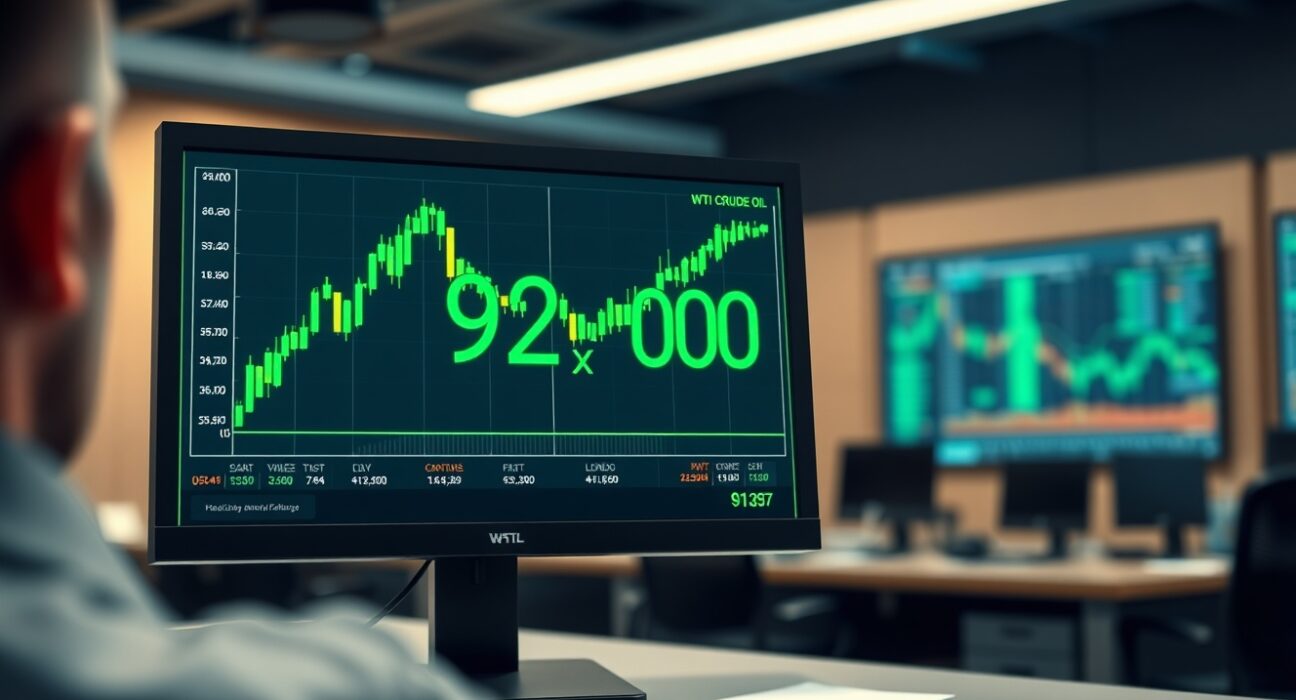
West Texas Intermediate (WTI) crude oil futures staged a significant rally, pushing prices back above the $92 per barrel mark this week. This surge occurred despite diplomatic efforts to extend a key ceasefire, highlighting the market’s deep-seated anxiety over global supply stability. Consequently, traders are now focusing on fundamental risks rather than temporary geopolitical pauses.
WTI Crude Oil Rally Defies Diplomatic Progress
The benchmark U.S. oil contract gained over 3% in Thursday’s trading session, decisively reclaiming territory last seen in early October. This price action directly contradicts the calming influence typically associated with ceasefire extensions. Market analysts point to several underlying factors driving this disconnect. Firstly, inventory data from the Energy Information Administration showed a larger-than-expected draw. Secondly, ongoing production discipline from the OPEC+ alliance continues to constrain supply. Finally, resilient global demand, particularly from emerging economies, provides a firm price floor.
Furthermore, the market’s reaction signals a assessment of long-term risks. “The ceasefire is a welcome development for humanitarian reasons, but it does little to address the structural supply vulnerabilities in the region,” noted a senior analyst from a major commodities research firm. The fear centers on the potential for a rapid escalation once any truce ends, which could immediately disrupt shipping lanes and production facilities. Therefore, the risk premium embedded in oil prices remains elevated.
Chart Analysis Reveals Key Technical Breakout
The technical picture for WTI strengthened considerably with this move. Critical resistance at the $90 psychological level was convincingly broken on high volume. Additionally, the 50-day moving average has turned upward, providing dynamic support. Market technicians now watch the $95 level, which represents the next significant technical hurdle from the late-2023 highs.
Persistent Supply Fears Underpin Market Sentiment
The failure of diplomacy to soothe the market stems from multiple, concurrent supply threats. These are not isolated to a single region but represent a global mosaic of risk.
- Geopolitical Flashpoints: Beyond the immediate conflict, tensions remain high in other key oil-producing regions. Strategic chokepoints like the Strait of Hormuz continue to see heightened military activity, threatening the transit of nearly 20% of global seaborne oil.
- Inventory Declines: Global oil inventories have been drawn down consistently. Notably, the United States’ Strategic Petroleum Reserve remains at multi-decade lows, limiting a key buffer against supply shocks.
- Underinvestment in Production: Years of subdued capital expenditure in traditional oil fields, partly due to energy transition pressures, have constrained the industry’s ability to quickly ramp up output in response to price signals.
A comparison of current supply risks versus the previous year illustrates the heightened environment:
| Risk Factor | Q4 2024 Severity | Q4 2023 Severity |
|---|---|---|
| Geopolitical Tension in Middle East | High | Medium |
| Global Commercial Inventory Levels | Low | Medium |
| Spare Production Capacity | Limited | Moderate |
| Freight & Shipping Security | Elevated | Normal |
The Ceasefire’s Limited Impact on Energy Logistics
While the extended ceasefire has halted immediate conflict, it has not resolved the logistical bottlenecks that preceded it. Insurance premiums for vessels operating in the region remain at war-risk levels. Moreover, many shipping companies continue to reroute cargoes around the Cape of Good Hope, adding significant time and cost to deliveries. This rerouting effectively removes barrels from the market for an additional 10-14 days per voyage, creating a de facto supply tightness.
Simultaneously, refinery demand remains robust as the northern hemisphere enters the winter heating season. Refiners are competing for available crude cargoes, supporting the spot price. “The physical market is tight,” confirmed a Singapore-based crude trader. “The paper market rally is simply catching up to the reality on the water.” This disconnect between physical and futures markets often corrects through price movements like the one witnessed.
Expert Insight on Market Psychology
Dr. Anya Sharma, Head of Commodities Strategy at Global Macro Advisors, explains the nuanced reaction. “Markets are forward-looking mechanisms. A ceasefire addresses the present, but traders are pricing in the future. The underlying structural issues—underinvestment, strategic stockpile depletion, and fragile supply chains—are now the dominant narrative. Until there is clear evidence of these fundamentals changing, any price dip on geopolitical news will be viewed as a buying opportunity.” This perspective is widely held among institutional investors, who have increased their net-long positions in oil futures for the third consecutive week.
Global Economic Implications of Sustained High Prices
Sustained WTI prices above $90 carry significant implications for the global economy. Central banks, already grappling with inflation, monitor energy costs closely. Higher oil prices translate directly into increased costs for transportation, manufacturing, and heating. This can create secondary inflationary effects, potentially delaying or altering monetary policy decisions. For consumers, it means continued pressure at the gasoline pump and on household energy bills, potentially dampening discretionary spending in other sectors.
Conversely, major oil-exporting nations see strengthened fiscal balances. This increased revenue could support domestic spending and sovereign wealth fund investments. The bifurcated impact creates a complex landscape for policymakers worldwide, who must balance growth and inflation objectives against a volatile energy backdrop.
Conclusion
The rally in WTI crude oil back to the $92 level underscores a critical market truth: geopolitical events provide volatility, but fundamental supply and demand dynamics set the trend. The extended ceasefire, while diplomatically significant, failed to calm the underlying supply fears that have gripped the energy complex. These fears are rooted in tangible factors like low inventories, production constraints, and fragile logistics. As the market looks ahead, the WTI crude oil price will likely remain sensitive to any sign of actual supply improvement or deterioration, making the current environment one of heightened vigilance for traders and economists alike.
FAQs
Q1: Why did WTI oil prices rise despite a ceasefire extension?
The market rose because the ceasefire did not resolve the core issues causing supply fears, such as low global inventories, ongoing production limits from OPEC+, and persistent risks to shipping routes. Traders focused on these enduring fundamentals.
Q2: What is the key resistance level for WTI after breaking $90?
The next major technical resistance level for WTI crude oil is around $95 per barrel, which was the high point reached in late 2023. A break above that could signal a test of the $100 psychological level.
Q3: How do high oil prices affect inflation and central banks?
High oil prices are directly inflationary, increasing costs for transport, goods, and energy. This can complicate central bank efforts to control inflation, potentially leading to higher interest rates for longer than previously anticipated.
Q4: What does ‘supply fear’ mean in the oil market context?
Supply fear refers to the market’s concern that available crude oil may not meet global demand due to factors like geopolitical disruption, underinvestment in new production, declining inventories, or logistical problems. This concern leads traders to bid up prices.
Q5: Are other oil benchmarks like Brent also rallying?
Yes, the rally is broad-based. Brent crude, the international benchmark, also experienced significant gains, trading at a premium to WTI. The global nature of the supply concerns is affecting all major oil contracts.
Disclaimer: The information provided is not trading advice, Bitcoinworld.co.in holds no liability for any investments made based on the information provided on this page. We strongly recommend independent research and/or consultation with a qualified professional before making any investment decisions.
