

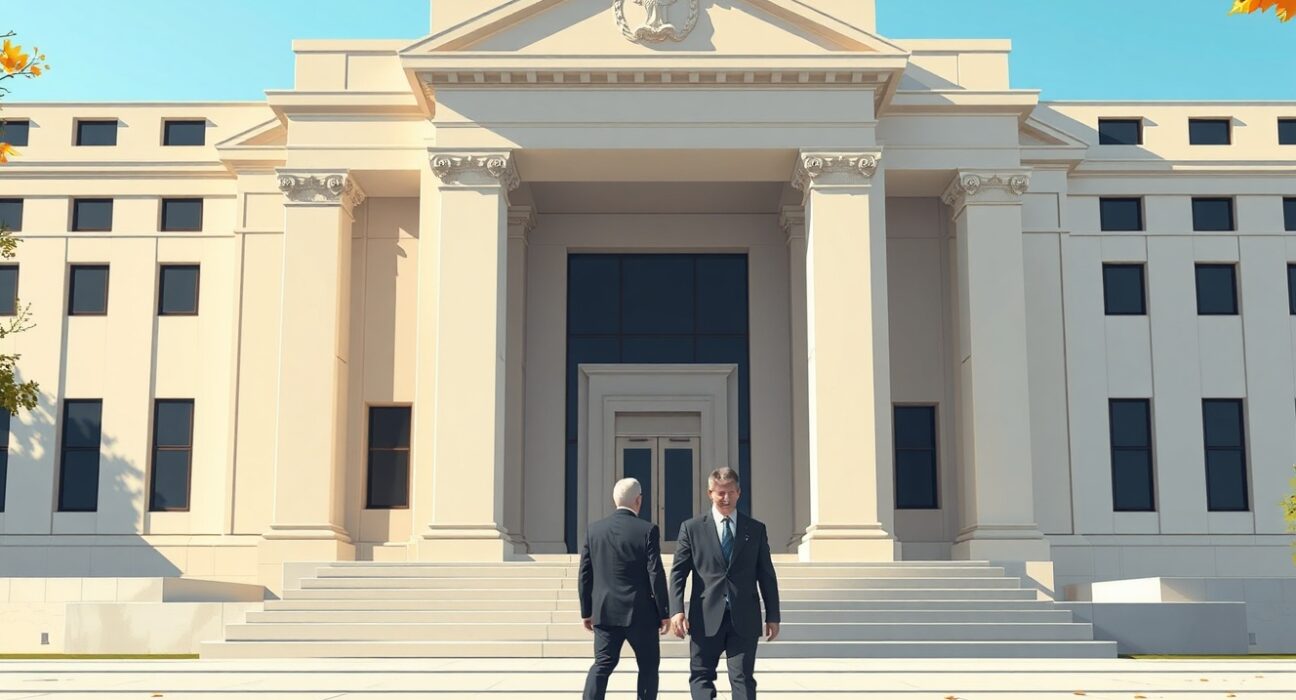
Washington D.C., March 15, 2025 – The Federal Reserve is widely expected to maintain its benchmark interest rate at the current level when its Federal Open Market Committee (FOMC) concludes its two-day meeting this Wednesday. However, market participants are increasingly focused on a parallel narrative: the potential leadership transition from Chair Jerome Powell to former Fed Governor Kevin Warsh. This dual dynamic—a steady rate decision combined with a looming leadership change—creates a unique environment for investors and policymakers alike.
Federal Reserve Expected to Hold Rates: The Data Behind the Decision
Recent economic data supports the Federal Reserve‘s decision to pause. Inflation, as measured by the core Personal Consumption Expenditures (PCE) index, remains above the 2% target but has shown signs of moderation. February’s consumer price index (CPI) rose 3.1% year-over-year, down from 3.4% in January. The labor market remains resilient, with nonfarm payrolls adding 275,000 jobs in February, exceeding expectations. However, wage growth has slowed to 4.3% annually, suggesting easing pressure on services inflation.
Market expectations for a rate hold are near 98%, according to CME Group’s FedWatch Tool. This marks the fifth consecutive meeting without a rate change. The Fed’s terminal rate, or the peak of this tightening cycle, remains at 5.50% to 5.75%. Analysts point to sticky inflation in housing and services as reasons for caution. The central bank’s preferred inflation gauge, the core PCE index, stood at 2.8% in January. This level remains above the Fed’s comfort zone.
Key factors influencing the decision include:
- Inflation persistence: Core services inflation, excluding housing, remains elevated at 3.9%.
- Labor market tightness: The unemployment rate holds at 3.9%, near historic lows.
- Consumer spending: Retail sales rose 0.6% in February, indicating robust demand.
- Geopolitical risks: Ongoing conflicts in Eastern Europe and the Middle East add uncertainty to energy prices.
The Powell-Warsh Leadership Change: A New Era for Monetary Policy
While the rate decision itself may be uneventful, the Powell-Warsh leadership change narrative dominates conversations among economists and traders. Reports suggest that President Donald Trump is considering Kevin Warsh as a potential successor to Jerome Powell, whose term as Chair ends in May 2026. Warsh, a former Fed Governor (2006–2011) and current Hoover Institution fellow, is known for his hawkish views on inflation and his advocacy for rule-based monetary policy.
Warsh’s potential appointment signals a shift toward a more transparent and predictable policy framework. He has publicly criticized the Fed’s reliance on forward guidance and quantitative easing. In a 2023 op-ed for the Wall Street Journal, Warsh argued that the central bank should adopt a Taylor Rule-like approach to set rates. This would tie policy decisions more directly to economic variables like inflation and output gaps.
The transition process remains speculative. Powell’s term as Chair does not expire until May 2026, but his term as a Board member runs until January 2028. However, political pressure from the White House could accelerate a change. In 2024, Trump publicly stated that he would not reappoint Powell if re-elected, citing disagreements over rate hikes. The current administration has not confirmed any formal nomination process.
Market Reactions to the Potential Shift
Financial markets have already begun pricing in a Warsh-led Fed. The yield on the 10-year Treasury note rose 15 basis points in the past week, reflecting expectations of tighter monetary policy. The U.S. dollar index (DXY) strengthened 0.8% against a basket of major currencies. Equities, particularly growth stocks, have underperformed as higher discount rates reduce the present value of future earnings.
Key market impacts include:
- Bond yields: The 2-year/10-year yield curve has steepened, indicating expectations of higher short-term rates.
- Currency markets: The euro fell 1.2% against the dollar, as traders anticipate a more hawkish Fed.
- Commodities: Gold prices dropped 2.5% to $2,150 per ounce, as real yields rise.
- Volatility: The CBOE Volatility Index (VIX) climbed to 18.5, up from 14.2 a month ago.
Comparing Powell and Warsh: Two Approaches to Monetary Policy
The potential Powell-Warsh leadership change highlights contrasting philosophies. Powell, a lawyer and investment banker, has emphasized data-dependent decision-making and flexibility. He guided the Fed through the COVID-19 pandemic with aggressive easing and later orchestrated the fastest rate hiking cycle in four decades. Warsh, by contrast, favors a rules-based system that reduces discretionary judgment.
| Aspect | Jerome Powell | Kevin Warsh |
|---|---|---|
| Policy framework | Data-dependent, flexible | Rule-based, Taylor Rule |
| Inflation stance | Patient, tolerant of overshoot | Hawkish, preemptive |
| Forward guidance | Extensive use | Skeptical, prefers clarity |
| Quantitative easing | Used aggressively | Critical of QE’s side effects |
| Communication style | Conciliatory, consensus-building | Direct, academic |
What This Means for Investors and the Economy
The combination of a steady rate decision and a potential leadership change creates a complex landscape. In the near term, the Fed’s hold signals that policymakers see no urgency to adjust rates. This provides a stable backdrop for corporate borrowing and consumer loans. Mortgage rates, currently at 6.8%, may stabilize, offering relief to the housing market.
However, the longer-term outlook depends on the pace of disinflation. If inflation remains stubborn, a Warsh-led Fed could resume rate hikes. This would raise borrowing costs for businesses and households, potentially slowing economic growth. The Congressional Budget Office (CBO) projects GDP growth of 2.1% in 2025, down from 2.5% in 2024. A more hawkish Fed could push growth below 1.5%.
Key sectors to watch include:
- Technology: Higher rates compress valuations, especially for unprofitable growth companies.
- Banking: Net interest margins improve with higher rates, but loan demand may weaken.
- Real estate: Commercial property values face headwinds from elevated financing costs.
- Consumer discretionary: Spending may slow as higher rates increase credit card and auto loan costs.
Expert Perspectives on the Fed’s Path Forward
Economists offer mixed views on the Federal Reserve‘s trajectory. Former Treasury Secretary Lawrence Summers has warned that the Fed may need to raise rates further if inflation reaccelerates. In a recent interview with Bloomberg, Summers stated, ‘The last mile of inflation is always the hardest. The Fed should not declare victory prematurely.’
Conversely, Nobel laureate Joseph Stiglitz argues that the current rate level is restrictive enough. He points to declining rental costs and easing supply chain pressures as evidence that inflation will continue to fall. Stiglitz told the Financial Times, ‘The Fed’s job is to avoid a recession, not to crush demand. Holding rates steady is the prudent course.’
Market strategists at Goldman Sachs predict that the Fed will cut rates by 25 basis points in September 2025, assuming inflation continues to moderate. However, they acknowledge that the Powell-Warsh leadership change could alter this timeline. If Warsh takes over earlier, rate cuts may be delayed or reversed.
Conclusion
The Federal Reserve is expected to hold interest rates steady this week, reflecting a cautious approach to monetary policy. However, the real story lies in the potential Powell-Warsh leadership change, which could reshape the central bank’s strategy for years to come. Markets are already adjusting to this possibility, with higher bond yields and a stronger dollar. Investors should monitor the FOMC statement and Powell’s press conference for any hints about future policy direction. The balance between inflation control and economic growth remains delicate, and the Fed’s next moves will be critical for global financial stability.
FAQs
Q1: Will the Federal Reserve raise interest rates in March 2025?
A1: No, the Fed is widely expected to hold rates steady at 5.50% to 5.75% during its March 2025 meeting, as inflation moderates but remains above target.
Q2: Who is Kevin Warsh, and why is he important for the Fed?
A2: Kevin Warsh is a former Federal Reserve Governor (2006–2011) and a potential successor to Chair Jerome Powell. He is known for his hawkish views and support for rule-based monetary policy, which could lead to tighter policy if he takes over.
Q3: How does the Powell-Warsh leadership change affect interest rates?
A3: If Warsh becomes Chair, markets expect a more aggressive stance on inflation, potentially leading to higher interest rates or delayed rate cuts. This has already pushed bond yields and the dollar higher.
Q4: What is the current inflation rate in the U.S.?
A4: The core PCE index, the Fed’s preferred measure, stood at 2.8% in January 2025, above the 2% target. The CPI rose 3.1% year-over-year in February.
Q5: Should investors expect a recession in 2025?
A5: Most economists project a soft landing, with GDP growth of around 2.1%. However, a more hawkish Fed under Warsh could increase recession risks, especially if rate hikes resume.
Disclaimer: The information provided is not trading advice, Bitcoinworld.co.in holds no liability for any investments made based on the information provided on this page. We strongly recommend independent research and/or consultation with a qualified professional before making any investment decisions.
