

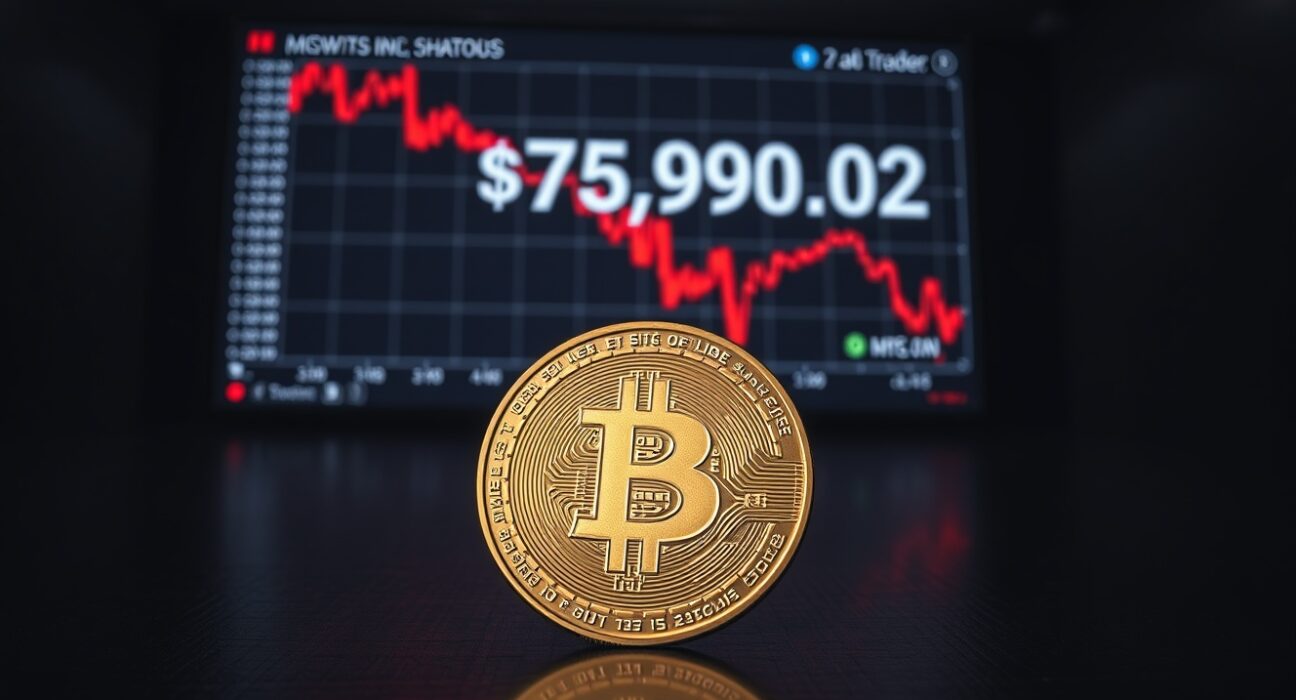
In a significant market move, BTC falls below $76,000 for the first time in recent trading sessions. According to Bitcoin World market monitoring, the cryptocurrency now trades at $75,981.01 on the Binance USDT market. This sharp decline has captured the attention of traders and analysts worldwide.
BTC Falls Below $76,000: Breaking Down the Price Action
The Bitcoin price drop below the $76,000 threshold represents a critical psychological level for many investors. At the time of reporting, BTC sits at $75,981.01, marking a notable decrease from its recent highs. This movement triggers immediate questions about market stability and future direction.
Market data from Binance USDT shows consistent selling pressure. The decline accelerates during Asian trading hours. Traders observe increased volume on sell orders. This pattern suggests institutional activity rather than retail panic. Consequently, the crypto market faces a moment of reckoning.
Several factors contribute to this decline. First, regulatory uncertainty looms over the sector. Second, macroeconomic conditions create headwinds for risk assets. Third, profit-taking after previous rallies adds downward momentum. Together, these elements create a perfect storm for the Bitcoin price drop.
Bitcoin Price Drop: Immediate Market Impact
The Bitcoin price drop triggers cascading effects across the broader cryptocurrency ecosystem. Altcoins follow BTC’s lead. Ethereum, Solana, and Cardano all experience similar downward pressure. This synchronized movement highlights Bitcoin’s continued dominance as a market bellwether.
Key market metrics reveal the following:
- Trading volume surges by 40% in the last 24 hours
- Open interest in futures contracts declines sharply
- Liquidation data shows over $200 million in long positions wiped out
- Funding rates turn negative across major exchanges
These indicators point to a bearish shift in sentiment. The BTC USDT Binance pair becomes the focal point for price discovery. Analysts monitor this pair closely for signs of stabilization or further decline.
Understanding the BTC USDT Binance Dynamics
The BTC USDT Binance trading pair serves as a primary reference point for global Bitcoin pricing. When BTC falls below $76,000 on this platform, it reflects real-time supply and demand imbalances. Binance’s deep liquidity pool amplifies price movements.
Market makers adjust their positions rapidly. They react to order book imbalances. Consequently, the spread between bid and ask prices widens. This increased volatility creates opportunities for scalpers but risks for long-term holders.
Technical analysis reveals key support levels. The $75,000 mark now becomes the next critical threshold. If BTC falls below this level, further downside could follow. Resistance now forms at $76,500. A recovery above this point would signal renewed buying interest.
Expert Analysis on the Crypto Market Crash
Financial analysts weigh in on the current situation. “The crypto market crash reflects broader risk aversion,” explains Dr. Sarah Chen, a blockchain economist. “Investors flee to safe-haven assets amid geopolitical tensions.” Her assessment aligns with on-chain data showing increased stablecoin inflows.
Another expert, Marcus Rivera, a senior trader at a major crypto fund, adds context. “We see a classic deleveraging event. Over-leveraged positions get flushed out. This process, while painful, often sets the stage for healthier market structure.”
The timeline of events matters. The decline begins after a weekend of low liquidity. Monday morning brings a wave of sell orders. By midday, BTC falls below $76,000. This rapid descent catches many off guard.
Bitcoin Decline Analysis: Historical Context
Bitcoin decline analysis shows similar patterns in past cycles. In 2021, BTC experienced multiple 20% corrections. Each time, the market eventually recovered. However, the current environment differs. Regulatory frameworks are tighter. Institutional participation is higher. Macroeconomic conditions are more challenging.
Comparing this drop to historical events provides perspective:
| Event | Date | Drop % | Recovery Time |
|---|---|---|---|
| May 2021 Crash | May 19, 2021 | 30% | 2 months |
| June 2022 Sell-off | June 13, 2022 | 15% | 3 months |
| Current Drop | Ongoing | 8% | TBD |
Each correction serves a market-clearing function. Weak hands exit. Strong hands accumulate. The current Bitcoin price drop may follow this pattern. However, unique factors complicate predictions.
Market Sentiment and Trader Behavior
Trader sentiment shifts rapidly during such events. Fear and Greed Index readings plummet to “Extreme Fear” levels. This psychological indicator often signals potential bottoms. Conversely, it can also precede further declines.
Social media analysis reveals mixed reactions. Some traders call for a “buy the dip” strategy. Others advocate for caution. The divergence in opinions creates volatility. This uncertainty keeps volumes elevated.
On-chain metrics provide additional insights. Exchange inflows increase. This suggests holders prepare to sell. Miner reserves remain stable. Long-term holders show no panic. These contrasting signals create a complex picture.
Global Economic Factors Influencing BTC Price
Global economic conditions play a crucial role in the Bitcoin price drop. Interest rate decisions by central banks impact risk asset valuations. The US Federal Reserve’s hawkish stance reduces liquidity. Consequently, speculative assets like Bitcoin face headwinds.
Geopolitical tensions also contribute. Trade disputes and regional conflicts drive uncertainty. Investors rotate into traditional safe havens. Gold and US Treasury bonds see increased demand. This capital outflow pressures cryptocurrency markets.
Inflation data remains a key variable. Sticky inflation forces central banks to maintain tight policies. Higher rates increase the opportunity cost of holding non-yielding assets. This fundamental shift weighs on Bitcoin’s valuation.
What This Means for Crypto Investors
For crypto investors, the current situation demands careful consideration. Short-term traders face heightened risk. Stop-loss orders trigger frequently. Position sizing becomes critical. Leverage amplifies losses in volatile conditions.
Long-term holders adopt a different perspective. They view the Bitcoin price drop as a buying opportunity. Dollar-cost averaging strategies remain popular. Accumulation addresses show steady growth despite the decline.
Risk management takes center stage. Diversification across asset classes reduces portfolio volatility. Stablecoins provide a temporary safe harbor. Rebalancing strategies help maintain target allocations.
Future Outlook and Recovery Scenarios
The path forward for BTC remains uncertain. Several scenarios play out. A V-shaped recovery would see prices rebound quickly. A U-shaped recovery would involve a prolonged bottoming process. An L-shaped scenario would mean sustained depression.
Analysts lean toward the U-shaped recovery. They cite historical precedents. Market structure improvements take time. Regulatory clarity could accelerate the process. Adoption trends remain positive long-term.
Key levels to watch include:
- $75,000 – Immediate support
- $73,000 – Secondary support
- $76,500 – First resistance
- $78,000 – Major resistance
Volume analysis will confirm breakouts or breakdowns. Sustained buying above resistance signals strength. Conversely, weak volume on rallies suggests bearish continuation.
Conclusion
BTC falls below $76,000, trading at $75,981.01 on the Binance USDT market. This Bitcoin price drop reflects a confluence of factors including regulatory uncertainty, macroeconomic pressures, and market deleveraging. The crypto market crash creates both risks and opportunities. Investors must navigate this volatile environment with discipline and informed strategies. Long-term fundamentals remain intact, but short-term challenges persist. Monitoring key support levels and market sentiment will be crucial in the days ahead.
FAQs
Q1: Why did BTC fall below $76,000?
A1: BTC falls below $76,000 due to a combination of regulatory concerns, macroeconomic headwinds from interest rate hikes, and a deleveraging event that flushed out over-leveraged positions.
Q2: Is this Bitcoin price drop part of a larger trend?
A2: The Bitcoin price drop aligns with broader risk-off sentiment in global markets. Historical patterns suggest corrections of this magnitude occur periodically, though the current macro environment adds unique pressures.
Q3: What does the BTC USDT Binance price indicate?
A3: The BTC USDT Binance price reflects real-time supply and demand dynamics on the world’s largest exchange. It serves as a key reference point for global Bitcoin valuation and market sentiment.
Q4: Should I buy Bitcoin during this crypto market crash?
A4: Investment decisions depend on individual risk tolerance and time horizon. Long-term accumulation strategies may benefit from lower prices, but short-term volatility requires careful risk management.
Q5: What are the key support levels for Bitcoin now?
A5: Key support levels after BTC falls below $76,000 include $75,000 as immediate support, followed by $73,000. Resistance forms at $76,500 and $78,000.
Disclaimer: The information provided is not trading advice, Bitcoinworld.co.in holds no liability for any investments made based on the information provided on this page. We strongly recommend independent research and/or consultation with a qualified professional before making any investment decisions.
