

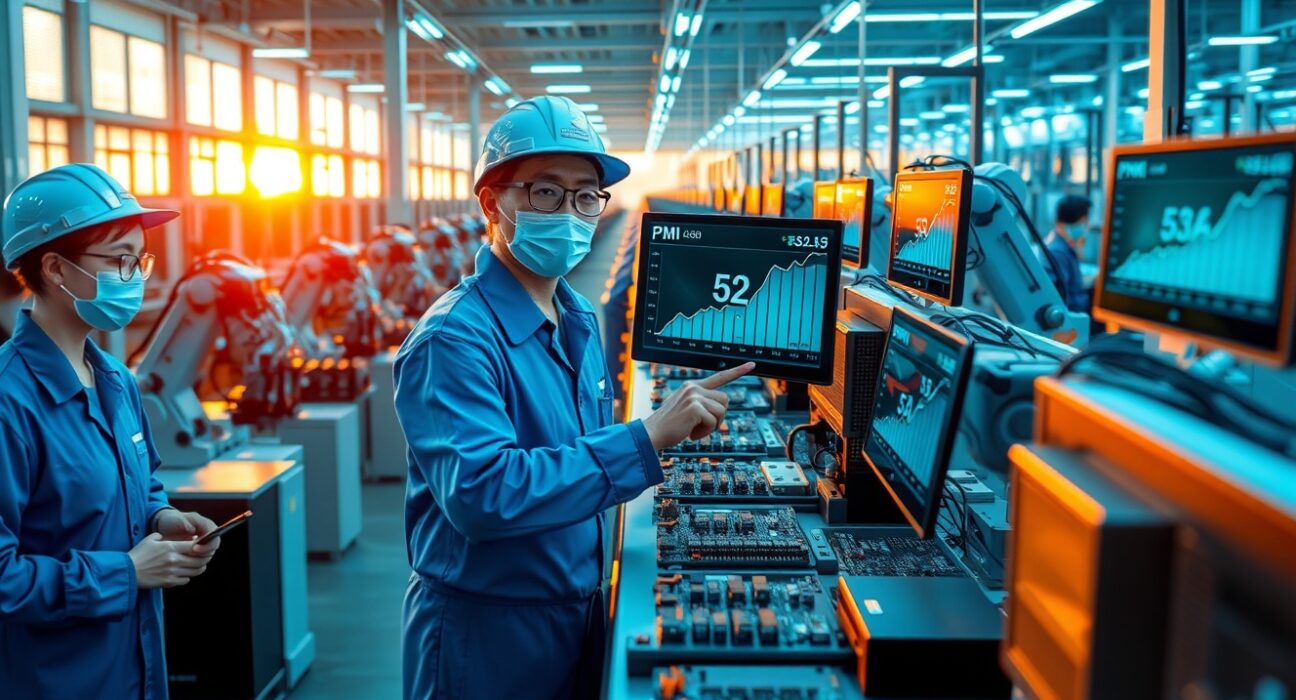
China’s manufacturing sector demonstrated unexpected strength in April 2025, as the RatingDog Manufacturing Purchasing Managers’ Index (PMI) climbed to 52.2, significantly surpassing the market consensus of 51.0. This reading marks the highest level in over six months, signaling a robust expansion in factory activity and reinforcing positive sentiment around the world’s second-largest economy.
Breaking Down the China Manufacturing PMI Data
The RatingDog Manufacturing PMI, a key economic indicator derived from a monthly survey of purchasing managers at over 800 manufacturing firms, measures the health of the sector. A reading above 50 indicates expansion, while below 50 signals contraction. The April figure of 52.2 not only beat the 51.0 forecast but also accelerated from March’s reading of 51.4. This consistent upward trend suggests that Chinese manufacturers are experiencing sustained demand growth, both domestically and internationally.
Analysts attribute this surge to several factors, including improved export orders, robust domestic consumption, and government stimulus measures aimed at bolstering industrial output. The sub-index for new orders rose to 53.5, the highest since late 2024, while production climbed to 53.8. Employment also edged higher, rising to 51.0, indicating that factories are hiring to meet growing demand.
Market and Economic Implications of the PMI Surge
The better-than-expected PMI data has immediate implications for financial markets and economic policy. Following the release, Chinese stock markets opened higher, with the Shanghai Composite Index gaining 1.2% in early trading. The offshore yuan also strengthened against the US dollar, reflecting increased investor confidence in China’s economic trajectory.
For global markets, this data point provides a counterbalance to ongoing concerns about trade tensions and slowing growth in other major economies. A strong Chinese manufacturing sector supports demand for raw materials, benefiting commodity-exporting nations like Australia and Brazil. It also signals resilience in global supply chains, which have faced disruptions in recent years.
Economists at Goldman Sachs noted that the PMI reading aligns with their view of a moderate but steady recovery in Chinese industrial activity. They expect the central bank to maintain its current accommodative monetary policy, as inflation remains subdued and the focus stays on supporting growth.
Expert Analysis: What the 52.2 Reading Really Means
Dr. Li Wei, a senior economist at the China Center for International Economic Exchanges, described the PMI jump as “a clear signal that the manufacturing engine is firing on all cylinders.” He emphasized that the breadth of the expansion—spanning new orders, production, and employment—indicates a genuine upturn rather than a one-off spike. However, he cautioned that external risks, including potential US tariff increases and geopolitical instability, could temper future gains.
The data also reveals interesting regional variations. Coastal provinces like Guangdong and Jiangsu reported stronger expansions compared to inland regions, reflecting their greater exposure to export markets. Small and medium-sized enterprises (SMEs) showed particular improvement, with their PMI rising to 51.8 from 50.6 in March, suggesting that government support measures are reaching smaller firms.
Context and Timeline: China’s Manufacturing PMI in 2025
To fully appreciate the April reading, it is useful to examine the trajectory of China’s manufacturing PMI over the past year:
- January 2025: 50.8 – Moderate expansion amid post-holiday slowdown
- February 2025: 50.5 – Lunar New Year disruptions weighed on activity
- March 2025: 51.4 – Steady recovery as supply chains normalized
- April 2025: 52.2 – Strongest reading since September 2024
This upward trajectory contrasts with the stagnation seen in many other major economies. The US ISM Manufacturing PMI, for example, has hovered around the 49–50 range in recent months, indicating contraction or minimal growth. Similarly, the Eurozone’s manufacturing PMI has remained below 50, reflecting persistent weakness in Germany and France.
China’s outperformance can be partly attributed to its aggressive infrastructure spending and targeted tax cuts for manufacturers. The government has also prioritized self-sufficiency in critical technologies, boosting domestic production of semiconductors and advanced machinery.
Impact on Global Trade and Supply Chains
The PMI surge has direct consequences for global trade flows. Chinese factories are major suppliers of consumer electronics, machinery, and automotive components. Increased production in China means faster delivery times and potentially lower prices for international buyers. However, it also raises questions about the ongoing decoupling efforts by Western nations, who are seeking to reduce reliance on Chinese supply chains.
Logistics companies have reported a 15% increase in container shipping volumes from Chinese ports in April compared to the same period last year. The Baltic Dry Index, a measure of shipping costs for bulk commodities, has also risen, reflecting higher demand for raw materials like iron ore and coal.
What This Means for Investors and Policymakers
For investors, the PMI data reinforces the case for overweighting Chinese equities, particularly in the industrial and materials sectors. Exchange-traded funds (ETFs) tracking Chinese manufacturing have seen net inflows of over $2 billion in the past week. Bond markets have also reacted positively, with yields on Chinese government bonds falling slightly as the data reduces the need for further stimulus.
Policymakers at the People’s Bank of China (PBOC) are likely to view the data as validation of their current policy stance. The central bank has kept its one-year loan prime rate (LPR) unchanged at 3.45% since January, balancing the need to support growth against concerns about financial stability. The strong PMI reading reduces pressure for immediate rate cuts, though analysts expect the PBOC to remain vigilant about potential headwinds from the property sector.
Conclusion
China’s RatingDog Manufacturing PMI climbing to 52.2 in April, well above the 51.0 expected, represents a significant positive development for the global economy. It signals robust expansion in the manufacturing sector, driven by strong demand, effective policy support, and improving business confidence. While risks remain, including geopolitical tensions and potential trade disruptions, the data provides a solid foundation for continued growth in the coming months. Investors, businesses, and policymakers will be watching closely to see if this momentum can be sustained into the second half of 2025.
FAQs
Q1: What is the RatingDog Manufacturing PMI?
A1: The RatingDog Manufacturing PMI is a monthly economic indicator that measures the health of China’s manufacturing sector based on a survey of purchasing managers at over 800 companies. A reading above 50 indicates expansion.
Q2: Why did the PMI climb to 52.2 in April?
A2: The increase was driven by strong new orders, higher production, and improved export demand. Government stimulus measures and a rebound in domestic consumption also contributed to the growth.
Q3: How does this PMI reading compare to expectations?
A3: The actual reading of 52.2 significantly exceeded the market consensus of 51.0, making it a positive surprise for economists and investors.
Q4: What are the implications for the global economy?
A4: A stronger Chinese manufacturing sector supports global trade, boosts demand for commodities, and provides a counterbalance to economic weakness in other major regions like the US and Europe.
Q5: Will the People’s Bank of China change its monetary policy?
A5: The strong PMI data reduces the immediate need for further stimulus. The PBOC is expected to maintain its current accommodative stance but may hold off on rate cuts given the improving economic outlook.
Q6: What risks could reverse this positive trend?
A6: Key risks include escalating trade tensions with the US, a potential slowdown in global demand, and ongoing challenges in China’s property sector, which could weigh on overall economic confidence.
Disclaimer: The information provided is not trading advice, Bitcoinworld.co.in holds no liability for any investments made based on the information provided on this page. We strongly recommend independent research and/or consultation with a qualified professional before making any investment decisions.
