

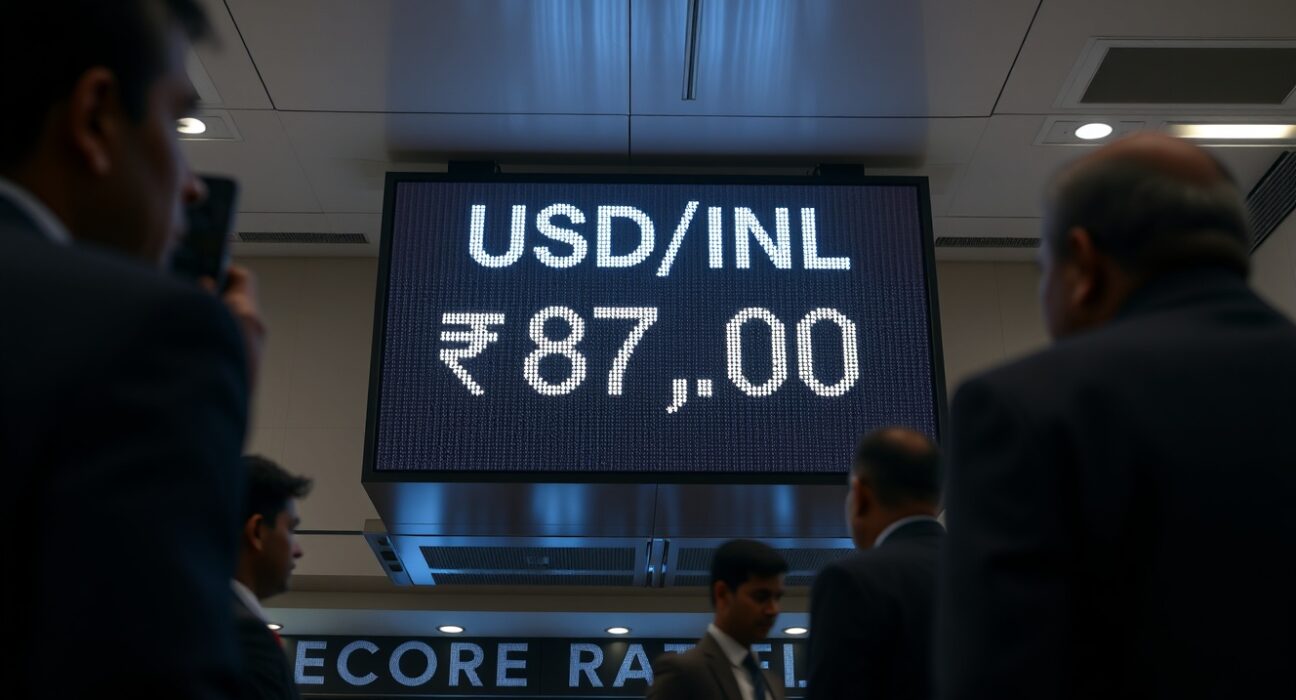
The Indian rupee plunged to a record low against the US dollar on Wednesday, as the **USD/INR** pair surged past the 87.00 mark for the first time in history. This sharp depreciation follows the Federal Reserve’s hawkish decision to hold interest rates steady and a sudden spike in global crude oil prices. Traders and analysts now brace for further volatility in the currency market.
USD/INR Record High: What Drove the Rupee to a New Low?
The **USD/INR** exchange rate breached the psychologically important 87.00 level during intraday trading, marking a fresh all-time low for the Indian currency. The catalyst was a combination of domestic and international pressures. The Federal Reserve’s decision to maintain its hawkish stance, signaling no immediate rate cuts, strengthened the US dollar globally. Simultaneously, a surprise output cut by OPEC+ and rising geopolitical tensions in the Middle East pushed Brent crude oil prices above $95 per barrel. India, being a major oil importer, faces higher import bills, which directly pressures the rupee.
Fed’s Hawkish Hold: A Global Dollar Rally
The US Federal Reserve’s latest policy statement confirmed a hold on interest rates, but the accompanying commentary was decidedly hawkish. Chair Jerome Powell emphasized that inflation remains above the 2% target and that the central bank is in no hurry to ease monetary policy. This triggered a broad-based rally in the US dollar index (DXY), which climbed to a three-month high. Emerging market currencies, including the Indian rupee, bore the brunt of this strength. The Fed’s stance effectively reduces the attractiveness of riskier assets, prompting capital outflows from countries like India.
Impact on Indian Markets
The hawkish Fed stance has a direct impact on India’s financial markets. Foreign portfolio investors (FPIs) have pulled out over $2 billion from Indian equities in the last two weeks. This capital flight increases the demand for US dollars, further weakening the rupee. The Reserve Bank of India (RBI) has likely intervened by selling dollars through state-run banks to curb volatility, but the pressure remains intense.
Oil Price Spike: A Double Blow for the Rupee
The simultaneous spike in global crude oil prices compounds the rupee’s woes. India imports approximately 85% of its crude oil requirements. A $10 per barrel increase in oil prices adds roughly $15 billion to India’s annual import bill. This widens the current account deficit (CAD) and increases the demand for US dollars to pay for more expensive oil imports. The correlation between rising oil prices and a weakening rupee is well-documented. As oil prices surge, the **USD/INR** pair tends to move higher.
Key Data Points on Oil and Rupee
- Crude Oil Impact: Every $10/barrel rise in oil adds 15-20 basis points to India’s CAD.
- Rupee Sensitivity: A 10% rise in oil prices typically leads to a 1-2% depreciation in the rupee.
- Current Scenario: Brent crude at $95/barrel is significantly above the government’s budget assumption of $80-85/barrel.
Expert Analysis: What Does This Mean for the Indian Economy?
Economists warn that a persistently weak rupee will fuel imported inflation. India’s consumer price index (CPI) is already above the RBI’s 4% target. A weaker rupee makes imports of electronics, machinery, and edible oils more expensive, pushing retail prices higher. This could force the RBI to delay any plans for domestic rate cuts, keeping borrowing costs elevated. For businesses that rely on imports, the rising **USD/INR** is squeezing profit margins. Exporters, however, may benefit from better realization on foreign earnings.
Timeline of Key Events
- March 19, 2025: Fed holds rates, signals hawkish stance.
- March 20, 2025: OPEC+ announces surprise production cut.
- March 21, 2025: Brent crude breaches $95/barrel.
- March 22, 2025: USD/INR hits all-time high of 87.05.
RBI’s Response: Intervention and Policy Tools
The Reserve Bank of India has several tools to manage the rupee’s decline. The most immediate is direct intervention in the forex market by selling US dollars. The RBI’s foreign exchange reserves, currently at $620 billion, provide a substantial buffer. However, aggressive intervention can deplete reserves. The central bank may also tighten liquidity or impose measures to curb speculative trading. Historically, the RBI does not target a specific exchange rate but aims to prevent excessive volatility. The recent move suggests the central bank is comfortable with a gradual depreciation but will step in to prevent a disorderly fall.
Global Context: Emerging Market Currencies Under Pressure
The Indian rupee is not alone in its struggle. Other Asian currencies, including the Indonesian rupiah, the South Korean won, and the Thai baht, have also weakened against the dollar. The strengthening dollar, driven by the Fed’s hawkish stance and safe-haven demand due to geopolitical tensions, is a global phenomenon. However, India’s vulnerability is amplified by its high oil import dependence and a widening trade deficit. The **USD/INR** movement is a key indicator of India’s economic health in the global context.
Conclusion
The **USD/INR** hitting a record high of 87.00 is a significant event that underscores the combined pressure from the Federal Reserve’s hawkish hold and surging oil prices. This development has far-reaching implications for India’s inflation, trade balance, and economic growth. While the RBI’s intervention may provide temporary relief, the medium-term outlook for the rupee remains challenging. Investors and businesses must prepare for a period of heightened volatility in the currency market, with the focus now on the next RBI policy meeting and global oil price trends.
FAQs
Q1: Why did the USD/INR hit a record high?
The USD/INR hit a record high due to a combination of the Federal Reserve’s hawkish hold on interest rates, which strengthened the US dollar, and a spike in global crude oil prices, which increased India’s import costs and dollar demand.
Q2: How does the Fed’s hawkish stance affect the Indian rupee?
The Fed’s hawkish stance makes the US dollar more attractive to investors, leading to capital outflows from emerging markets like India. This increased demand for dollars pushes the USD/INR exchange rate higher.
Q3: What is the impact of rising oil prices on the rupee?
India imports most of its oil. Higher oil prices increase the country’s import bill, widening the current account deficit and increasing the demand for US dollars, which weakens the rupee.
Q4: What can the RBI do to control the rupee’s fall?
The RBI can intervene by selling US dollars from its reserves, tightening monetary policy, or imposing measures to curb speculative trading. Its primary goal is to prevent excessive volatility, not to defend a specific exchange rate.
Q5: Will the USD/INR continue to rise?
The future movement of USD/INR depends on global factors like the Fed’s next policy decision, oil price trends, and geopolitical developments. Most analysts expect continued pressure in the near term, with potential for further highs if oil prices remain elevated.
Disclaimer: The information provided is not trading advice, Bitcoinworld.co.in holds no liability for any investments made based on the information provided on this page. We strongly recommend independent research and/or consultation with a qualified professional before making any investment decisions.
