

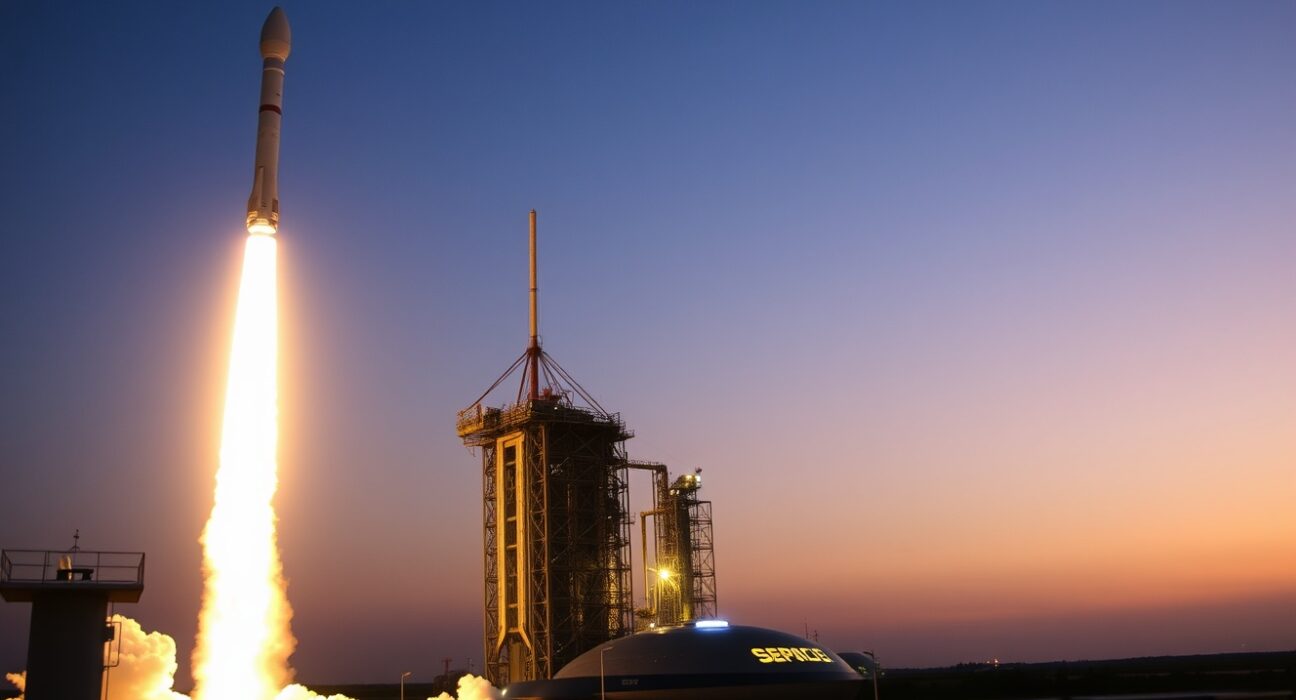
SpaceX has officially filed its S-1 registration statement with the U.S. Securities and Exchange Commission, taking the first concrete step toward what could become the largest initial public offering in American history. The filing, which runs 36 pages of risk factors alone, lays out a financial narrative that stretches far beyond rockets and satellite launches.
A $28 trillion addressable market
The most striking number in the document is the total addressable market SpaceX claims: $28 trillion. This figure encompasses not just launch services and Starlink broadband, but also point-to-point Earth transport, lunar logistics, and the long-term colonization of Mars. While the market sizing is ambitious, it reflects the company’s strategy of positioning itself as a multi-planetary infrastructure provider rather than a traditional aerospace contractor.
The Mars compensation clause
One of the more unusual disclosures involves executive compensation. A portion of Elon Musk’s pay package is tied to milestones related to establishing a permanent human settlement on Mars. This is unprecedented in public company filings and underscores how deeply the Mars mission is embedded in SpaceX’s corporate structure. The filing does not specify exact targets or timelines, but it signals to investors that long-term value creation is linked to interplanetary ambitions.
Risk factors and regulatory hurdles
The 36-page risk factors section covers everything from launch failures and satellite collisions to regulatory changes in spectrum allocation and export controls. Notably, SpaceX highlights the uncertainty around Starship’s regulatory approval for orbital launches, which is critical to both the Mars timeline and the Starlink expansion. The filing also acknowledges potential competition from China’s state-backed space programs and emerging private players like Blue Origin.
Valuation and IPO timing
SpaceX’s valuation in private markets has already exceeded $180 billion, and analysts expect the IPO to target a valuation north of $250 billion, which would surpass the record set by Saudi Aramco. The company has not yet set a price range or a date for the offering, but the S-1 filing typically precedes a listing by several months. The timing will depend on market conditions and SEC review.
Why this matters
For investors, the SpaceX IPO represents a rare opportunity to buy into a company that has fundamentally reshaped the space industry. For the broader public, it marks a shift in how space exploration is funded and governed. The filing also raises questions about risk tolerance: SpaceX’s business model depends on technologies that have not yet been proven at scale, and the company’s success is tightly linked to one individual, Elon Musk. The S-1 does not shy away from these realities, but it asks investors to take a leap of faith.
Conclusion
SpaceX’s S-1 filing is a document of extraordinary ambition. It presents a company that sees itself not just as a launch provider, but as the architect of a multi-planetary economy. Whether investors share that vision will be tested in the coming months. The filing is a must-read for anyone following the future of space, finance, or technology.
FAQs
Q1: When will the SpaceX IPO happen?
The S-1 filing has been submitted, but no date or price range has been set. The IPO is expected within the next 6 to 12 months, pending SEC review and market conditions.
Q2: How is Elon Musk’s pay tied to Mars?
A portion of Musk’s compensation package is linked to milestones related to establishing a permanent human settlement on Mars. Specific targets and timelines are not disclosed in the filing.
Q3: What is the $28 trillion market estimate based on?
SpaceX’s total addressable market includes launch services, Starlink broadband, point-to-point Earth transport, lunar logistics, and Mars colonization. The figure is a forward-looking estimate and not a current revenue projection.
Disclaimer: The information provided is not trading advice, Bitcoinworld.co.in holds no liability for any investments made based on the information provided on this page. We strongly recommend independent research and/or consultation with a qualified professional before making any investment decisions.
