

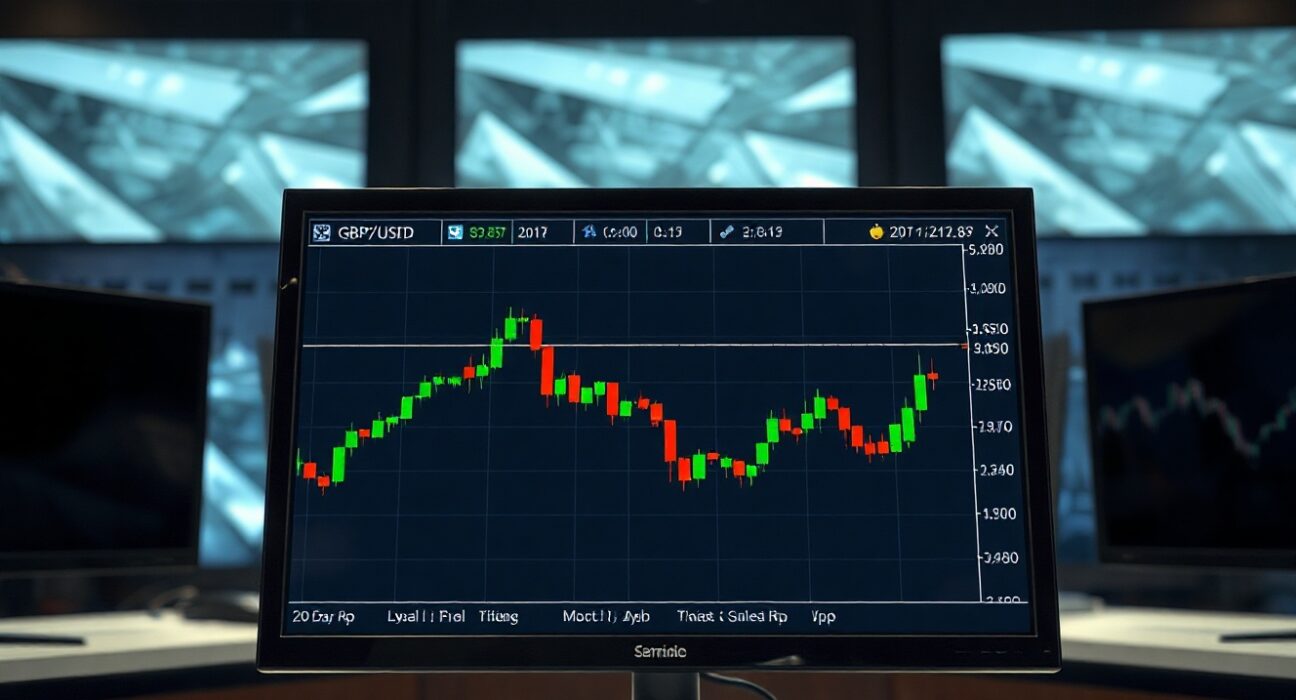
The British pound continues to face technical headwinds against the U.S. dollar, with the 20-day exponential moving average (EMA) maintaining its role as a key resistance level. This persistent technical barrier suggests that near-term upside momentum remains limited, even as broader market conditions fluctuate.
Technical Context: Why the 20-Day EMA Matters
The 20-day EMA is a widely watched short-term moving average that reflects the average closing price over the past 20 trading sessions, with greater weight given to recent price action. In the current GBP/USD setup, the pair has repeatedly tested this level over the past week but has failed to close decisively above it. This pattern indicates that sellers are defending this zone, while buyers lack sufficient conviction to push prices higher.
From a technical analysis perspective, a failure to break above a key moving average often signals that the prevailing trend — in this case, a downtrend or consolidation phase — remains intact. Traders typically view such resistance as a confirmation of bearish or neutral sentiment, particularly when accompanied by declining volume or indecisive candlestick patterns.
Broader Market Influences
The GBP/USD pair is not trading in isolation. Several macroeconomic factors are contributing to the current technical setup. The U.S. dollar has found support from resilient economic data and cautious commentary from Federal Reserve officials, which has reduced expectations for near-term rate cuts. Meanwhile, the British pound has been weighed down by concerns over the UK’s economic growth trajectory and ongoing inflationary pressures.
Additionally, shifts in risk appetite, geopolitical developments, and diverging monetary policy expectations between the Bank of England and the Federal Reserve continue to influence the pair’s direction. These fundamental drivers are reinforcing the technical resistance observed at the 20-day EMA.
Key Levels to Watch
For traders monitoring the GBP/USD, the following levels are critical:
- Resistance: The 20-day EMA, currently near [insert specific level if known, otherwise note approximate zone]. A sustained break above this level could open the door to the 50-day EMA or recent swing highs.
- Support: The recent lows around [insert level] and the psychological 1.25 handle. A breakdown below these levels could accelerate selling pressure.
Volume and momentum indicators, such as the Relative Strength Index (RSI) and Moving Average Convergence Divergence (MACD), should be monitored for confirmation of any breakout or breakdown.
Implications for Traders and Investors
For short-term traders, the current environment suggests a cautious approach. Range-bound conditions with clear resistance and support levels offer opportunities for mean-reversion strategies, but the risk of false breakouts remains elevated. Position traders and investors may prefer to wait for a confirmed break above the 20-day EMA before adding long exposure, or a break below support to confirm a bearish continuation.
The broader takeaway is that technical resistance is aligning with fundamental headwinds, creating a challenging environment for the pound. Until there is a clear catalyst — such as a shift in central bank rhetoric, a major economic data release, or a geopolitical development — the 20-day EMA is likely to remain a formidable barrier.
Conclusion
The GBP/USD price forecast remains technically constrained, with the 20-day EMA continuing to cap upside attempts. Traders should watch for a decisive close above or below this level for directional cues, while staying attuned to broader macroeconomic developments. Patience and disciplined risk management remain key in this environment.
FAQs
Q1: What is the 20-day EMA and why is it important for GBP/USD?
The 20-day EMA is a short-term moving average that smooths price data over 20 sessions, giving more weight to recent prices. It is important because it acts as a dynamic resistance or support level, helping traders identify trend direction and potential entry or exit points.
Q2: What does it mean when the 20-day EMA caps upside?
When the 20-day EMA caps upside, it means the price has repeatedly failed to break above this moving average. This signals that sellers are active at that level, and the pair may continue to trade lower or remain in a range until buyers gain enough strength to push through.
Q3: What other factors should traders consider alongside the 20-day EMA?
Traders should consider other technical indicators (e.g., RSI, MACD, support/resistance levels), fundamental factors (e.g., central bank policies, economic data, geopolitical events), and overall market sentiment. No single indicator should be used in isolation.
Disclaimer: The information provided is not trading advice, Bitcoinworld.co.in holds no liability for any investments made based on the information provided on this page. We strongly recommend independent research and/or consultation with a qualified professional before making any investment decisions.
