

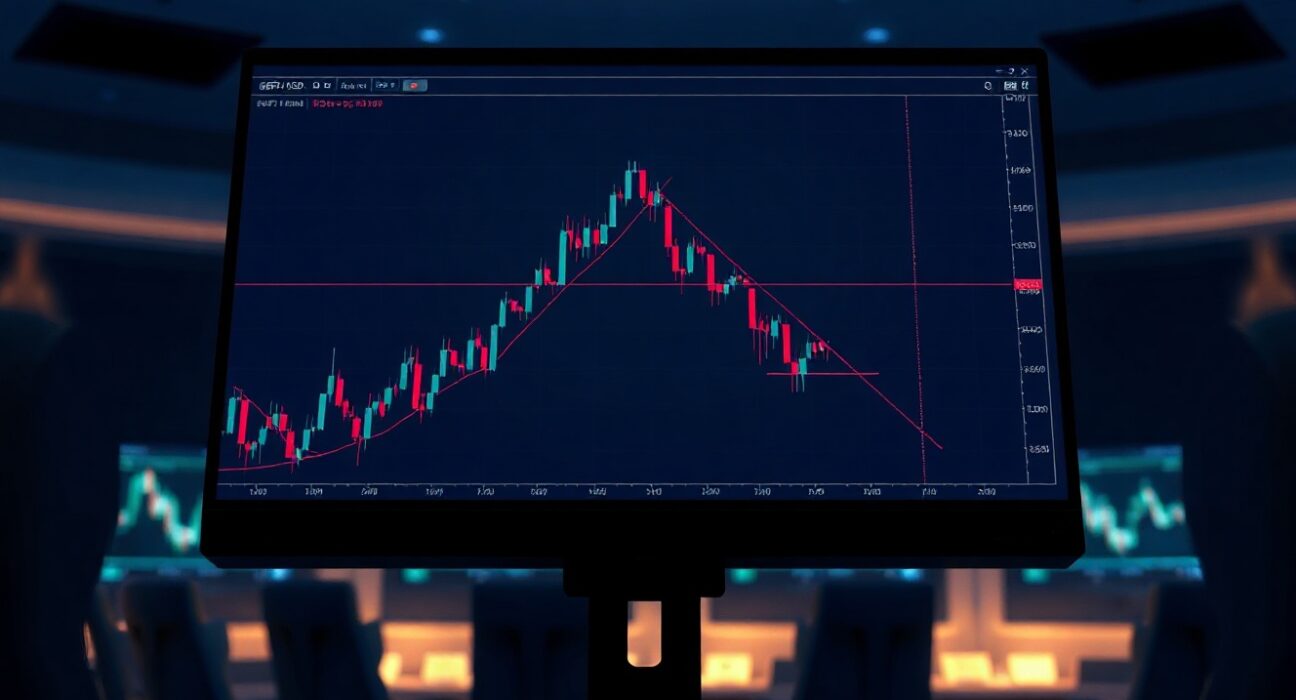
The British pound against the US dollar (GBP/USD) continues to trade within a consolidative range, with the overall trend appearing sideways as a symmetrical triangle formation takes shape on the daily chart. This pattern, characterized by converging trendlines, suggests a period of indecision in the market as buyers and sellers remain evenly matched.
Triangle Formation Signals Potential Breakout
The symmetrical triangle pattern currently visible on the GBP/USD daily chart is a classic technical formation that often precedes a significant directional move. The pattern forms when price action creates lower highs and higher lows, converging toward a point. For GBP/USD, the upper boundary of the triangle has been defined by a series of declining peaks near the 1.2700–1.2750 region, while the lower boundary has been supported by rising troughs around the 1.2500–1.2550 area.
Traders are closely watching this pattern because it indicates that volatility is compressing, and a breakout — either to the upside or downside — could lead to a sustained trend. The direction of the breakout will likely depend on broader macroeconomic factors, including interest rate differentials, economic data releases, and geopolitical developments.
Technical Indicators Reflect Neutral Bias
Momentum indicators such as the Relative Strength Index (RSI) and Moving Average Convergence Divergence (MACD) are currently hovering near their neutral midpoints, offering little directional clarity. The RSI on the daily timeframe is near 50, indicating neither overbought nor oversold conditions. The MACD line is flat and near the signal line, confirming the absence of strong directional momentum.
Key moving averages, including the 50-day and 200-day simple moving averages, are also converging, which often signals a period of consolidation. The 50-day SMA is currently near 1.2620, while the 200-day SMA is around 1.2580, suggesting that the pair is trading in a zone of technical equilibrium.
Implications for Traders and Market Participants
For short-term traders, the sideways movement within the triangle presents opportunities for range-bound strategies, such as buying near support and selling near resistance. However, the narrowing range also increases the risk of false breakouts. A confirmed breakout above the upper trendline could target the next resistance zone near 1.2800–1.2850, while a breakdown below the lower trendline could open the door toward 1.2400–1.2450.
Long-term investors and institutional players may adopt a wait-and-see approach until a clear directional signal emerges. The current pattern reflects broader uncertainty in the forex market, driven by diverging monetary policies between the Bank of England and the Federal Reserve, as well as ongoing economic data releases from both the UK and the US.
Conclusion
The GBP/USD pair remains in a sideways trend, with the symmetrical triangle formation highlighting a period of consolidation and indecision. Technical indicators are neutral, and the market awaits a catalyst for a decisive breakout. Traders should monitor key support and resistance levels closely, as a confirmed move outside the triangle could set the tone for the next major trend in the pair. The coming days and weeks will be critical in determining whether the pound can regain upward momentum or if further weakness lies ahead.
FAQs
Q1: What does a symmetrical triangle pattern mean in forex trading?
A symmetrical triangle pattern indicates a period of consolidation where the price forms lower highs and higher lows, converging toward a point. It suggests that the market is undecided, and a breakout in either direction is likely once the pattern completes.
Q2: What are the key support and resistance levels for GBP/USD right now?
Key support is in the 1.2500–1.2550 area, while resistance is near 1.2700–1.2750. A breakout above resistance could target 1.2800–1.2850, while a breakdown below support could lead to 1.2400–1.2450.
Q3: How long can the GBP/USD sideways trend last?
Sideways trends can persist for several weeks or even months, depending on the underlying market conditions. The duration of the current triangle pattern depends on upcoming economic data, central bank decisions, and broader risk sentiment.
Disclaimer: The information provided is not trading advice, Bitcoinworld.co.in holds no liability for any investments made based on the information provided on this page. We strongly recommend independent research and/or consultation with a qualified professional before making any investment decisions.
