

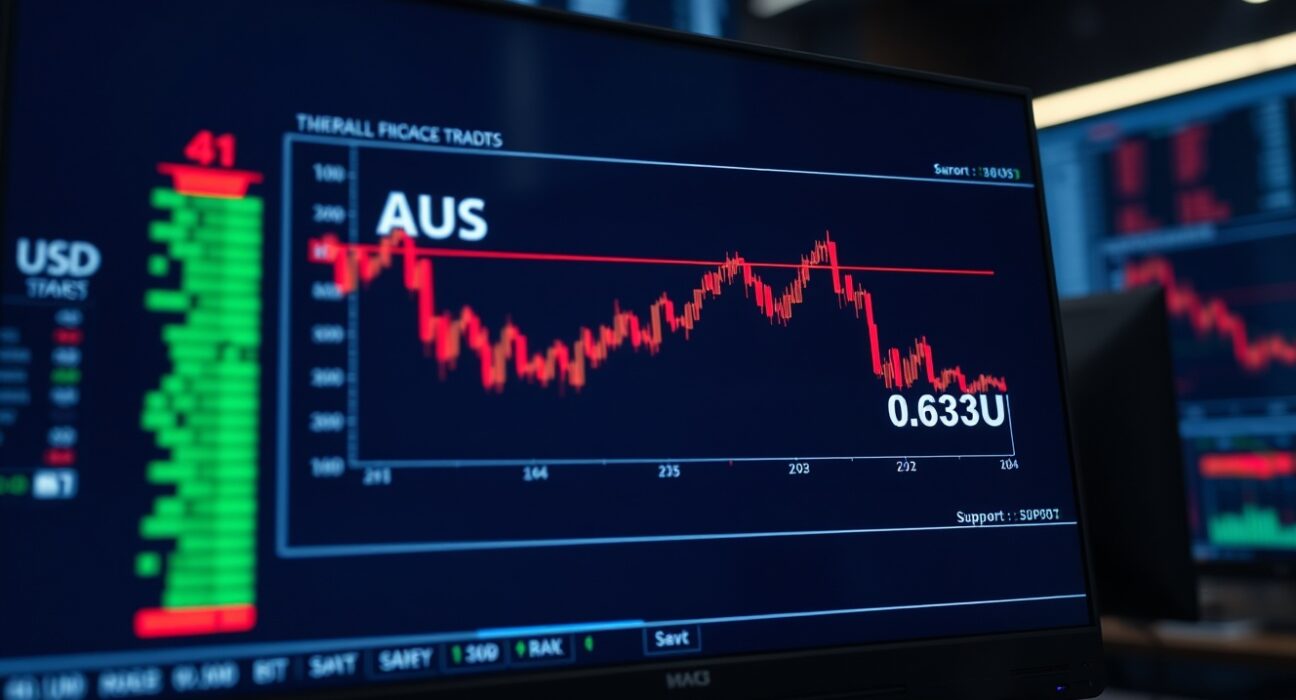
The Australian dollar remains under pressure against the US dollar, with technical indicators pointing to a likely extension of the current decline below the key support level of 0.6830. Traders are closely watching this threshold as a break lower could open the door to further losses in the near term.
Technical Setup Points to Further Weakness
From a technical perspective, the AUD/USD pair has been trading in a bearish channel since mid-March, consistently making lower highs and lower lows. The 0.6830 level has acted as a critical support zone over the past several sessions, but momentum indicators such as the Relative Strength Index (RSI) and the Moving Average Convergence Divergence (MACD) are signaling that selling pressure is intensifying.
A sustained break below 0.6830 would likely confirm the bearish outlook, with the next major support target around the 0.6770 area, a level that previously acted as resistance in February. On the upside, resistance is now seen at 0.6870, followed by the 0.6900 psychological barrier.
Fundamental Factors Weighing on the Aussie
The Australian dollar’s weakness is not solely a technical story. Fundamental factors are also contributing to the bearish sentiment. The US dollar has been gaining strength on the back of resilient US economic data and hawkish commentary from Federal Reserve officials, which has reduced expectations for near-term rate cuts.
Meanwhile, the Reserve Bank of Australia (RBA) has maintained a cautious stance, with recent minutes from its April meeting indicating that the board considered the case for holding rates steady. The divergence in monetary policy expectations between the Fed and the RBA is creating a headwind for the Aussie.
Commodity Prices Offer Limited Support
Typically, Australia’s export-driven economy benefits from rising commodity prices. However, while iron ore and coal prices have remained relatively stable, they have not been enough to offset the broader dollar strength and risk-off sentiment in global markets. The ongoing uncertainty surrounding China’s economic recovery, a key trading partner for Australia, is also capping any potential upside for the AUD.
What This Means for Traders
For forex traders, the focus remains on the 0.6830 level in the coming sessions. A daily close below this support would be a strong bearish signal, potentially triggering stop-loss orders and accelerating the decline. Conversely, a bounce from this level could lead to a short-term consolidation, but the overall trend remains tilted to the downside.
Traders should also watch for any upcoming US economic data, particularly non-farm payrolls and inflation figures, which could further influence the dollar’s trajectory. Any surprises in the data could quickly shift market dynamics.
Conclusion
The AUD/USD pair is at a critical juncture. Technical indicators and fundamental pressures both suggest that a break below 0.6830 is increasingly likely. While a short-term bounce is possible, the broader trend favors further downside. Traders should remain cautious and watch for confirmation before positioning for a sustained move lower.
FAQs
Q1: What is the key support level for AUD/USD right now?
The key support level is 0.6830. A break below this level could signal further declines toward 0.6770.
Q2: Why is the Australian dollar weakening against the US dollar?
The Aussie is under pressure due to a stronger US dollar, driven by resilient US economic data and hawkish Fed policy expectations, combined with a cautious RBA stance and uncertainty around China’s economic recovery.
Q3: Should traders expect a quick reversal for AUD/USD?
A quick reversal is unlikely given the current bearish momentum and fundamental headwinds. Any bounce from the 0.6830 level is likely to be short-lived unless there is a significant shift in US economic data or Fed policy signals.
Disclaimer: The information provided is not trading advice, Bitcoinworld.co.in holds no liability for any investments made based on the information provided on this page. We strongly recommend independent research and/or consultation with a qualified professional before making any investment decisions.
