

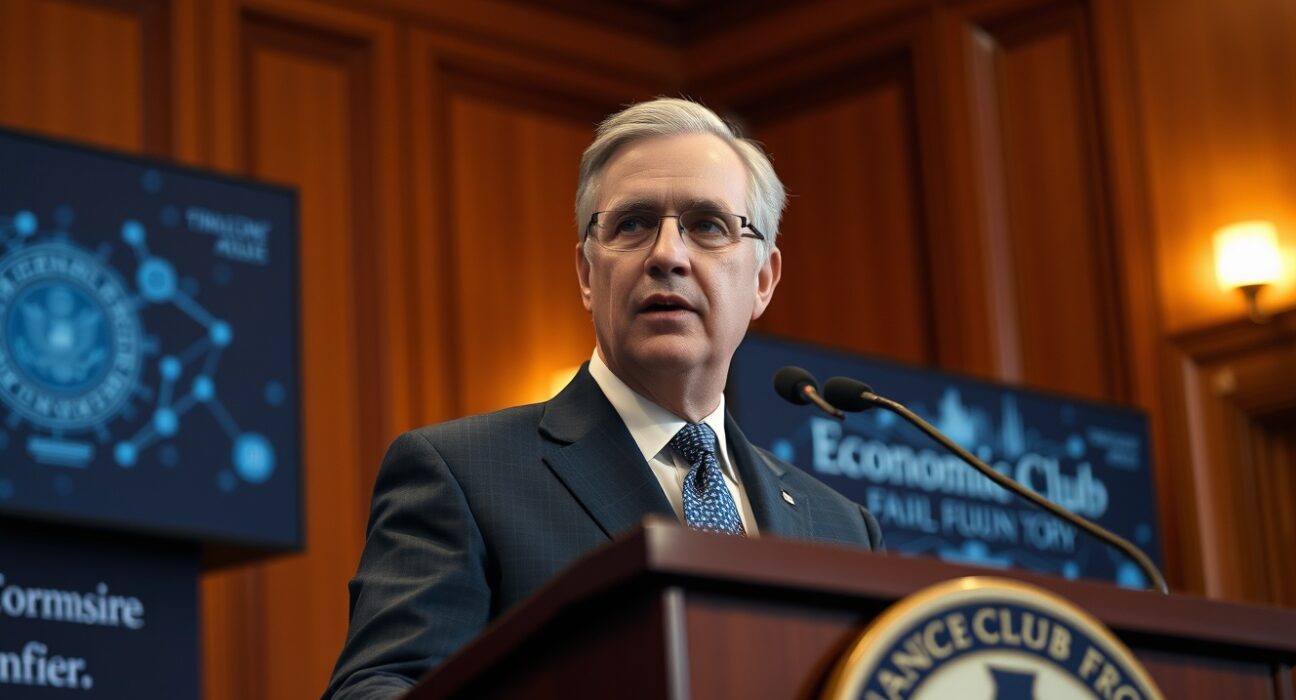
U.S. Securities and Exchange Commission Chairman Paul Atkins has described digital assets as the most important financial frontier of our time, signaling a significant shift in the agency’s approach to cryptocurrency regulation. Speaking at the Economic Club of New York, Atkins outlined his vision for a more defined regulatory framework, emphasizing the SEC’s commitment to its Advancement, Clarification, and Innovation (ACT) strategy.
A New Regulatory Direction for Crypto
Atkins’ remarks mark a departure from the enforcement-heavy posture of the previous administration. He stressed that the SEC is now focused on providing clear guidelines for digital asset markets, rather than relying primarily on punitive actions. The ACT strategy, which Atkins introduced earlier this year, aims to balance investor protection with the need to foster technological innovation.
During his address, Atkins noted that the rapid evolution of blockchain technology and cryptocurrencies requires a regulatory framework that is both adaptable and forward-looking. He argued that the United States risks falling behind other global financial hubs if it does not establish a coherent policy for digital assets.
What the ACT Strategy Means for Investors and Industry
The SEC’s new approach under Atkins includes three core pillars:
- Advancement: Encouraging responsible innovation in digital asset markets through regulatory sandboxes and pilot programs.
- Clarification: Issuing clear, enforceable rules for token classifications, exchange registration, and custody requirements.
- Innovation: Collaborating with industry stakeholders to develop standards that support both security and growth.
Industry observers view this as a potential turning point for the U.S. crypto market, which has faced regulatory uncertainty and a wave of enforcement actions in recent years. Atkins’ comments suggest a more collaborative tone, though he stopped short of endorsing specific legislative proposals.
Why This Matters
For investors and businesses operating in the digital asset space, Atkins’ statement signals a possible reduction in regulatory friction. Clearer rules could lower compliance costs, attract institutional capital, and encourage the development of blockchain-based financial products. However, the SEC has not yet released specific rule changes, and the timeline for implementation remains uncertain.
Internationally, the U.S. approach has been closely watched. The European Union has already enacted the Markets in Crypto-Assets (MiCA) regulation, while jurisdictions like Singapore and the UAE have established comprehensive licensing frameworks. Atkins’ remarks indicate that the SEC is now prioritizing a more structured U.S. framework to remain competitive.
Conclusion
Paul Atkins’ characterization of digital assets as the most important financial frontier reflects a notable policy shift at the SEC. While the agency has not yet published detailed regulations, the ACT strategy provides a roadmap for a more predictable and innovation-friendly environment. The coming months will be critical as the SEC translates these principles into actionable rules, with significant implications for the future of cryptocurrency in the United States.
FAQs
Q1: What is the SEC’s ACT strategy?
The ACT strategy stands for Advancement, Clarification, and Innovation. It is a regulatory framework introduced by SEC Chairman Paul Atkins aimed at providing clearer rules for digital assets while encouraging responsible innovation in the cryptocurrency market.
Q2: How does Atkins’ approach differ from previous SEC leadership?
Previous SEC leadership under Gary Gensler focused heavily on enforcement actions against crypto firms, often through litigation. Atkins’ approach emphasizes rulemaking, collaboration, and regulatory clarity, which many in the industry view as a more constructive path forward.
Q3: When will the new crypto regulations take effect?
The SEC has not announced a specific timeline for implementing new rules under the ACT strategy. The agency is expected to release proposed guidelines for public comment in the coming months, with final rules potentially taking effect in 2026 or later.
Disclaimer: The information provided is not trading advice, Bitcoinworld.co.in holds no liability for any investments made based on the information provided on this page. We strongly recommend independent research and/or consultation with a qualified professional before making any investment decisions.
