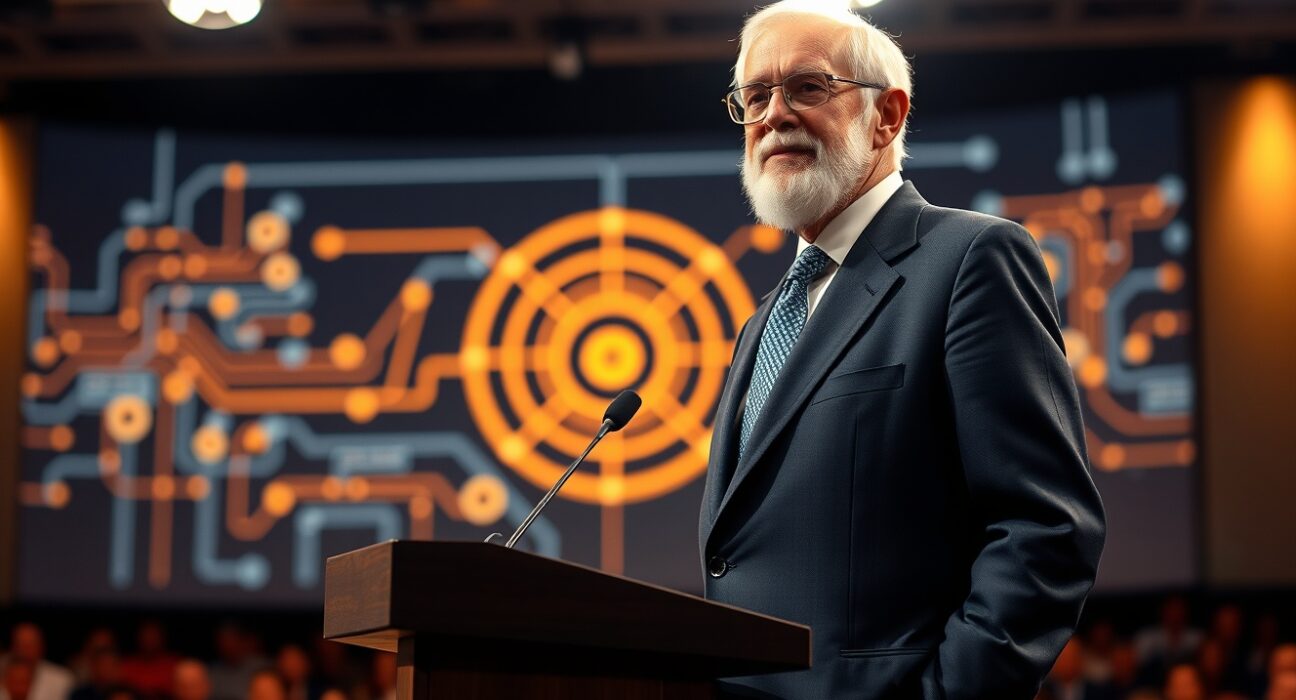
Vinton Cerf, the computer scientist widely recognized as a co-creator of the foundational protocols that power the internet, will retire from Google next week after more than 20 years at the company. Cerf, 83, currently serves as Google’s vice president and chief internet evangelist, a role he has held since 2005.
The announcement was made publicly during the Open Frontier conference hosted by the Laude Institute, where Cerf was speaking on a panel. Dave Patterson, a UC Berkeley professor and co-creator of RISC processor architecture, acknowledged Cerf’s departure. “Vint has been at Google more than 20 years, and he is retiring a week from today,” Patterson said, prompting applause from the audience. Google did not respond to a request for comment by publication time.
A legacy that built the internet
Cerf’s influence on modern technology is difficult to overstate. Working with collaborator Robert Kahn in the 1970s, Cerf developed the TCP/IP protocol suite — the set of rules that allows disparate computer networks to communicate with each other. This work became the technical foundation of the internet as we know it today.
His contributions have been recognized with numerous honors, including the Presidential Medal of Freedom, the Turing Award, and multiple honorary degrees. For the past two decades, Cerf has served as Google’s chief internet evangelist, a role that combined public advocacy for open internet standards with internal guidance on networking and policy issues.
Predictions on AI and the future of protocols
During the same conference panel, Cerf offered a forward-looking perspective on artificial intelligence and the need for standardization. He argued that the rise of AI agents — autonomous software capable of coordinating with other systems — will push the industry back toward formal protocols, much like the early internet.
“The agentic model of AI, with multiple agents from multiple sources interacting with each other, is going to force composability, and a requirement for interoperability and standardization,” Cerf said.
He cautioned against relying solely on natural language for inter-agent communication, citing the potential for ambiguity and error. “I don’t think English is going to be the best choice. There’s a flexibility in it, but there’s ambiguity, and I think precision for interagent interaction is going to be very, very important,” he added.
Why this matters for the open internet
Cerf’s retirement marks the end of an era for internet governance and open standards advocacy. His career bridged the transition from a research network to a global commercial and social infrastructure. The panel also included other prominent computer scientists known for their work on durable open source projects, including François Chollet, creator of the Keras deep-learning library, and Matei Zaharia, co-founder of Databricks.
Much of the conference discussion centered on the tension between centralized AI development — concentrated in a few well-resourced labs — and the decentralized, open model that made the internet resilient. Cerf’s prediction that AI will drive a return to formal standards suggests that the companies defining those standards early could gain significant influence over the emerging agentic economy.
A personal note from the early days
In a lighter moment during the panel, Patterson recalled meeting Cerf in the 1970s when both were graduate students. “He’s always been the best dressed computer scientist I’ve ever met,” Patterson said. Cerf acknowledged the memory, noting that he deliberately chose a different style to stand out. “I even had a vest, and for some reason I always wanted to stick out, and instead of having long hair, and something in my nose, I thought just dressing differently was one way to do it,” Cerf said.
Conclusion
Vinton Cerf’s retirement from Google closes a remarkable chapter in technology history. His work on TCP/IP made the internet possible, and his subsequent advocacy helped shape its evolution. As the industry turns toward AI and agent-based systems, his warning about the need for precision and standardization may prove as prescient as his earlier contributions.
FAQs
Q1: Who is Vinton Cerf?
Vinton Cerf is an American computer scientist who, along with Robert Kahn, co-designed the TCP/IP protocols that form the technical foundation of the internet. He is often referred to as one of the “fathers of the internet.”
Q2: What was his role at Google?
Cerf served as Google’s vice president and chief internet evangelist since 2005, advocating for open internet standards and advising on networking and policy issues.
Q3: What did Cerf say about AI agents and protocols?
Cerf predicted that the rise of autonomous AI agents will require formal, standardized protocols for interoperability, rather than relying on natural language, to avoid ambiguity and errors in communication between systems.
Disclaimer: The information provided is not trading advice, Bitcoinworld.co.in holds no liability for any investments made based on the information provided on this page. We strongly recommend independent research and/or consultation with a qualified professional before making any investment decisions.