

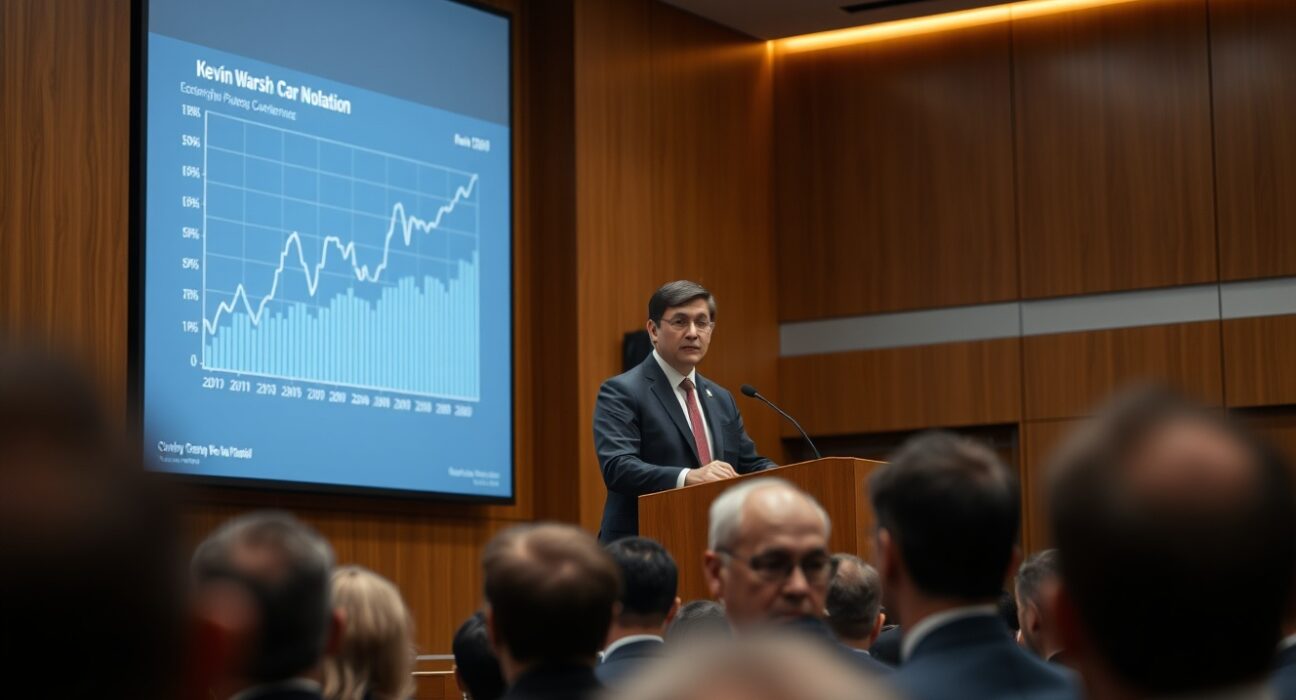
Federal Reserve Governor Kevin Warsh delivered a highly anticipated speech on Wednesday, yet offered no explicit forward guidance on interest rate policy. While some market participants hoped for a clearer signal on the central bank’s next move, the lack of a definitive statement itself became the story.
The Speech That Wasn’t a Signal
Speaking at the annual Economic Policy Symposium in Jackson Hole, Wyoming, Warsh focused his remarks on structural changes in the labor market and the challenges of measuring productivity in a digital economy. He did not directly address the timing or magnitude of future rate cuts, nor did he offer a firm timeline for the Fed’s balance sheet reduction. This absence of explicit policy clues, however, was not interpreted as a void. Instead, traders and analysts parsed his tone, his emphasis on data dependency, and his deliberate avoidance of a hawkish posture.
Reading the Silence: Market Interpretation
Financial markets reacted swiftly. The S&P 500 edged higher, and the yield on the 10-year Treasury note fell by 3 basis points. According to several market strategists, the lack of a hawkish pushback against current market pricing for rate cuts was itself a dovish signal. “If Warsh wanted to push back against the market’s easing expectations, he had the perfect platform to do so,” noted a senior economist at a major investment bank. “His silence on that front spoke volumes.”
Why This Matters for Investors
For investors, the key takeaway is that the Fed’s policy path remains data-dependent, but the bar for a hawkish surprise appears high. Warsh’s focus on structural issues rather than near-term inflation risks suggests the central bank is comfortable with the current trajectory of disinflation. This reinforces the narrative that the next move in rates is likely downward, though the timing remains uncertain. The market is now pricing in a higher probability of a rate cut in the third quarter, a shift that occurred directly after Warsh’s speech.
Conclusion
Kevin Warsh’s speech provided no explicit policy clues, but in the world of central banking, what is left unsaid can be as powerful as what is spoken. The market’s interpretation of his silence as a tacit endorsement of current easing expectations demonstrates that communication extends beyond explicit statements. For now, the path of least resistance for rates appears lower, but the Fed’s commitment to data dependency means every subsequent economic report will carry outsized weight.
FAQs
Q1: Did Kevin Warsh give any specific timeline for interest rate cuts?
No. Warsh did not mention any specific timeline for rate cuts, focusing instead on structural economic issues and data dependency.
Q2: Why did the market react positively if there was no news?
The market interpreted the lack of a hawkish tone or pushback against rate-cut expectations as a dovish signal, which was seen as supportive for equities and bonds.
Q3: What should investors watch next for Fed policy clues?
Investors should focus on upcoming inflation data, employment reports, and speeches by other Fed officials, as the central bank remains data-dependent.
Disclaimer: The information provided is not trading advice, Bitcoinworld.co.in holds no liability for any investments made based on the information provided on this page. We strongly recommend independent research and/or consultation with a qualified professional before making any investment decisions.
