

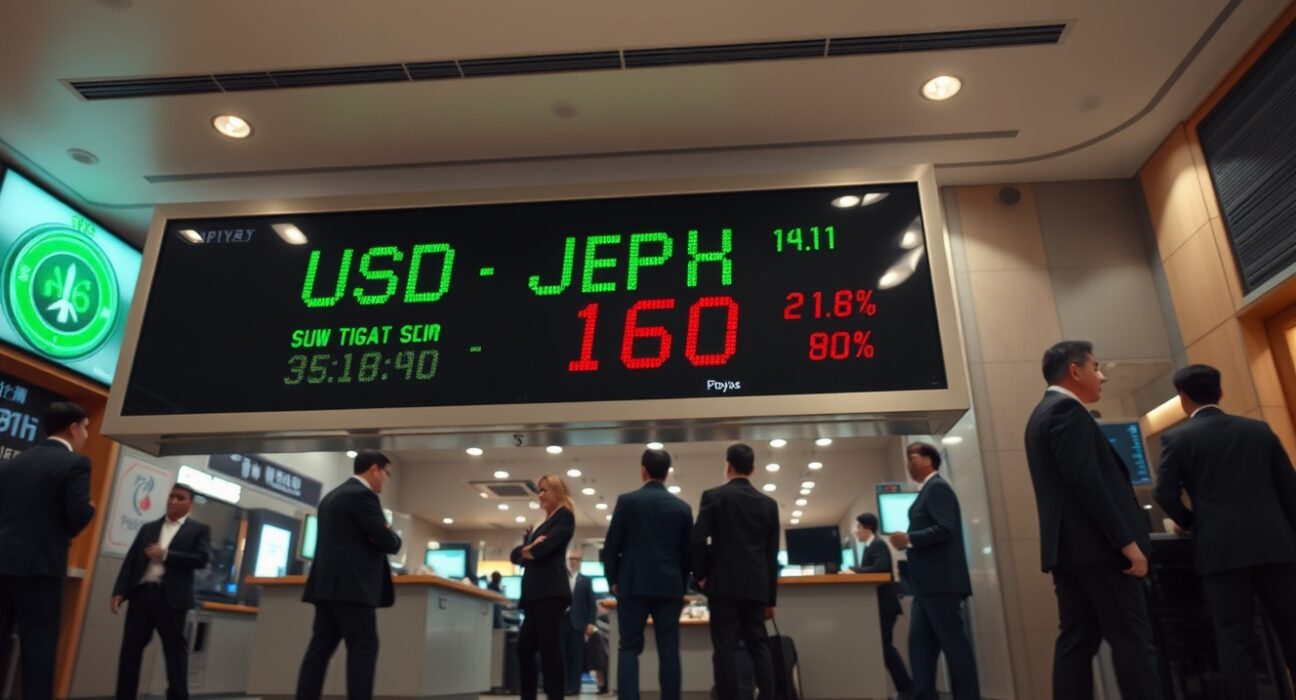
The Japanese Yen is showing signs of stabilization near its lowest level in four decades against the US dollar, as currency traders digest a mixed batch of economic data from the United States. The USD/JPY pair has been hovering around the 160 mark, a level not seen since the early 1980s, raising concerns about potential intervention from Japanese authorities.
Mixed US Data Provides Little Direction
The recent stability comes after a period of sharp depreciation for the Yen, driven by the wide interest rate differential between Japan and the United States. While the Federal Reserve has maintained a hawkish stance, recent US economic reports have been conflicting. Strong employment figures have been offset by signs of a cooling manufacturing sector and slightly softer consumer spending data, leaving the market without a clear catalyst for further Yen weakening.
Bank of Japan’s Dilemma
The Bank of Japan (BOJ) faces a complex policy challenge. While inflation has been above its 2% target for over a year, the central bank has only tentatively moved away from its ultra-loose monetary policy. The BOJ’s reluctance to raise interest rates aggressively, for fear of derailing the fragile economic recovery, has kept the Yen under sustained pressure. Market participants are closely watching for any hints of a more aggressive tightening cycle, but the BOJ’s recent communications suggest a cautious, data-dependent approach.
Intervention Risks Remain High
The current level of the Yen has put Japanese officials on high alert. Finance Minister Shunichi Suzuki has repeatedly stated that authorities are watching currency market movements with a high sense of urgency and will take appropriate action against excessive volatility. The threat of direct market intervention, similar to the actions taken in late 2022, is acting as a temporary floor under the Yen. However, the effectiveness of such interventions is often limited without a fundamental shift in monetary policy.
Implications for Global Markets
A persistently weak Yen has significant implications for global financial markets. For Japanese exporters, it boosts profits when repatriated, but it also increases the cost of imports, squeezing household purchasing power. For global investors, the Yen’s decline has made Japanese assets cheaper, but the currency risk remains a major deterrent. The situation also adds a layer of complexity to the global macroeconomic outlook, as a weaker Yen can contribute to imported inflation in other Asian economies and influence trade dynamics.
Conclusion
The Japanese Yen’s stabilization near its 40-year low reflects a tense equilibrium between bearish market forces and the risk of official intervention. The next major move will likely depend on clearer signals from the BOJ regarding its policy normalization timeline or a significant shift in the US economic outlook. For now, the currency remains in a precarious position, with the potential for sharp movements in either direction.
FAQs
Q1: Why is the Japanese Yen so weak against the US dollar?
The primary reason is the large interest rate differential. The US Federal Reserve has raised rates significantly to combat inflation, while the Bank of Japan has maintained ultra-low rates to support its economy. This makes holding US dollars more attractive than holding Yen.
Q2: What is a 40-year low for the Yen?
The Japanese Yen recently traded near the 160 level against the US dollar, a value not seen since the early 1980s. This means the Yen has lost significant purchasing power compared to the dollar over that period.
Q3: Could the Japanese government intervene to support the Yen?
Yes. Japanese officials have repeatedly warned that they are prepared to intervene in the currency market to curb excessive volatility. They have done so in the past, most notably in 2022, by selling US dollars and buying Yen. However, such interventions are typically seen as a short-term fix.
Disclaimer: The information provided is not trading advice, Bitcoinworld.co.in holds no liability for any investments made based on the information provided on this page. We strongly recommend independent research and/or consultation with a qualified professional before making any investment decisions.
