

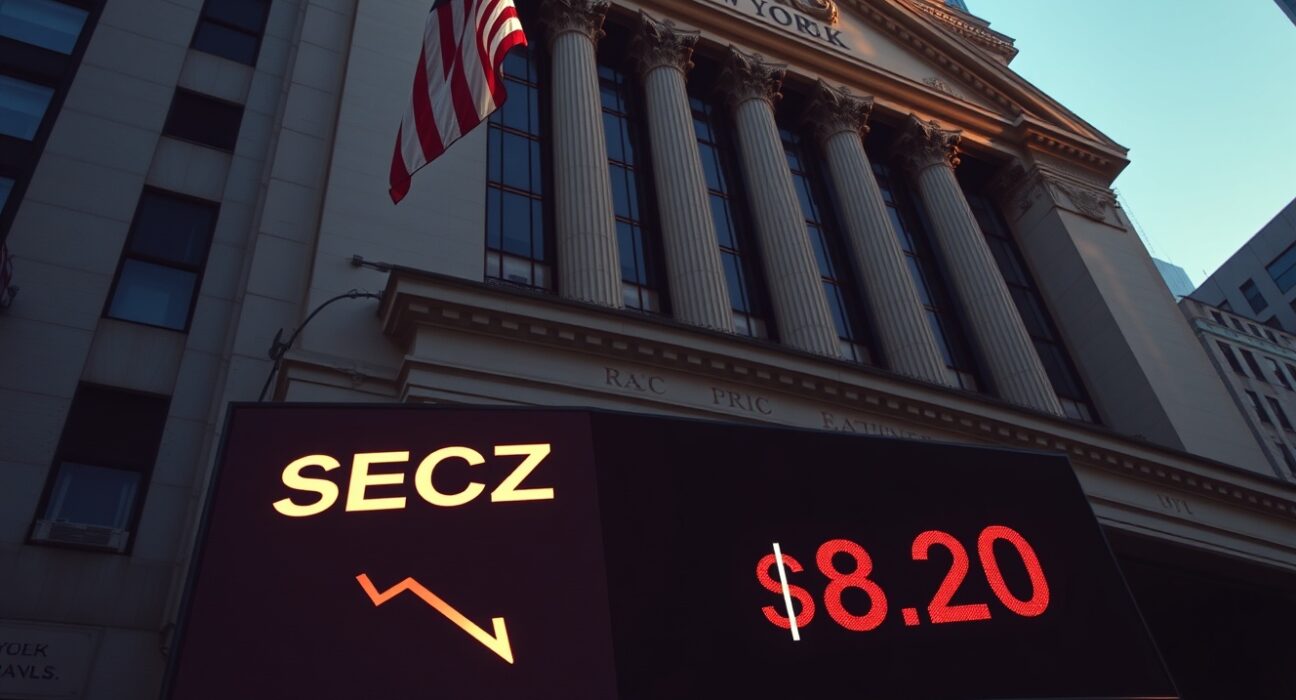
Shares of Securitize (SECZ), the tokenization platform that officially began trading on the New York Stock Exchange on July 2, have fallen by nearly 25% in their first days as a public company. The decline has drawn attention from market analysts who see it as part of a broader, recurring pattern affecting cryptocurrency-related companies after their public listings.
Post-Listing Volatility and Shifting Investor Base
According to a report from CoinDesk, Jeff Dorman, Chief Investment Officer at investment firm Arca, noted that the drop does not appear to be tied to any specific negative news about Securitize’s fundamentals. Instead, he attributed the volatility to the typical transition that occurs after a SPAC (Special Purpose Acquisition Company) merger. As the initial SPAC investors, who are often bond-focused and seek near-term returns, sell their positions, the stock’s price adjusts as long-term, fundamentals-driven equity investors take their place.
Dorman characterized this as a ‘common’ and ‘unsurprising’ market adjustment, suggesting that the price movement reflects a change in the shareholder base rather than a deterioration of the company’s business prospects.
A Broader Trend in Crypto Public Listings
The analyst further contextualized Securitize’s performance by comparing it to a string of other high-profile crypto companies that have struggled to maintain their listing prices. Dorman specifically referenced the post-IPO performance of Coinbase (COIN), Bullish (BLSH), Gemini (GEMI), BitGo (BTGO), and Circle (CRCL), all of which have experienced significant downward pressure on their stock prices after going public.
This pattern suggests that the market is applying a distinct valuation framework to crypto-native firms, one that often results in a period of price discovery that can be harsh relative to the initial hype or SPAC valuation.
What This Means for Investors
For retail and institutional investors, the Securitize listing serves as a cautionary tale about the unique risks associated with crypto IPOs and SPACs. The initial trading days may not reflect the long-term health of the business but rather the mechanics of the market structure. Investors are advised to differentiate between fundamental business value and short-term price action driven by shareholder rotation.
Conclusion
Securitize’s 25% decline post-listing is not an isolated event but a continuation of a trend seen across the crypto sector. While the company’s fundamentals remain unchanged according to analysts, the market’s reception underscores the volatility and unique challenges crypto firms face in the public markets. SECZ currently trades at $8.20, down 24.63% from its listing price.
FAQs
Q1: Why did Securitize stock drop so quickly after listing?
The drop is largely attributed to a shift in the investor base following the SPAC merger. Initial SPAC investors, who are often focused on short-term returns, sold their shares, while long-term equity investors are still evaluating the stock, creating a temporary imbalance that drives the price down.
Q2: Is this decline specific to Securitize or a broader trend?
It appears to be part of a broader trend. Other crypto companies like Coinbase, Bullish, Gemini, BitGo, and Circle have experienced similar post-IPO or post-listing price declines, suggesting a market-wide pattern for crypto stocks.
Q3: Does the stock drop mean Securitize is a bad investment?
Not necessarily. Analysts like Jeff Dorman point out that the decline is unrelated to the company’s fundamentals. The price movement is more about market mechanics and investor rotation than the company’s business health. Long-term investors may view the lower price as an entry point, but the stock remains volatile.
Disclaimer: The information provided is not trading advice, Bitcoinworld.co.in holds no liability for any investments made based on the information provided on this page. We strongly recommend independent research and/or consultation with a qualified professional before making any investment decisions.
