

Can Someone Receive Crypto From Abroad Into an Indian Wallet Legally?
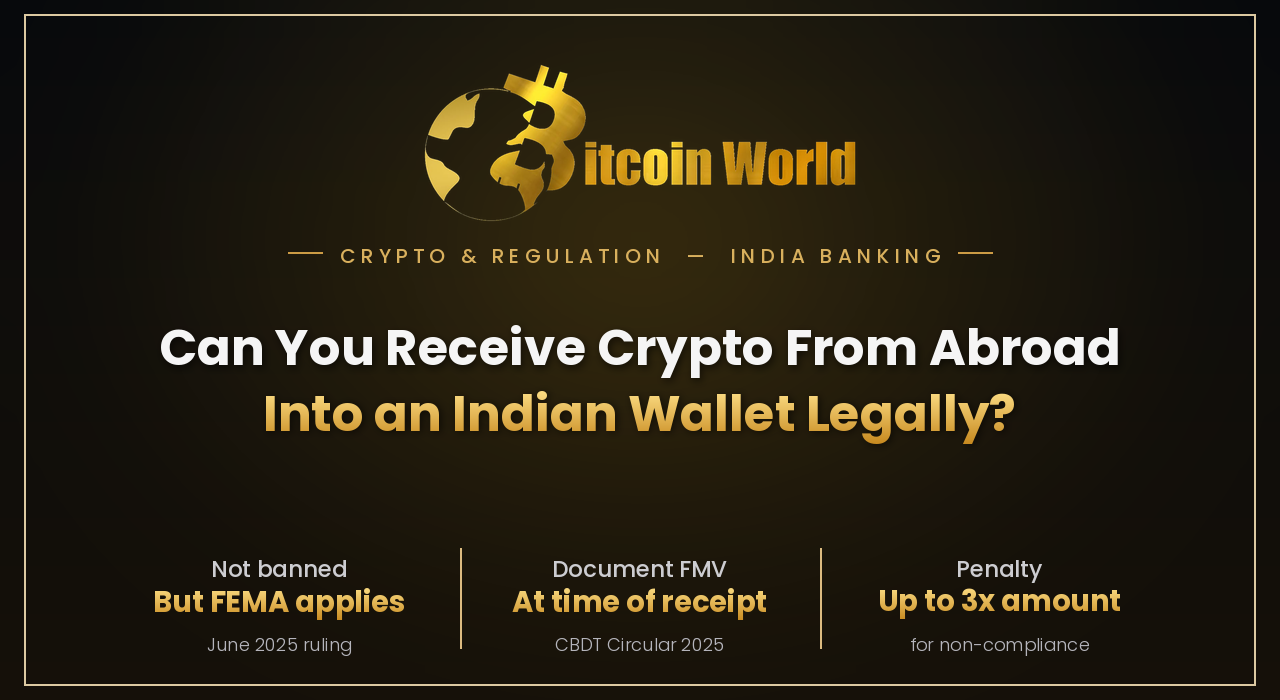
Receiving crypto from abroad into an Indian wallet sits in one of the most genuinely complex regulatory spaces in India’s crypto framework in 2026 – and it became significantly more complicated after the Finance Ministry officially classified Virtual Digital Assets as intangible movable property in June 2025, bringing all cross-border VDA transfers explicitly within the scope of the Foreign Exchange Management Act (FEMA). Before that classification, the position was ambiguous; in 2026, the legal obligations are clearer, the enforcement appetite is demonstrably higher, and the documentation required is specific. This article explains the current legal position, what FEMA requires for inbound crypto transfers, the purpose-based distinctions that affect compliance, and what Indian residents and freelancers must do to receive crypto internationally without triggering FEMA contraventions. Verified against current sources, including CBDT Circular 18/2025 and FEMA 1999.
Can Someone in India Legally Receive Crypto Transferred From Abroad?
Receiving crypto from abroad in India is not categorically prohibited – but it is not freely permitted either. The legal position depends on the purpose of the transfer and how it is handled after receipt.
- Not banned outright: There is no notification under FEMA that explicitly prohibits Indian residents from receiving crypto from a foreign sender.
- FEMA applies from June 2025: The Finance Ministry officially classified Virtual Digital Assets as “intangible movable property” in June 2025 – meaning moving crypto across India’s borders is now treated like sending money abroad, with extra layers of scrutiny.
- Indian residents making or receiving cross-border VDA transfers should assume FEMA applies and that documentation is required.
- Purpose matters: The regulatory treatment differs based on whether the crypto is received as a gift, as payment for services, as an investment transfer, or as a remittance from a family member.
- The grey area remains: Cryptocurrencies are legally in a grey zone in India under FEMA – defined as VDAs under tax law but not recognised as currency or legal tender, meaning they sit in a category FEMA’s original framework was not built to address.
What Does FEMA Actually Require for Inbound Crypto Transfers?
FEMA obligations for receiving crypto from abroad are triggered by the June 2025 classification and require documentation and, in some cases, advance authorisation.
- Capital account vs current account: FEMA distinguishes between current account transactions (trade, services, remittances) and capital account transactions (investments, loans, property). FEMA treats cross-border VDA transfers like sending money abroad – requiring documentation and, for larger amounts, prior approval from an authorised dealer bank.
- $250,000 annual cap: Under India’s Liberalised Remittance Scheme (LRS), residents can send up to $250,000 per year without needing special approval – anything above that requires prior permission. There is no exception for small transfers – even $100 in crypto counts toward your annual limit. The same cap framework applies conceptually to inbound VDA transfers under FEMA’s capital account rules.
- CBDT Circular 18/2025 on valuation: The CBDT clarified in Circular 18/2025 that crypto must be valued in Indian Rupees at the exact time of transfer using the RBI’s daily exchange rate – not at the time of filing or any other point.
- Authorised dealer bank involvement: For significant inbound crypto transfers, involving your bank’s forex desk in advance and documenting the nature and purpose of the transfer reduces FEMA contravention risk.
What Are the Permitted and Riskier Purposes for Receiving Crypto From Abroad?
The purpose behind receiving crypto from abroad determines both the compliance path and the regulatory risk.
Lower-risk and more clearly permitted:
- Freelance payment for services: An Indian freelancer receiving crypto payment from a foreign client for legitimate services is broadly analogous to a foreign inward remittance – but must be documented and eventually converted to INR through compliant channels. Unlike rupees arriving via SWIFT with a FIRA certificate, crypto received from abroad doesn’t go through authorised banking channels, meaning it lives outside India’s financial framework until converted.
- Gift from a family member: Receiving crypto as a gift from a non-resident Indian family member has some analogy to inward remittance, but carries the same documentation requirement – FMV at receipt in INR per CBDT Circular 18/2025, taxable as income above ₹50,000 from a non-relative.
- Portfolio transfers from your own foreign account: An Indian resident moving their own crypto from a foreign exchange to an Indian wallet – to comply with FEMA disclosure obligations – must document the transaction clearly and ensure foreign holdings were already declared in Schedule FA.
Higher-risk scenarios:
- Receiving stablecoins in lieu of USD: A stablecoin transfer does not go through the SWIFT system or bank – the RBI would see it as a private crypto transaction, not as USD entering your account. Money changing hands via USDT must eventually enter India through banking or RBI-sanctioned methods.
- Receiving from unregistered foreign exchanges: Transfers from Binance, KuCoin, or other non-FIU-registered platforms carry compounded FEMA and PMLA risk – the ED has issued notices to users of non-compliant platforms.
- Large inbound transfers without documentation: The ED’s FEMA enforcement in 2025-26 included 812 charge sheets with a 94% conviction rate – cross-border crypto transfers without documentation represent a live enforcement priority.
What Must Indian Residents Do When Receiving Crypto From Abroad?
The compliance steps for receiving international crypto in India are specific and must be completed at the time of receipt, not retrospectively.
- Record INR FMV at exact transfer time: Per CBDT Circular 18/2025, record the INR value of the received crypto at the precise time of transfer using the RBI’s daily exchange rate – this is both the taxable income figure and the cost of acquisition for any future sale.
- Declare as income from other sources (if gift/payment): Crypto received as payment for services or as a gift above ₹50,000 from a non-relative must be declared as income from other sources in your ITR at the applicable slab rate.
- Declare foreign holding if applicable: If the crypto arrived from a foreign exchange account you hold, ensure that exchange account is already declared in Schedule FA – failing to do so compounds the risk.
- Convert through compliant channels: For crypto received as freelance payment, converting it to INR via a FIU-registered exchange creates a documented audit trail – preferable to leaving it in a foreign or self-custody wallet indefinitely.
- Seek professional advice for large transfers: FEMA violations are strict liability offences. Engage a legal advisor before initiating any cross-border movement of significant crypto. Post-facto regularization is possible but expensive, with penalties up to three times the amount involved.
Frequently Asked Questions
Is it legal to receive Bitcoin or USDT from a foreign friend or client in India in 2026?
Receiving crypto from abroad in India is not explicitly banned but is now governed by FEMA following the June 2025 classification of VDAs as intangible movable property. Indian residents receiving cross-border VDA transfers should assume FEMA applies and that documentation is required. For freelance payments and gifts, documentation of the purpose, the INR FMV at receipt per CBDT Circular 18/2025, and eventual conversion through compliant channels reduces risk significantly. Receiving large amounts without documentation or from non-FIU-registered platforms carries active FEMA enforcement risk.
Can Indian freelancers legally accept crypto payments from foreign clients?
Accepting crypto from foreign clients for legitimate services is broadly possible – but it is not treated like a standard foreign inward remittance. Unlike rupees arriving via SWIFT with a FIRC certificate, crypto received from abroad doesn’t go through authorised banking channels and lives outside India’s financial framework until converted. The safest approach is to document the invoice, record the INR FMV of the crypto at receipt, declare it as income from other sources in your ITR, and convert to INR via a FIU-registered exchange promptly. Consulting a tax professional familiar with FEMA and VDA rules is strongly recommended for regular international crypto receipts.
What is the penalty for receiving crypto from abroad without proper documentation in India?
FEMA violations are strict liability offences – penalties can be up to three times the amount involved, and the Enforcement Directorate has demonstrated increased enforcement appetite in 2025-26. Receiving large cross-border crypto transfers without documentation, from non-FIU-registered platforms, or without declaring the income in your ITR compounds multiple violations simultaneously. The combination of FEMA contraventions, undisclosed foreign assets under the Black Money Act, and income tax non-disclosure creates significant cumulative legal exposure.
Conclusion: Legally Possible, FEMA-Governed, and Documentation-Dependent
Receiving crypto from abroad into an Indian wallet in 2026 is legally possible but requires a level of documentation discipline that most users do not apply. The June 2025 VDA-as-property classification put cross-border crypto firmly inside FEMA’s framework, CBDT Circular 18/2025 specified the valuation methodology, and the ED’s 2025-26 enforcement surge demonstrated the consequences of non-compliance. For Indian residents, the practical approach is straightforward: document every inbound international crypto transfer at the moment of receipt with the INR FMV, declare it correctly in your ITR as income or a capital asset, convert to INR through a FIU-registered exchange to create a banking-channel audit trail, and seek professional advice before any significant cross-border transfer. The rules are complex; the documentation that satisfies them is manageable – but only if you apply it at the time of receipt, not after a notice arrives.
Disclaimer: The information provided is not trading advice, Bitcoinworld.co.in holds no liability for any investments made based on the information provided on this page. We strongly recommend independent research and/or consultation with a qualified professional before making any investment decisions.
