

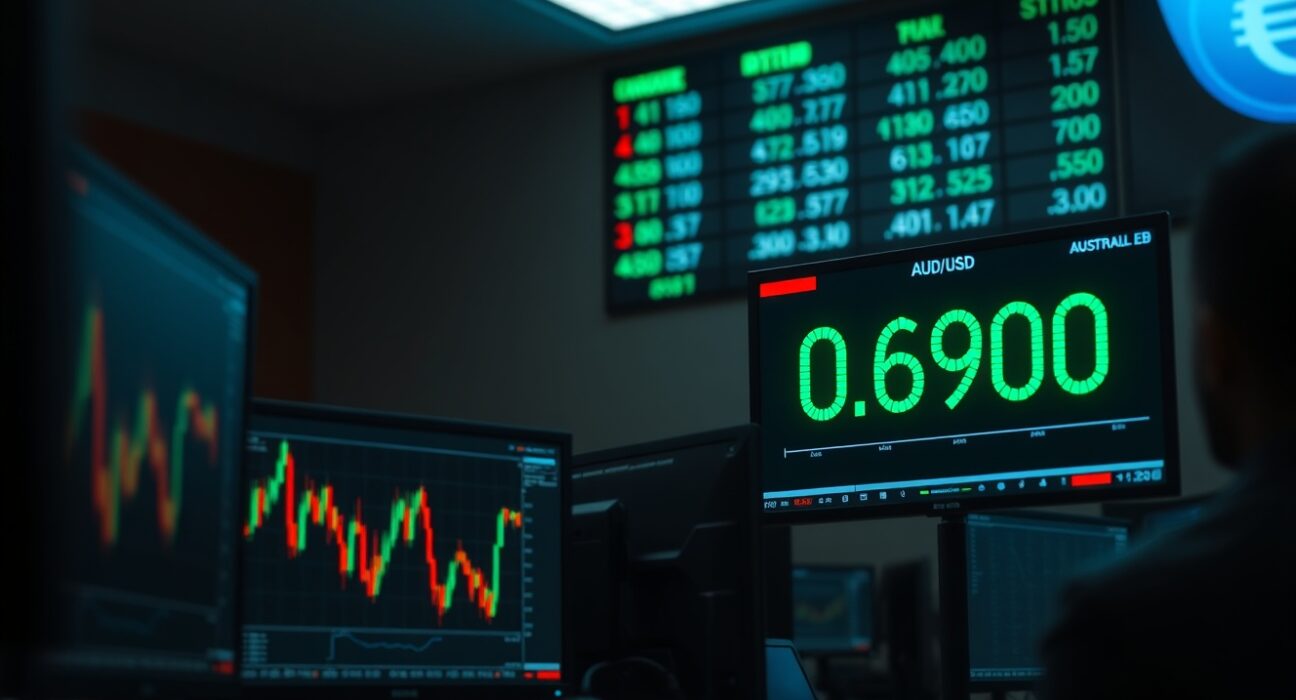
The Australian dollar weakened against the US dollar on Tuesday, slipping toward the 0.6900 mark as the United States launched a fresh wave of military strikes against Iranian targets. The escalation in the Middle East has reignited risk aversion across global markets, prompting investors to rotate out of higher-yielding currencies like the Aussie and into the safe-haven greenback.
Geopolitical Shockwaves Hit Currency Markets
The US strikes, confirmed by Pentagon officials late Monday, targeted Iranian military installations in response to recent attacks on American assets in the region. The move marks a significant escalation in an already volatile geopolitical landscape, drawing sharp reactions from Tehran and raising fears of a broader conflict.
For currency traders, the immediate consequence has been a flight to safety. The US dollar index (DXY) climbed sharply, while the Australian dollar—often used as a proxy for risk appetite due to its close ties to global trade and commodity prices—bore the brunt of the sell-off. The AUD/USD pair, which had been trading comfortably above 0.6950 earlier in the week, now faces the critical psychological support level at 0.6900.
Why the Aussie Dollar Is Vulnerable
The Australian dollar is particularly sensitive to geopolitical shocks for several reasons. First, Australia’s economy is heavily reliant on trade with China, and any disruption to global supply chains or energy markets can quickly impact demand for its commodity exports. Second, the Reserve Bank of Australia (RBA) has been pursuing a relatively dovish monetary policy stance compared to the Federal Reserve, which narrows the interest rate differential and makes the Aussie less attractive during risk-off periods.
“The market is pricing in a higher probability of a sustained conflict, which tends to favor the dollar,” said Marcus Chen, a senior currency strategist at Sydney-based Global FX Partners. “For the AUD, the 0.6900 level is a major line in the sand. A break below that could open the door to a test of 0.6800.”
Impact on Commodities and Trade
The strikes have also rattled commodity markets. Oil prices surged more than 3% in early Asian trading, with Brent crude pushing above $85 per barrel. Higher energy costs are a double-edged sword for Australia: they boost revenue from liquefied natural gas exports but also raise import costs and inflation pressures. Meanwhile, gold, another traditional safe haven, rallied, further underscoring the broad risk-off mood.
Market Outlook and Key Levels
Traders are now watching for any retaliatory actions from Iran, which could trigger another wave of volatility. The 0.6900 handle remains the immediate support level for AUD/USD, with a break below likely accelerating selling pressure. On the upside, resistance is seen near 0.6950 and then 0.6980, though any recovery would require a de-escalation in tensions or a shift in market sentiment.
The situation remains fluid, and the direction of the Australian dollar in the coming days will largely depend on developments in the Middle East. Central bank commentary and upcoming US economic data, including non-farm payrolls, may add further layers of complexity.
Conclusion
The AUD/USD pair is under significant pressure as the US-Iran conflict escalates, with the 0.6900 level serving as a critical threshold. While the Australian dollar has shown resilience in the past, the current geopolitical environment favors the US dollar as a safe haven. Investors should monitor news flow closely and prepare for potential further downside if tensions continue to mount.
FAQs
Q1: Why does the Australian dollar weaken when geopolitical tensions rise?
A: The Australian dollar is considered a risk-sensitive currency because Australia’s economy depends heavily on global trade and commodity exports. During geopolitical crises, investors move capital into safer assets like the US dollar, gold, or government bonds, causing the Aussie to decline.
Q2: What is the significance of the 0.6900 level for AUD/USD?
A: The 0.6900 level is a major psychological support zone for the AUD/USD pair. A break below this level often triggers further selling, as it signals that risk aversion is deepening. Traders view it as a key line in the sand for the pair’s short-term direction.
Q3: How do US military strikes affect currency markets?
A: US military strikes increase geopolitical uncertainty, which typically boosts demand for safe-haven currencies like the US dollar, Swiss franc, and Japanese yen. Conversely, currencies linked to risk appetite, such as the Australian dollar, New Zealand dollar, and emerging market currencies, tend to weaken as investors reduce exposure to volatile assets.
Disclaimer: The information provided is not trading advice, Bitcoinworld.co.in holds no liability for any investments made based on the information provided on this page. We strongly recommend independent research and/or consultation with a qualified professional before making any investment decisions.
