

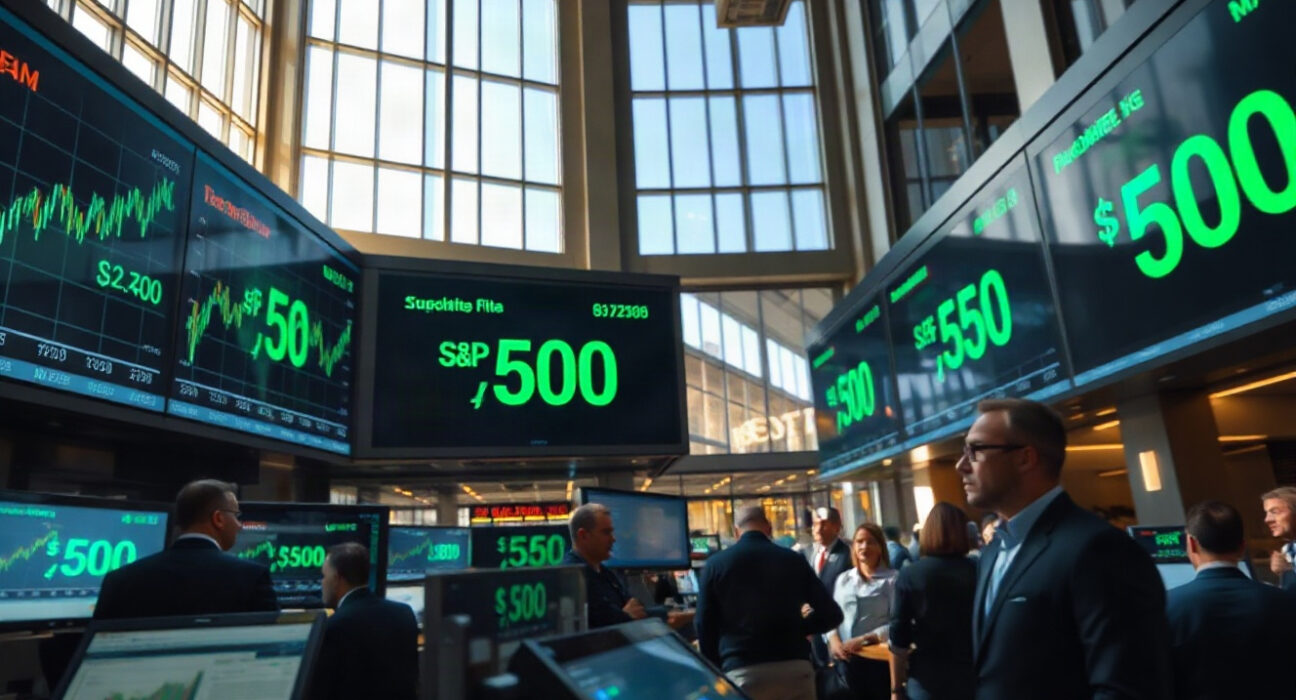
Wall Street strategists are increasingly setting 8,000 as a realistic target for the S&P 500 by the end of 2026, driven by renewed enthusiasm for artificial intelligence and its potential to boost corporate profits across multiple sectors.
As of February 2026, several major financial institutions have revised their year-end 2026 targets upward, citing stronger-than-expected AI adoption, resilient consumer spending, and improving earnings growth. The new forecasts represent a roughly 10% upside from current levels, a significant shift from the more cautious outlooks seen just six months ago.
What’s Fueling the AI Optimism?
The primary driver behind the bullish targets is the accelerating integration of AI into business operations. Companies are moving beyond experimental pilots to full-scale deployments, leading to measurable productivity gains and cost savings. Tech giants, in particular, are reporting robust revenue from AI-related cloud services and enterprise software, which is lifting the entire technology sector.
Additionally, the semiconductor industry continues to benefit from surging demand for AI chips. Recent earnings reports from key chipmakers have exceeded expectations, and their forward guidance suggests sustained growth through 2026. This momentum is not limited to mega-cap tech; mid-cap companies in sectors like healthcare, finance, and manufacturing are also adopting AI tools to streamline operations, broadening the market rally.
Historical Context and Market Dynamics
To put the 8,000 target in perspective, the S&P 500 crossed the 7,000 mark in late 2025, after a volatile period marked by interest rate uncertainty and geopolitical tensions. The index’s climb from 6,000 to 7,000 took just over a year, and analysts note that a similar pace could push the index to 8,000 by the end of 2026.
However, such rapid gains are not without precedent. In the late 1990s, the index surged more than 20% annually for three consecutive years, driven by the internet boom. Today’s AI-driven rally shares similarities, but there are key differences: companies are showing actual earnings growth rather than just promises, and valuations, while elevated, are not as stretched as they were at the peak of the dot-com bubble.
Risks That Could Derail the Rally
Despite the optimism, several risks could temper the market’s trajectory. Persistent inflation remains a concern, and the Federal Reserve has signaled it may keep interest rates higher for longer if price pressures persist. Higher rates can increase borrowing costs for companies, potentially squeezing margins and slowing investment.
Geopolitical tensions, particularly around trade and energy supplies, also pose a threat. Any major disruption could quickly shift investor sentiment. Moreover, the AI sector itself could face regulatory headwinds, as governments worldwide consider new rules to govern AI development and data privacy, which might slow adoption in some industries.
Another risk is concentration. A significant portion of the index’s gains has been driven by a handful of mega-cap tech stocks. If these companies fail to meet lofty expectations, the broader market could suffer disproportionately. Diversification across sectors will be crucial for sustaining the rally.
Why This Matters to Investors
For investors, the 8,000 target is more than a number—it signals confidence in the economy’s ability to adapt and grow through technological innovation. But it also serves as a reminder of the importance of a balanced portfolio. While AI stocks have been the stars, sectors like healthcare, renewable energy, and financials are also poised to benefit from AI-driven efficiencies, offering opportunities beyond the tech giants.
Moreover, the path to 8,000 is unlikely to be linear. Market corrections, even in strong bull markets, are normal. Investors should focus on long-term fundamentals rather than short-term price movements, and consider dollar-cost averaging to navigate volatility.
Conclusion
In summary, the S&P 500’s potential rise to 8,000 by 2026 is underpinned by genuine AI-driven earnings growth, but it is not guaranteed. Investors should weigh the optimism against the risks, stay informed, and maintain a diversified approach. As always, past performance is not indicative of future results, and individual circumstances should guide investment decisions.
FAQs
Q1: What is driving the S&P 500 to 8,000?
The primary driver is the rapid adoption of artificial intelligence across industries, leading to stronger corporate earnings and productivity gains. This is complemented by resilient consumer spending and a robust labor market.
Q2: Is an 8,000 target realistic by 2026?
Many analysts believe it is, given current earnings momentum and historical precedents. However, it depends on factors like inflation, interest rates, and geopolitical stability. It’s a plausible scenario, not a certainty.
Q3: What risks could prevent the S&P 500 from reaching 8,000?
Key risks include persistent inflation forcing the Fed to keep rates high, geopolitical shocks, regulatory changes in AI, and a potential market correction due to overvaluation in tech stocks. Any of these could slow or reverse the rally.
Disclaimer: The information provided is not trading advice, Bitcoinworld.co.in holds no liability for any investments made based on the information provided on this page. We strongly recommend independent research and/or consultation with a qualified professional before making any investment decisions.
