

Key Takeaways
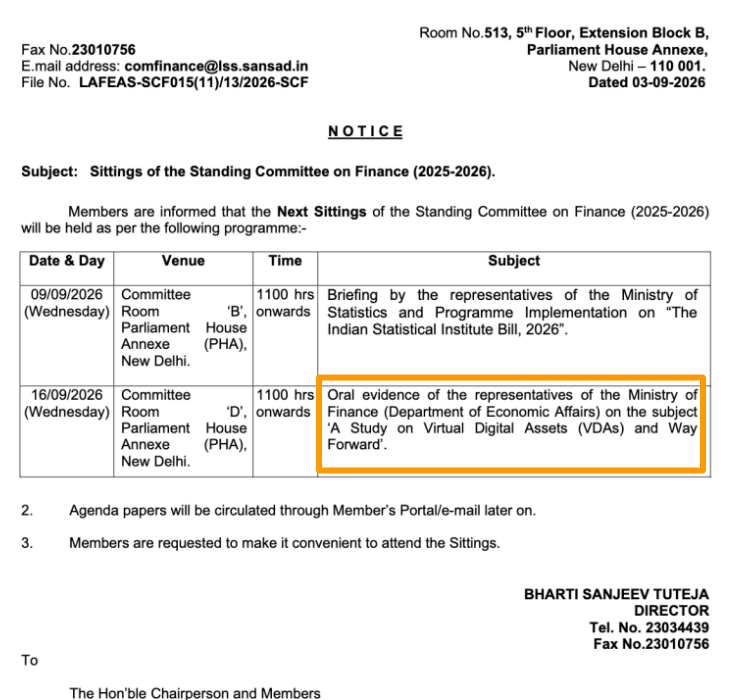
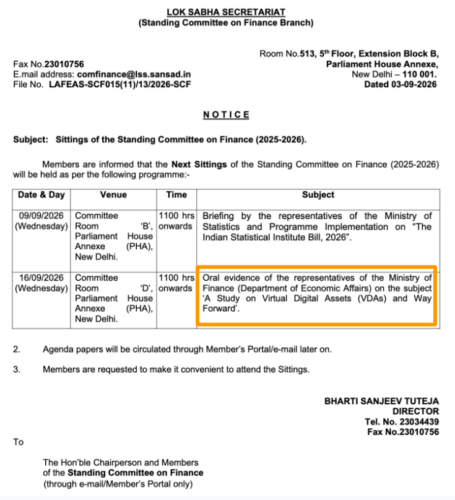
- The Finance Ministry’s Department of Economic Affairs (DEA) will appear before the Parliamentary Standing Committee on Finance on September 16, 2026, at 11 AM, Committee Room D, Parliament House Annexe.
- About 91.5% of India’s crypto trading volume in FY2024-25 went to offshore exchanges. Only 8.5% stayed home.
- No new law is coming out of this meeting. What we’re actually waiting for is a name – who regulates crypto, and what crypto legally is.
Everyone is calling September 16 a “big clarity moment.” Let’s be honest about what it really is. The DEA is going to sit in front of MPs and explain a tax system that has been running for four years – one that collected less money than expected and pushed most of the market somewhere the taxman can’t reach.
The numbers say it plainly. When 91.5% of trading happens abroad and only 8.5% stays on FIU-registered Indian exchanges, the 1% TDS didn’t fail. It worked too well as a deterrent. It was supposed to create a paper trail. Instead, people simply went where no trail gets created.
The Full Timeline
- April 2018 – RBI tells banks to cut off crypto firms. Exchanges struggle to survive.
- March 2020 – Supreme Court strikes down the RBI circular. Banking access returns.
- July 1, 2022 – Section 115BBH (30% flat tax) and Section 194S (1% TDS) kick in. No loss set-off allowed.
- March 2023 – VDA service providers brought under PMLA anti-money-laundering rules.
- 2024 – FIU acts against unregistered offshore platforms. Several later register and continue serving Indians.
- August 14, 2024 – Standing Committee formally takes up “A Study on Virtual Digital Assets (VDAs) and Way Forward.”
- Through 2025-26 – Exchanges (Binance, WazirX, ZebPay, CoinDCX, CoinSwitch, Coinbase), FIU, CBDT, MCA and IFSCA all depose. By mid-2026, 54 VDA providers are FIU-registered.
- May 20, 2026 – Committee Chairman Bhartruhari Mahtab calls the outflow of thousands of crores “very alarming.”
- July 2, 2026 – RBI and ICAI depose. RBI stays opposed to legal status. ICAI pushes for proper accounting and legal clarity.
- August 20, 2026 – Lok Sabha Secretariat notice: the August 27 DEA sitting “stands CANCELLED.” No new date.
- September 3, 2026 – Fresh notice fixes the DEA hearing for September 16.
What X Is Saying
The industry conversation is mostly happening on X, not in press releases. Worth following:
- Bharat Web3 Association – the loudest voice asking for TDS to drop to 0.01% and loss set-off to be allowed.
- Sumit Gupta, CoinDCX CEO – his post on India ranking #1 in grassroots adoption sums up the industry’s core argument: users are here, the rules aren’t.
The Part Nobody Wants To Own
The real problem isn’t tax. It’s turf. Until someone says clearly whether a token is a security, a commodity, or its own thing, no regulator has to take charge. SEBI, RBI and the ministry all quietly benefit from the confusion.
The committee’s own idea – an interim setup run through Self-Regulatory Organisations under a designated regulator – tells you everything. Governments suggest SROs when they want supervision without doing the hard work of writing a law. It’s a placeholder. And placeholders in Indian finance tend to stick around for years.
Conclusion
India built the enforcement machinery first and never got around to the definitions. The 91.5% figure is the receipt for that choice. September 16 won’t fix it. But it will tell us whether the government has finally accepted the bill.
Disclaimer: The information provided is not trading advice, Bitcoinworld.co.in holds no liability for any investments made based on the information provided on this page. We strongly recommend independent research and/or consultation with a qualified professional before making any investment decisions.
