

Key Takeaways
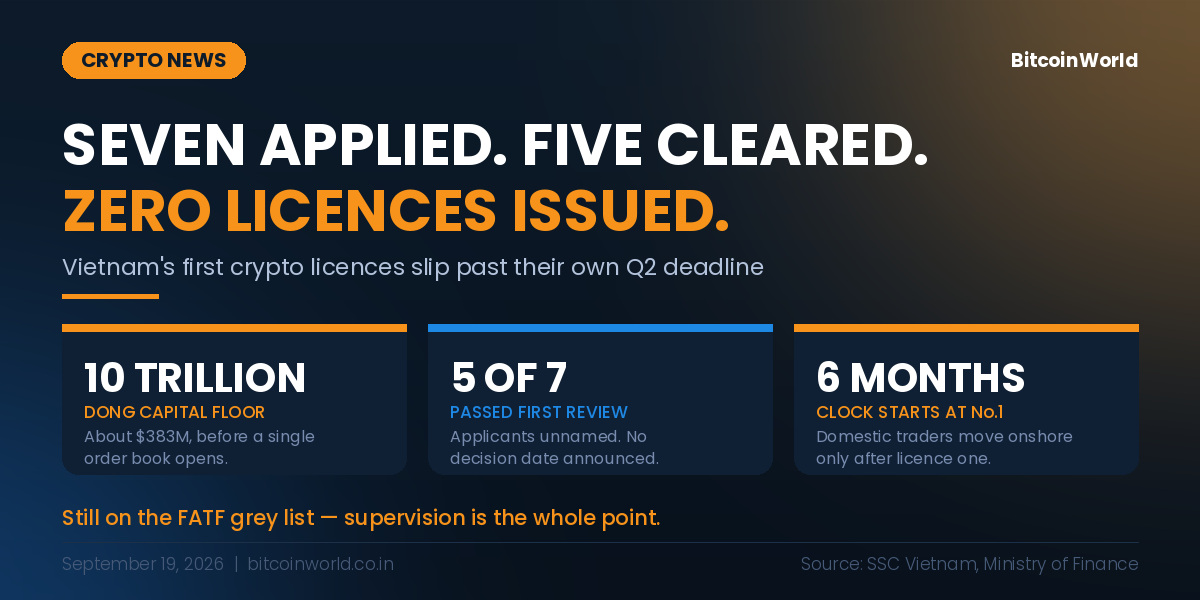
- Hanoi says the first crypto licences arrive in 2026. Its own Q2 deadline came and went.
- Seven firms applied. Five cleared round one. Nobody has been approved.
- The rulebook copies FATF and European supervision for a reason that has nothing to do with optics.
- The day licence one is signed, a six-month clock starts pulling Vietnamese traders off foreign platforms.
Deputy Finance Minister Nguyen Duc Chi was in Vienna on September 15, sitting across from Mariana Kühnel, who runs Austria’s Financial Market Authority. He brought the chair of the State Securities Commission, the ambassador, and senior people from the Vietnam Stock Exchange and the clearing corporation. That is a heavy delegation for a meeting written up as an exchange of views.
Commission chair Vu Thi Chan Phuong said the supervisory design leans on FATF recommendations and EU models. Kühnel floated technical workshops and closer contact through IOSCO. All very cordial. The interesting part is what nobody said out loud, which is when the licence actually lands.
How we got here
Resolution 05, signed in September 2025, set up a five-year pilot: everything settles in dong, only licensed firms may operate, and fiat-backed stablecoins are shut out entirely. The ministry then capped the pilot at five operators and, in October 2025, reported nobody had applied. The window finally opened on January 20, 2026, under Decision 96. By April the Prime Minister was publicly ordering a Q2 launch, with seven applications on the desk. On August 30 officials confirmed five had passed a first assessment, named none of them, and offered no decision date. Then on September 1, a decree arrived with fines for anyone operating without a licence. Punishments before permissions. That sequence tells you something.
What is really holding it up
Applicants need 10 trillion dong in charter capital, a Level 4 information-system security appraisal, and sign-off from the Ministry of Public Security before opening a single order book. Vietnam wrote exchange rules as if exchanges were stock exchanges, because in its view they are.
Austria was not a coincidence either. The FMA supervises crypto firms inside the EU machine, so what Hanoi wants is not a statute, it is the habit of enforcing one. The pressure behind that is quieter. Vietnam was still on the FATF grey list after the June 2026 plenary. A licensed, monitored, dong-settled venue reads as a direct answer to that.
What happens next
The six-month transition for domestic traders only begins once the first licence exists, and it does not exist yet. When it does, offshore liquidity gets squeezed quickly. But licensed venues will open without USDT, the pair Vietnamese retail actually trades in. A gap between onshore and offshore prices is close to guaranteed.
Conclusion
This is not a government dragging its feet. It is one spending 2026 collecting credibility before handing out permission. Ignore the launch talk. Watch for the signature on licence one, because nothing binding starts before it.
Disclaimer: The information provided is not trading advice, Bitcoinworld.co.in holds no liability for any investments made based on the information provided on this page. We strongly recommend independent research and/or consultation with a qualified professional before making any investment decisions.
