
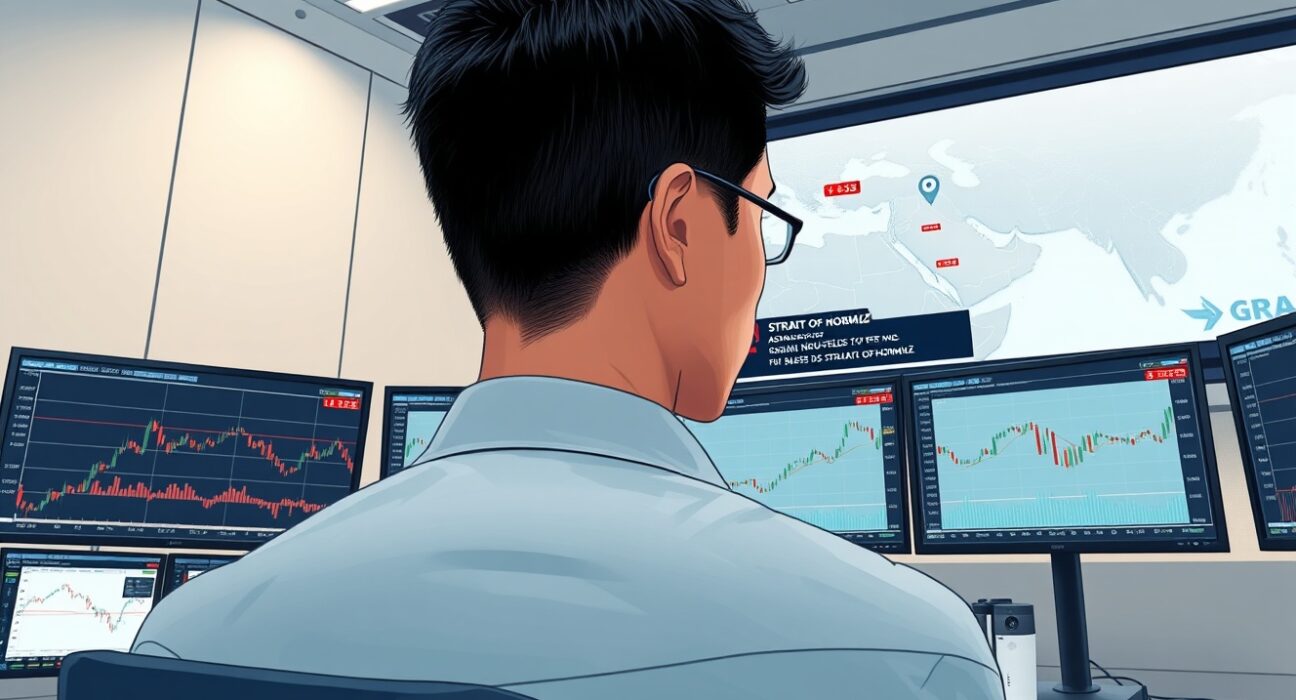
SINGAPORE – Asian foreign exchange (FX) markets exhibited a distinct lack of directional momentum this week, trading in a tight, sideways pattern as persistent geopolitical tensions surrounding the critical Strait of Hormuz continue to inject uncertainty into the regional economic outlook, according to a latest analysis from OCBC Bank.
Asian FX Markets Move Sideways Amid Geopolitical Uncertainty
Major Asian currencies, including the Singapore dollar (SGD), South Korean won (KRW), and Thai baht (THB), have shown remarkably subdued volatility. Consequently, traders and analysts describe the current environment as range-bound. This sideways movement directly contrasts with typical market reactions to economic data releases. Furthermore, the usual drivers like interest rate differentials have taken a backseat. The primary catalyst for this stagnation is the elevated risk premium associated with Middle Eastern stability.
The Strait of Hormuz, a narrow maritime chokepoint between Oman and Iran, serves as the world’s most important oil transit lane. Approximately 21 million barrels of oil, or one-fifth of global seaborne oil trade, pass through it daily. Any disruption threatens immediate spikes in global oil prices. Asian economies, as net energy importers, remain particularly vulnerable to such shocks. Therefore, currency markets are pricing in this latent risk, leading to cautious, non-committal trading.
OCBC Analysis Highlights the Lingering Hormuz Risk Factor
Economists at OCBC Treasury Research note that while direct conflict has been avoided, the underlying friction points remain unresolved. “The market is in a holding pattern,” the report states, emphasizing that the risk-off sentiment is capping any appreciation in Asian currencies, despite otherwise supportive domestic fundamentals. The analysis points to recent incidents, including heightened military posturing and seizures of commercial vessels, as factors that keep risk assessments elevated.
This environment creates a complex dynamic for regional central banks. For instance, they must balance growth-supportive policies with the inflationary threat of potential oil price surges. OCBC’s model suggests that a sustained 10% increase in Brent crude prices could translate to a 15-25 basis point drag on GDP growth for major Asian importing nations within a quarter. This economic headwind naturally pressures their respective currencies.
Historical Context and Market Comparisons
Historical data reveals a clear pattern of Asian FX sensitivity to Hormuz tensions. During similar periods of elevated risk in 2019 and 2022, currencies like the Indian rupee (INR) and Philippine peso (PHP) experienced pronounced weakness and heightened volatility. The current scenario differs, however, as markets have not priced in an acute crisis but rather a prolonged state of heightened alert. This results in the observed sideways consolidation, where currencies neither strengthen nor weaken significantly as traders await a clearer signal.
A brief comparison of current implied volatility (a measure of expected price swings) against historical averages illustrates this cautious stance:
| Currency Pair | Current 1-Month Implied Volatility | 5-Year Average |
|---|---|---|
| USD/SGD | 4.5% | 5.8% |
| USD/KRW | 7.2% | 9.1% |
| USD/INR | 6.8% | 7.5% |
The table shows suppressed volatility, indicating markets are compressed, not calm—a technical state often preceding a significant breakout once a catalyst emerges.
Broader Impacts on Regional Trade and Investment Flows
The sideways trading in FX markets mirrors a broader hesitation in regional capital flows. Foreign direct investment (FDI) decisions and portfolio allocations are facing delays. Multinational corporations with supply chains reliant on stable energy inputs are reportedly reassessing contingency plans. Moreover, the cost of hedging currency risk for importers and exporters has crept upward, subtly eroding trade margins.
Key impacts include:
- Increased Hedging Costs: Companies are paying more to protect against potential currency swings linked to oil.
- Capital Flow Caution: Investors are favoring short-term, liquid positions over long-term commitments.
- Central Bank Dilemma: Policymakers must monitor inflation from a weak currency versus growth from a strong one.
This financial caution acts as a subtle drag on economic activity, even in the absence of an actual supply disruption. The situation underscores how geopolitical risk in one region can transmit financial stability concerns globally, especially to energy-dependent Asia.
Conclusion
In conclusion, Asian FX markets are trapped in a sideways trend, reflecting a market consensus that views the Strait of Hormuz risks as persistent but not yet critical. The analysis from OCBC confirms that this geopolitical overhang is the dominant factor suppressing normal currency movements, overshadowing local economic data. The path forward for regional currencies remains inextricably linked to developments in the Middle East, with a clear resolution likely needed to break the current stalemate. Until then, traders should prepare for continued range-bound trading punctuated by sudden volatility on any headline from the Gulf.
FAQs
Q1: What does “sideways trading” mean for Asian FX markets?
Sideways trading, or moving within a tight range, means Asian currencies like the SGD and KRW are neither consistently strengthening nor weakening against the US dollar. This indicates market indecision and a balance between buying and selling pressure, often due to external uncertainty.
Q2: Why is the Strait of Hormuz so important for Asian economies?
The Strait is the world’s most critical oil transit lane. Asia imports the majority of its oil via this route. Any disruption threatens immediate oil price spikes, increasing import costs, fueling inflation, and hurting growth prospects for energy-importing Asian nations.
Q3: How do geopolitical risks typically affect currency values?
Geopolitical risks usually trigger “risk-off” sentiment. Investors seek safe-haven assets like the US dollar and Swiss franc, selling riskier assets including emerging market currencies. This typically weakens Asian FX, but sideways action suggests markets are pricing in a prolonged, not acute, risk.
Q4: What would cause Asian FX to break out of this sideways pattern?
A clear escalation or de-escalation of tensions in the Hormuz region would likely be the catalyst. Alternatively, unexpectedly strong domestic economic data or a major shift in US Federal Reserve policy could override the geopolitical factor and provide directional momentum.
Q5: Which Asian currencies are most vulnerable to oil price shocks from the Hormuz?
Currencies of major net oil importers are most vulnerable. This includes the Indian rupee (INR), Philippine peso (PHP), Thai baht (THB), and South Korean won (KRW). Their economies would face the greatest inflationary and growth pressures from an oil price spike.
Disclaimer: The information provided is not trading advice, Bitcoinworld.co.in holds no liability for any investments made based on the information provided on this page. We strongly recommend independent research and/or consultation with a qualified professional before making any investment decisions.