

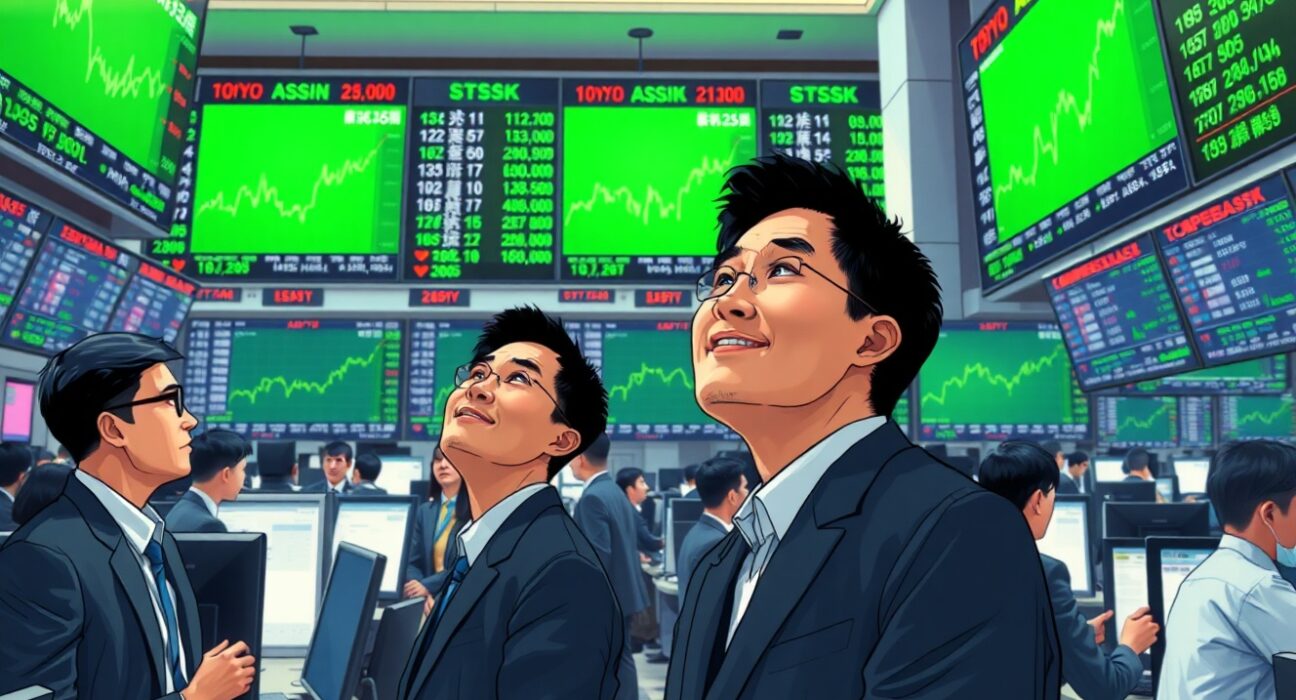
Asian stock markets experienced a significant surge on Tuesday, extending their recovery trajectory following former President Donald Trump’s unexpected ceasefire proposal in ongoing geopolitical conflicts. The dramatic market movement reflects renewed investor confidence across major financial hubs including Tokyo, Hong Kong, and Shanghai. Market analysts immediately noted the correlation between the political announcement and financial market responses, creating a ripple effect throughout Asian trading sessions.
Asian Stock Markets Respond to Geopolitical Developments
The Nikkei 225 index in Japan climbed 2.3% during morning trading, while Hong Kong’s Hang Seng index advanced 3.1%. Similarly, South Korea’s KOSPI gained 1.8% and Australia’s ASX 200 rose 1.5%. These movements represent the most substantial single-day gains across Asian markets in three months. Market participants quickly reacted to the breaking news, with trading volumes spiking approximately 40% above average levels.
Financial institutions across the region reported increased buying activity, particularly in sectors previously impacted by geopolitical tensions. Technology stocks, which had suffered during recent uncertainty, showed remarkable resilience. Semiconductor manufacturers and export-oriented companies led the recovery. Meanwhile, energy stocks also gained ground as investors anticipated reduced supply disruptions.
Trump’s Ceasefire Proposal Details and Market Impact
The former president’s proposal, announced through official channels on Monday evening U.S. time, called for immediate de-escalation in multiple conflict zones. While specific details remain confidential, the announcement emphasized economic stability and global trade protection. Financial markets interpreted the development as potentially reducing geopolitical risk premiums that had weighed on Asian equities for months.
Regional analysts noted several immediate effects:
- Currency movements: Asian currencies strengthened against the U.S. dollar
- Bond yields: Government bond yields declined as risk appetite increased
- Commodity prices: Oil prices moderated while industrial metals gained
- Volatility indices: Market fear indicators dropped significantly
Expert Analysis of Market Reactions
Dr. Kenji Tanaka, Chief Economist at Tokyo Financial Research Institute, provided context: “Market reactions demonstrate how geopolitical developments directly influence capital flows. The ceasefire proposal reduces uncertainty, which has been the primary constraint on Asian market performance. However, investors should monitor implementation details and international responses.” His analysis aligns with historical data showing Asian markets’ sensitivity to geopolitical announcements.
Historical comparisons reveal similar patterns. During previous geopolitical de-escalations, Asian markets typically experienced initial surges followed by consolidation periods. The current recovery’s sustainability will depend on several factors including diplomatic progress, economic data, and central bank policies. Regional central banks have maintained cautious stances, but may adjust monetary policies if stability persists.
Sector Performance and Regional Variations
Technology sectors outperformed significantly, with semiconductor stocks leading gains. Taiwanese and South Korean chip manufacturers saw particularly strong buying interest. Automotive and manufacturing stocks also advanced, benefiting from reduced trade disruption concerns. Financial institutions showed moderate gains as improved economic prospects enhanced their outlook.
Regional variations emerged despite the broad recovery. Southeast Asian markets demonstrated more measured responses compared to Northeast Asian counterparts. This divergence reflects differing economic exposures and geopolitical relationships. Singapore’s market advanced 1.2%, while Malaysia’s gained 0.9%. These variations highlight the complex interplay between global politics and regional economics.
| Market | Index | Gain (%) | Trading Volume Change |
|---|---|---|---|
| Japan | Nikkei 225 | +2.3 | +42% |
| Hong Kong | Hang Seng | +3.1 | +38% |
| South Korea | KOSPI | +1.8 | +35% |
| Australia | ASX 200 | +1.5 | +28% |
| Singapore | STI | +1.2 | +25% |
Long-term Implications for Asian Economies
The market recovery extends beyond immediate price movements. Reduced geopolitical tensions could stimulate foreign direct investment across Asia. Manufacturing supply chains might experience fewer disruptions, benefiting export-dependent economies. Tourism and service sectors could also see improvements if travel confidence increases. However, economists caution that structural challenges remain, including demographic shifts and technological transitions.
Central bank policies will likely evolve in response to changing conditions. The Bank of Japan faces particular challenges balancing currency stability with economic growth. Similarly, the People’s Bank of China must manage domestic priorities amid shifting global dynamics. These institutional responses will significantly influence market trajectories in coming months.
Global Context and International Reactions
European and U.S. markets showed positive responses in subsequent trading sessions, though less pronounced than Asian reactions. This differential response highlights Asia’s particular sensitivity to regional stability developments. International financial institutions issued cautiously optimistic assessments, emphasizing the importance of sustained diplomatic progress.
The International Monetary Fund recently revised its Asian growth projections upward, citing improving conditions. However, the organization emphasized that geopolitical stability represents just one factor influencing economic performance. Structural reforms, technological adoption, and climate considerations remain crucial for long-term development. Regional governments face complex policy decisions balancing immediate opportunities with sustainable growth.
Conclusion
Asian stock markets demonstrated remarkable responsiveness to geopolitical developments, with Trump’s ceasefire proposal triggering substantial recovery across major indices. The market movements reflect reduced risk perceptions and improved investor confidence. However, sustainable growth requires continued diplomatic progress and sound economic policies. Market participants should monitor implementation details and economic indicators as the situation evolves. The Asian markets recovery provides encouraging signals but warrants careful observation amid global uncertainties.
FAQs
Q1: Which Asian markets showed the strongest recovery?
The Hong Kong Hang Seng index led gains with a 3.1% increase, followed by Japan’s Nikkei 225 at 2.3%. South Korean and Australian markets also showed significant improvements.
Q2: How did the ceasefire proposal specifically affect market sectors?
Technology and semiconductor stocks outperformed, benefiting from reduced supply chain concerns. Export-oriented companies and financial institutions also gained substantially as economic prospects improved.
Q3: What factors will determine if this market recovery continues?
Sustained diplomatic progress, economic data releases, central bank policies, and corporate earnings will influence market trajectories. Implementation details of geopolitical agreements will be particularly important.
Q4: How did currencies react to the market movements?
Asian currencies generally strengthened against the U.S. dollar as risk appetite increased. This currency movement reflects improved confidence in regional economic stability.
Q5: What historical precedents exist for such market reactions?
Previous geopolitical de-escalations have typically produced initial market surges followed by consolidation periods. The current situation shares characteristics with past episodes of reduced geopolitical tension.
Disclaimer: The information provided is not trading advice, Bitcoinworld.co.in holds no liability for any investments made based on the information provided on this page. We strongly recommend independent research and/or consultation with a qualified professional before making any investment decisions.