

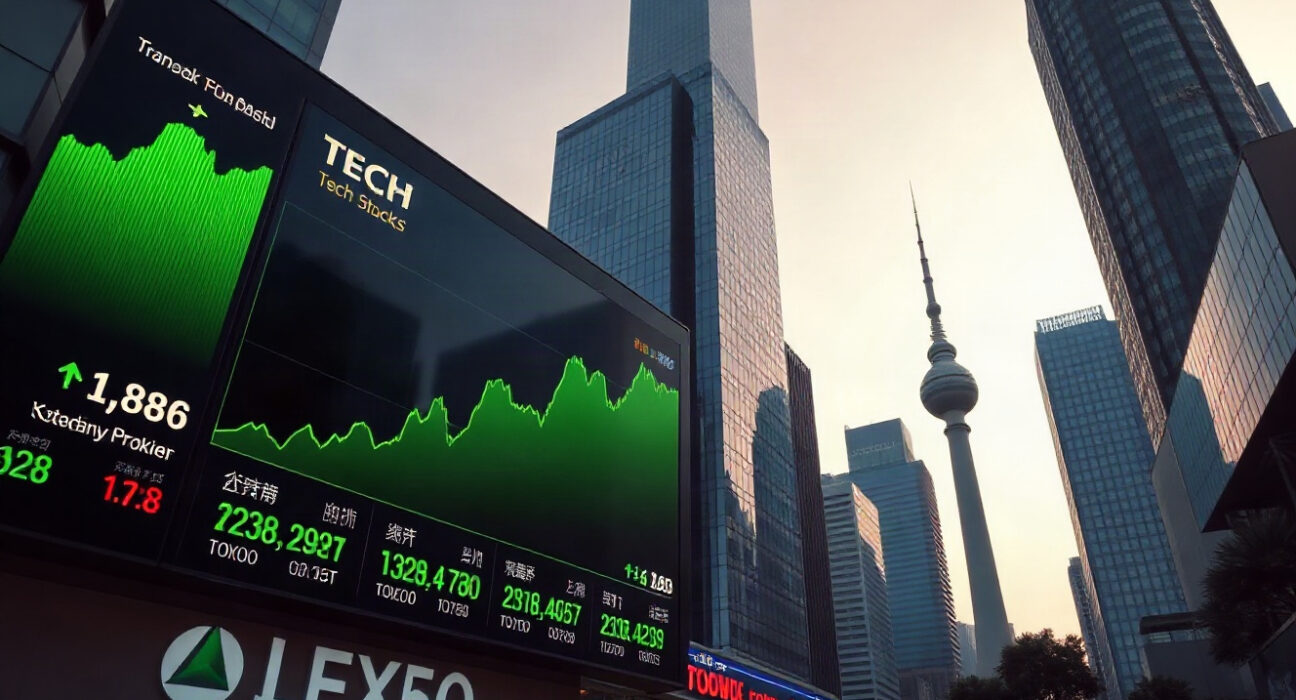
Asian technology stocks and government bonds rallied on Wednesday as investors interpreted the U.S. Treasury’s recent debt buyback program—dubbed a ‘mini QE’—as a signal of continued liquidity support, boosting risk appetite across the region.
Market Overview: What Drove the Rally?
The rally was broad-based, with major indices in Tokyo, Seoul, and Taipei posting gains, while yields on regional government bonds fell as prices rose. The U.S. Treasury’s announcement of a buyback program, though smaller in scale than quantitative easing, was seen as a liquidity backstop that could ease funding pressures and support asset prices.
According to market data as of Wednesday’s close, Japan’s Nikkei 225 rose 1.2%, South Korea’s KOSPI gained 1.5%, and Taiwan’s Taiex climbed 1.8%. In the bond market, the yield on the 10-year Japanese government bond fell 3 basis points to 0.75%, while the Australian 10-year yield dropped 4 basis points to 4.10%.
Why the ‘Mini QE’ Matters for Asian Markets
The U.S. Treasury’s buyback program, announced last week, aims to improve liquidity in the Treasury market by repurchasing older, less liquid securities. While the scale is modest compared to the Federal Reserve’s asset purchases, analysts say the program signals a proactive approach to market functioning, which could reduce volatility and support risk-taking globally.
For Asian markets, the program’s impact is twofold: it helps stabilize U.S. yields, which in turn reduces pressure on regional currencies and capital flows, and it provides a template for other central banks and treasuries to follow, potentially enhancing global financial stability.
Impact on Tech Stocks
Technology stocks, which are particularly sensitive to interest rate expectations, led the gains. Lower bond yields improve the present value of future earnings, making high-growth tech companies more attractive. The rally was also supported by a weaker U.S. dollar, which typically benefits Asian exporters.
Semiconductor stocks were among the biggest winners, with Taiwan’s TSMC rising 2.3% and South Korea’s Samsung Electronics up 1.9%. Investors also rotated into software and internet names, reflecting broad-based optimism about the sector’s prospects.
Government Bonds: A Safe Haven Reassessed
The rally in government bonds across Asia suggests that investors are not only seeking risk but also reassessing the safety of regional debt. With the U.S. Treasury’s program potentially reducing global funding stress, Asian bonds appear more attractive on a relative basis.
In India, the 10-year yield fell 5 basis points to 6.95%, while in Indonesia, the 10-year yield dropped 6 basis points to 6.55%. These moves indicate that investors are confident in the region’s economic fundamentals and see value in fixed income assets.
Expert Insights and Market Implications
Market strategists view the rally as a positive sign for the region’s economic outlook. ‘The ‘mini QE’ provides a backstop that could encourage more foreign investment into Asian markets,’ said Wei Ling, a fixed-income strategist at a Singapore-based asset manager. ‘We expect continued inflows into regional bonds and selective tech equities.’
However, some analysts caution that the rally may be overdone in the short term, given that the U.S. Treasury’s program is not a full-scale easing measure. They advise investors to focus on fundamentals and remain selective, particularly in tech stocks that have already priced in optimistic growth expectations.
Conclusion
Wednesday’s rally in Asian tech stocks and government bonds reflects a market embracing the U.S. Treasury’s ‘mini QE’ as a stabilizing force. While the program is limited in scope, its symbolic value and potential to reduce market volatility have resonated across the region. Investors should monitor U.S. Treasury operations and global liquidity conditions for further cues, but the immediate outlook appears cautiously optimistic.
FAQs
Q1: What is the U.S. Treasury’s ‘mini QE’?
The ‘mini QE’ refers to the U.S. Treasury’s debt buyback program, announced in early 2025, which repurchases older, less liquid Treasury securities to improve market liquidity. It is smaller in scale than the Federal Reserve’s quantitative easing but signals a proactive approach to supporting market functioning.
Q2: How does the ‘mini QE’ affect Asian markets?
The program helps stabilize U.S. yields, which reduces pressure on Asian currencies and capital flows. It also boosts risk appetite, leading to rallies in equities, particularly tech stocks, and supports bond prices across the region.
Q3: Should investors be cautious despite the rally?
Yes, some analysts advise caution because the ‘mini QE’ is not a full-scale easing measure. Investors should focus on fundamentals and avoid overpaying for growth stocks that may already reflect optimistic expectations.
Disclaimer: The information provided is not trading advice, Bitcoinworld.co.in holds no liability for any investments made based on the information provided on this page. We strongly recommend independent research and/or consultation with a qualified professional before making any investment decisions.
